Escaping the KOSPI Roller Coaster and Moving Into Time Deposits... Balances at the Five Major Banks Rose by 25 Trillion Won in a Month [Volatile Market Analysis]
- Input
- 2026-08-02 19:08:56
- Updated
- 2026-08-02 19:08:56
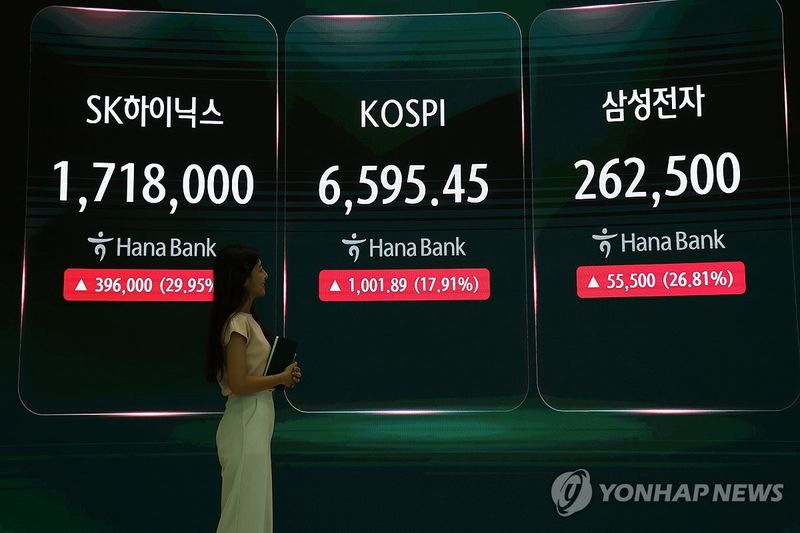
Investors shaken by a series of stock market selloffs are pulling out of risky assets and turning to safer time deposits. As deposit rates rise and the KOSPI (Korea Composite Stock Price Index) swings wildly, the preference for safe assets is becoming more pronounced.
According to the financial sector on the 2nd, time deposit balances at the Five Major Commercial Banks — KB Kookmin Bank, Shinhan, Hana Bank, Woori Bank and NH NongHyup — stood at 974.349 trillion won as of July 30. That was up 24.9492 trillion won from the end of June, when the total was 949.3998 trillion won, marking the sharpest monthly increase in three years and nine months. On average, the balance rose by more than 800 billion won a day.
One reason money is flowing into time deposits is higher interest rates. Last month, the Bank of Korea raised its benchmark rate by 0.25 percentage point from 2.50% to 2.75%, and the Five Major Commercial Banks quickly lifted deposit rates by as much as 0.3 percentage point. Time deposit rates at the five banks are currently in the 2.90% to 3.25% range, while installment savings products offer 2.60% to 3.85% a year.
The recent increase in KOSPI volatility has also boosted demand for deposits. After repeated sharp declines, retail investors have become more cautious about risky assets and are moving funds into relatively stable deposits.
For banks, which have long been burdened by so-called money moves, the trend is at least a temporary relief. More deposits raise funding costs, but they also provide a stable source of lending funds and can support higher interest income as lending expands.
The slowdown in fund outflows is also being felt at mutual finance cooperatives and savings banks, not just commercial banks. A financial industry official said, "With recent rate hikes and stock market instability coming together, the decline in deposit balances is starting to stabilize."
By contrast, so-called standby funds that can be withdrawn at any time fell sharply. Demand deposits at the Five Major Commercial Banks, including MMDA, totaled 669.8635 trillion won as of July 30, down 52.4293 trillion won from 722.2928 trillion won at the end of June. That is the largest drop since the five-bank combined data began in January 2019. Even if the entire increase in time deposits came from demand deposits, a significant portion of the money is still moving into other investment destinations such as stocks and real estate. A banking industry source said, "If the rate hike trend continues, the shift into deposits will likely continue for now, but the direction of money moves could change depending on whether the stock market rebounds, so it is difficult to predict where the funds will go at this point."
[email protected] Seo Ji-yoon Reporter