‘A 17.9% Surge in a Single Day’ Wild Volatility... Should You Buy Stocks in August or Stay Out?
- Input
- 2026-08-02 09:54:10
- Updated
- 2026-08-02 09:54:10
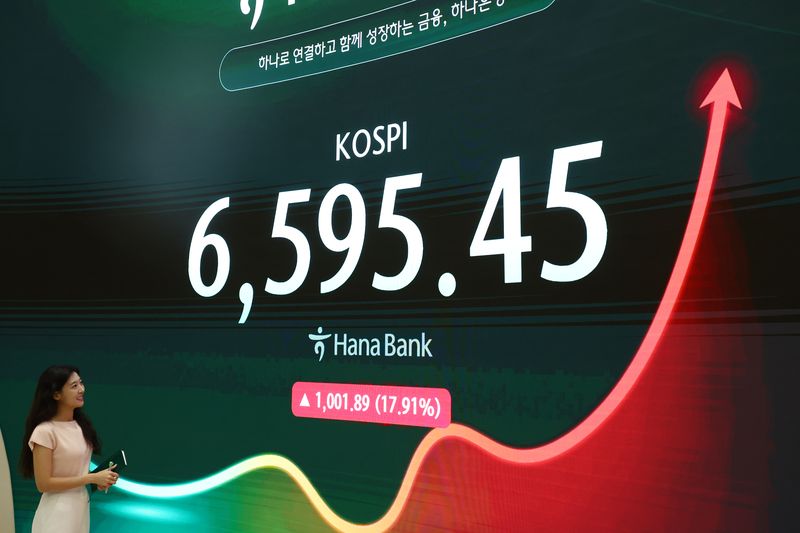
[Financial News] South Korean stocks, which endured a nightmare-like July marked by historic swings, are drawing attention as investors wonder whether the market can find a rebound in August. Brokerage houses said the index is likely to recover as concerns over a semiconductor peak have eased somewhat. Still, they expect a step-by-step rebound rather than a sharp V-shaped recovery because of lingering external risks.
According to the Korea Exchange on the 2nd, KOSPI fell 22.19% in July. That was the steepest decline among major stock indices worldwide. After surging 101.14% in the first half of the year to rank first globally, the domestic market collapsed in just one month.
Excluding the sharp rebound on the last trading day of July, the decline from the 1st to the 30th reached 34.01%. That exceeded the volatility seen during the IMF Crisis in October 1997, when the index fell 27.25%, and during the Global Financial Crisis (GFC) in October 2008, when it dropped 23.13%. As the index plunged, KOSPI market capitalization shrank by about 1,484 trillion won in a month.
Even the market’s safety mechanisms were powerless. In July alone, the circuit breaker mechanism, which halts trading for 20 minutes, was triggered four times. That accounted for about one-quarter of all 15 activations in history. On the 28th and 29th, the circuit breaker mechanism was triggered on consecutive days for both the Korea Exchange Main Board and the KOSDAQ market for the first time ever. Sidecars were also triggered 15 times in July, including six buy-side and nine sell-side activations, further crushing investor sentiment.
The main cause of the sell-off was growing doubt about a peak in the global semiconductor and AI cycle. Concerns over slowing gains in memory export prices, fears that China’s rise in AI, including the strong debut of ChangXin Memory Technologies (CXMT), would erode market share, and a concentration of funds driven by the launch of a single-stock leveraged ETF all weighed on the market. As a result, Samsung Electronics fell 21.41% in July, while SK hynix dropped 35.17%.
KOSPI jumps 17.9% on the last day of July... "A short-term bottom signal" vs. "A leverage illusion"
But on the 31st, the final trading day of July, the mood changed dramatically. KOSPI closed at 6,595.45, soaring 17.91%, or 1,001.89 points, in a single day and setting a record for the largest daily gain ever. Samsung Electronics jumped 26.81%, and SK hynix rose 29.95%, both nearing the upper limit. Foreign investors also posted net buying of more than 7 trillion won on the exchange.
The turning point was a wave of reassurance from major U.S. Big Tech companies such as Google, Alphabet Inc., Amazon, and Microsoft, which said they would expand AI investment. In addition, the liquidation of positions by the hedge fund Situational Awareness, which had been using large amounts of borrowed money, was seen in the market as a short-term bottom signal after a Margin Call, further fueling buying.
Overseas media and market experts offered mixed reactions to the extreme moves. According to CNBC, Kun Go, head of research at Australia’s ANZ Bank, said, "KOSPI is trading like a meme stock or cryptocurrency, so it is hard to view this as a normal phase." By contrast, JPMorgan Chase said, "The deleveraging process is effectively in its final stage, and with valuations now lower, this is an attractive buying opportunity."
August market outlook points to a step-by-step recovery... Jackson Hole and NVIDIA earnings in focus
Domestic brokerage firms expect the South Korean stock market to move out of July’s panic and stage a rebound in August, but they are leaning toward a gradual recovery that builds higher lows rather than a sharp V-shaped rally.
Key factors that could shape August include the trend in the 10-year Treasury yield, which recently broke above 4.74%, geopolitical risks, the Federal Reserve’s Jackson Hole meeting scheduled for the 28th and 29th, and earnings announcements from NVIDIA and other U.S. Big Tech companies.
Because there will be no Federal Open Market Committee (FOMC) meeting in August, remarks from Federal Reserve Chair Kevin Warsh at the Jackson Hole meeting on employment, inflation, and the future path of interest rates are expected to be a crucial turning point. The performance of NVIDIA’s next-generation GPU, Vera Rubin, and whether AI investment continues will also be major factors shaping the outlook for semiconductor stocks.
Na Jeong-hwan, a researcher at NH Investment & Securities, said, "The operating profit level of semiconductor companies will rise step by step each quarter through next year." He added, "Ultimately, I believe stock prices will try to rebound by reflecting absolute profit levels rather than the rate of earnings growth."
Kim Yong-gu, a researcher at Yuanta Securities Korea, also forecast that "KOSPI in August will treat the 5,150 level as the worst-case floor, go through a period of consolidation up to the 6,350 level while confirming uncertainties, and then gradually raise its lows in a step-by-step manner."
[email protected] Moon Young-jin Reporter