A Cousin Reunited in the Pacific: A 96-Year-Old Veteran Remembers the Korean War
- Input
- 2026-08-03 06:00:00
- Updated
- 2026-08-03 06:00:00
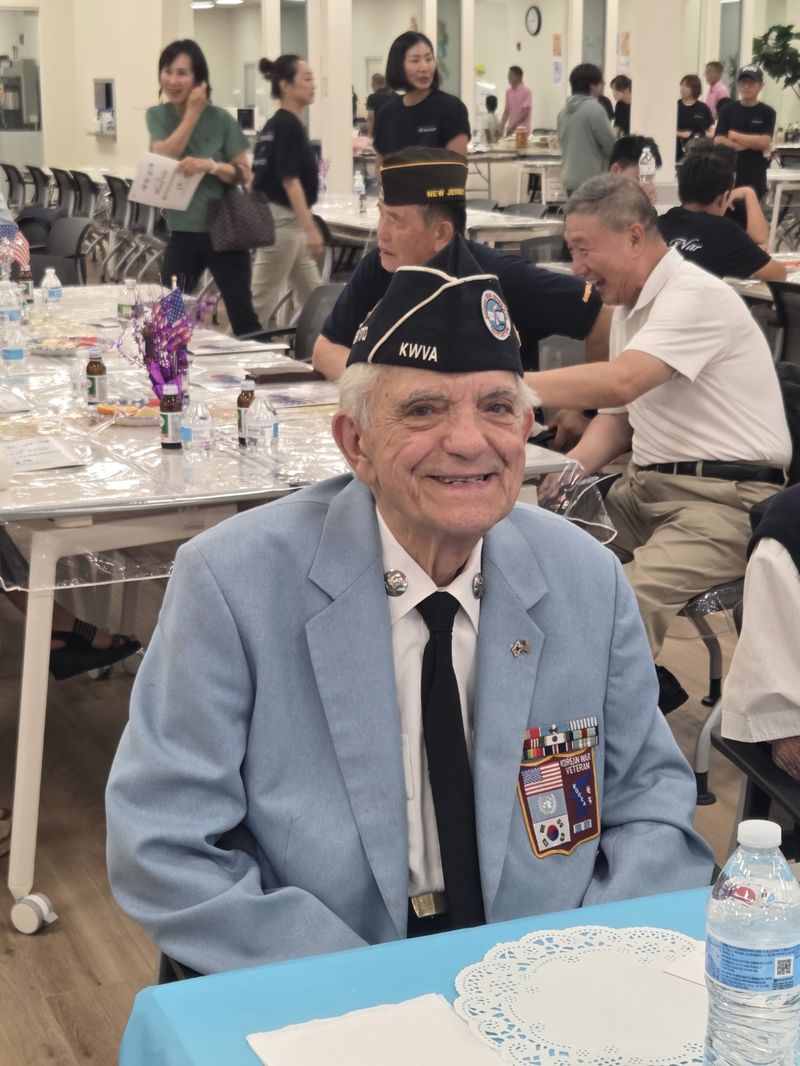
【Financial News New York = Lee Byung-chul】 Summer 1953.
A U.S. military transport ship carrying troops home after the Korean War was cutting through the middle of the Pacific. Perhaps relieved to be leaving the battlefield behind, the soldiers stood in a long line to watch a movie for the first time in a while.
Alex Atheras, a 96-year-old Korean War veteran, was standing in the middle of that line. Then someone kept pushing him in the back.
Once.
Twice.
When he was shoved a third time, he finally lost his patience.
"Why on earth are you doing that?"
He turned around in anger, only to fall silent.
It was his cousin.
The two men had served in the same war but were assigned to different units and never once met during the fighting. They had not even known the other was in Korea. Yet here they were, unexpectedly reunited on a return ship in the middle of the Pacific.
Their reunion made the front page of the New York newspaper New York Journal-American. The paper told the story of two cousins who ran into each other by chance on the way home from the Korean War.
"I didn't even know my cousin was in Korea until then."
More than 70 years have passed, but Atheras still remembers that scene as if it happened yesterday.
And yet that chance meeting in the Pacific was only possible because both men had survived Korea.
"We didn't even know where Korea was"
The story goes back to 1951. Atheras, then a 20-year-old living in New Jersey, received his draft notice. He never imagined he would be sent to Korea.
He had gone through high school a year late, which also delayed his draft by a year. At the time, he felt behind his peers. But many years later, he said that delay may have saved his life.
"It turned out to be a blessing that I finished high school a year late. That meant I went to Korea a year later, too."
That brief remark carried the memory of soldiers who had gone to the front before him and never returned.
The troops assembled in New York trained in artillery at Fort Dix in New Jersey, Fort Banks in Massachusetts, and Fort Bliss in Texas.
After training, he returned to New York and boarded a transport ship late at night. The ship picked up more troops in Puerto Rico, passed through the Panama Canal, and headed into the Pacific. It also stopped in Hawaii along the way.
But the soldiers did not know where they were going. Then one day, they were handed a small folder.
"Do not open it."
That was all the officer said.
A few days later, an announcement came over the ship's loudspeaker. "You may open it now."
Inside the envelope was a map. It was a map of the Korean Peninsula.
The officer pointed to the map and said, "This is where you are going."
Atheras laughed as he recalled the moment.
"We didn't even know where Korea was. We really knew nothing."
The Korean War, which began with North Korea's invasion of the South in June 1950, had already expanded into an international conflict involving UNC forces, North Korean troops, and Chinese forces. But to ordinary young men in the U.S. mainland, Korea was little more than a strange country they had first discovered on a map. They had to risk their youth and their lives in that unfamiliar land.
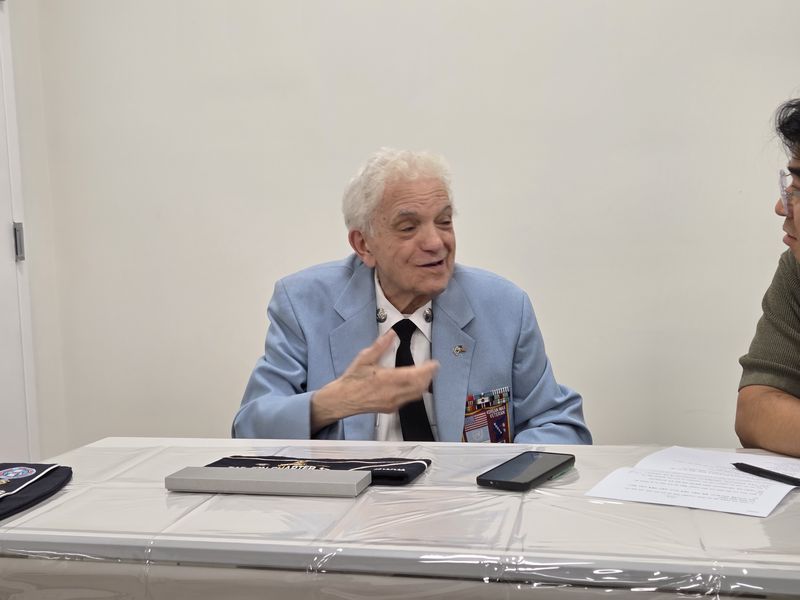
"It was supposed to be our train"
Atheras arrived in Korea in December 1951. Soon after setting foot on Korean soil, the soldiers waited at a train station for movement orders. A train left the station before they did. No one explained why it had departed first.
A short while later, a sergeant passed by and asked Atheras, "You remember the train that left before us?" He nodded.
"That train was a decoy. It was blown up."
The sergeant added one final line.
"It was supposed to be our train."
They never learned who carried out the attack, how many people were on the train, or how many were killed.
Atheras paused for a moment as he described that time.
"That was the beginning of my life in Korea." It was a line marked less by relief at surviving than by the memory of unnamed soldiers who had left before him.
From a 'moving war' to a 'war of endurance'
By the time Atheras arrived in Korea, the war had changed completely from its early phase.
After the Incheon landing, Chinese intervention, and the recapture of Seoul, the front line had frozen near the 38th parallel by the second half of 1951. Armistice talks began in July that year, but the gunfire did not stop. To gain even a slight advantage in negotiations, both sides kept fighting costly battles over hilltops in the mountains north of Seoul. Many soldiers died over ridgelines that never even had a name.
Atheras moved through Osan and Suwon before heading into the mountainous area north of Seoul.
The cities he remembered were Suwon, Seoul, and Gimpo. Farther north, it was hard to find a village that had not been destroyed.
"Once you passed Seoul, there was nothing but mountains. There were no villages. If there had been any, they had already been destroyed."
To him, Korea was a vast front line built on ruins.
Sandbag Castle... a front line built with sandbags
Atheras's unit was stationed near the Main Line of Resistance (MLR). During the Korean War, especially after the front stabilized in the summer of 1951, the MLR referred to the main defensive line that UNC and communist forces continuously defended and tried to hold.
The soldiers called it Sandbag Castle. It was exactly what it sounded like: a castle made of sandbags. New troops filled small sacks with sand and stacked them to raise the position. When shells landed, part of it collapsed, and the soldiers filled and stacked the sandbags again.
That small fortress was Sandbag Castle.
"It was very close to the front line. I don't remember whether it was 50 yards or 100 yards away. But it was really close."
A large sign stood at the entrance to the position.
'SNIPERS.'
That single word captured the tension of the front line at the time.
The supply road leading to the outpost was so narrow that only one truck could pass at a time. Before a vehicle climbed the mountain road, soldiers had to check the other side by radio.
"Truck going up." The reply would come back from the other side. "Any vehicles coming down?"
Other vehicles had to wait until one truck made it through. If two met in the middle, neither side could move.
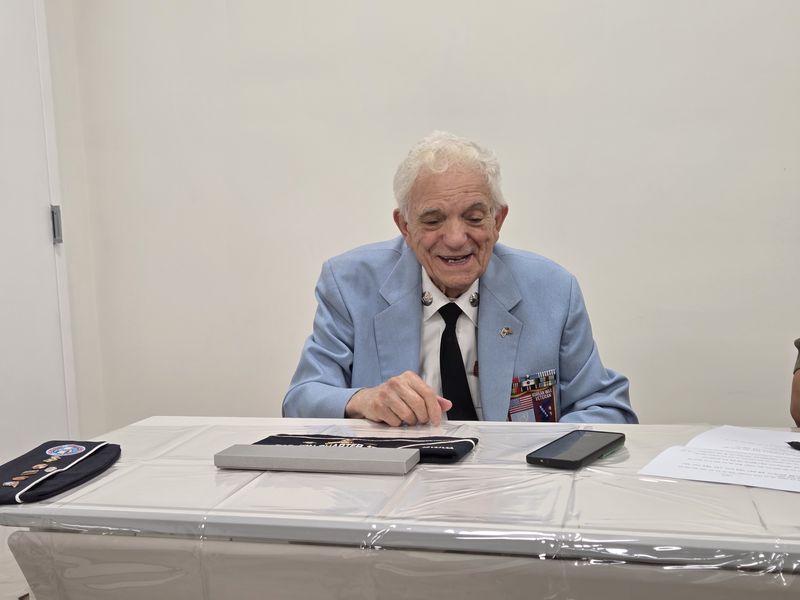
At night, gunfire began at the barbed wire
The area around the position was surrounded by barbed wire and sharp stakes. At night, Chinese troops would crouch low and approach the position. The moment the wire shook or a body got caught, the silence turned into gunfire.
"When Chinese troops got caught in the wire, our unit opened fire. We could tell they were approaching from that sound."
Atheras was an artilleryman, not an infantryman. He waited behind the infantry positions and supported the front whenever something happened.
He repeatedly stressed that he never killed anyone himself. "I didn't kill anybody."
But he was no different from the other soldiers when it came to preparing for death.
When he was sent to Korea, he told himself:
"I told myself I was already dead. Don't think about home. Once I got there, I would just focus on surviving."
Then he added quietly:
"When you join the military, you have to accept death. There is no other way."
"You said you were Greek, right?"
Atheras had originally been an artilleryman, but war did not always move soldiers according to plan.
Not long after he was assigned to the front, the sergeant in charge of the mess hall was gone, and one day an officer called him over.
"Atheras, you said you were Greek, right?"
He nodded.
"Then you will run the kitchen."
The officer seemed to think that being Greek meant he could handle food.
And so Atheras went from artilleryman to the mess sergeant responsible for feeding hundreds of soldiers.
War was not fought only by men with guns. Someone had to carry shells, someone had to move supplies, and someone had to prepare hot meals for the soldiers returning from the front.
Even while the fighting continued, the soldiers still had to eat.
Atheras took on the role of keeping the soldiers' day going just behind the front line.
People coming out of mud huts
Near the kitchen there were a few small mud huts. At first, Atheras did not know who lived there. When it was time for the soldiers to finish eating, people began to emerge from the huts one by one.
They were children, women, and elderly people.
They rushed to the food containers the soldiers had thrown away, looking for anything edible. Bread crusts, potatoes, scraps of meat — anything they could put in their mouths.
Atheras watched this happen two or three times. Then he decided he could not leave it as it was.
He gave the soldiers an order.
"Do not throw uneaten food into the trash. Separate the bread, meat, and potatoes and set them aside."
The leftovers were sorted by type and placed in separate containers. The lids were kept on. Only after all the soldiers had finished eating and left the kitchen could the waiting Koreans come and take the food.
"I didn't want them rummaging through the trash."
Around the front lines at the time, residents who had lost their homes and livelihoods gathered wherever they could. For them, leftover food from UNC units was not just scraps. It was what kept them alive through the day.
In Atheras's memory, the Korean War was not only gunfire and shells, but also the faces of people running to the food containers in search of something to eat.
"I remember those hungry people more than I remember the fighting."
War did not only take lives. It also destroyed the dignity of daily meals and the simple right to eat.
Another war fought with old supplies
Another image of the Korean War that Atheras remembers is that of an old war. Much of the equipment and supplies he encountered in his unit had been used during World War II or produced after it.
The boxes of frozen chopped meat were marked with a 1947 production date. In his memory, the eggs issued at the time sometimes had greenish yolks when cracked or cooked.
Many rifles, rounds of ammunition, and field supplies were also inherited from World War II-era standards and stockpiles.
"Everything seemed to be from World War II."
The soldiers were no different.
Some who had fought in World War II put on uniforms again and came to Korea. Younger soldiers called them Retreads. Like tires that had been worn down and given new rubber, the term referred to soldiers who had already been through one war and were sent back to another battlefield.
The Korean War was another conflict fought only a few years after World War II ended. Traces of the earlier war remained everywhere — in the soldiers, the weapons, and the supplies.
"If you get shot down, you'll need this gun"
In 1953, as the war neared its end, Atheras received his long-awaited order to return home after about a year and a half in Korea. The armistice talks were still underway, but artillery fire continued along the front.
His unit told him to report to headquarters by 3 p.m. The order to go home was as sudden as the order that had sent him to Korea.
After packing his things, Atheras stopped by the PX for a moment. At his waist was a small 25-caliber Mauser pistol, a palm-sized handgun made during World War II. He also had two boxes of ammunition.
Two Air Force pilots were at the PX. One of them looked closely at Atheras's pistol.
"May I see that gun?"
Atheras removed the magazine, checked that there was no round in the chamber, and handed it over. The pilot examined the gun for a while.
Then he asked carefully:
"Would you consider selling it?"
Atheras was puzzled.
"Why do you need such a small pistol?"
The pilot explained that he wanted it in case he was shot down behind enemy lines.
"It's small enough to hide in a flight cap or under your clothes. Even if the enemy captures you and searches your body, they might not find it."
The small pistol was a last means of survival in case of a crash landing in enemy territory or capture as a prisoner of war. After hearing that, Atheras did not bargain over the price.
"Twenty dollars will do."
The pilot handed over the money, then took Atheras's hand and thanked him again and again.
To Atheras, he looked as young as a 12-year-old boy.
"I was going home in a few hours. But this man still had to stay here and go back up into the sky. If he got shot down, he might need that gun."
Holding the pilot's hand, Atheras said:
"I will pray that you never have to use it."
That was the last exchange between the two men.
Atheras never learned whether the pilot made it home safely. One man left for home, while the other headed back into the war-torn sky.
Family reunited in the Pacific
After handing over the pistol, Atheras boarded the return ship as planned. A few days later, while standing in line to watch a movie in the middle of the Pacific, he came face to face with the cousin who had been pushing him from behind.
The Air Force pilot remained at the front, but Atheras and his cousin were heading home alive. The two had served in the same war without even knowing the other was in Korea. They never met on Korean soil. Only after the war, on a transport ship floating in the middle of the Pacific, did they see family again.
That is why Atheras has never forgotten the moment for more than 70 years.
Surviving a war is sometimes something that cannot be explained by skill or courage alone.
The train they were supposed to take left first and was blown up. He survived countless shells and gunfire. On the way home, he happened to meet a cousin who had also survived the same war. His Korean War was a time of repeated death, survival, separation, and reunion.
"I have done enough kitchen work"
Atheras completed his military service in 1953 and was later formally discharged.
The military urged him to stay on, but he refused.
"I had done enough."
He later reflected that if he had stayed in the military, he would likely have been sent to the Vietnam War as well.
Right after leaving the service, he did not know what to do next. Before joining the military, he had bought a small house in Fort Lee, New Jersey, with his mother, and through a neighbor's introduction he also worked at a construction site.
But he did not want to work in the kitchen again.
"I have done enough kitchen work."
He used veterans' education benefits to study art. He also attended the New York School of Interior Design. Later, he taught art and ran a small business of his own.
The war took part of his youth, but it did not decide the rest of his life.
After taking off his uniform, he rebuilt his life.
Korea, which he never returned to
After the war, Atheras never returned to Korea.
He prepared twice to visit through the Government of the Republic of Korea's veterans invitation program. Both times, he had plans to travel, but family matters came up just before departure and he had to cancel.
"I prepared twice, but I couldn't go either time. So I gave up. I never applied again."
After leaving in 1953, he never again set foot in the country he had risked his life to defend.
But Korea never disappeared from his memory.
The mountainous area north of Seoul, the Sandbag Castle built with sandbags, the warning sign for snipers at the entrance, the barbed wire that shook every night, and the children, women, and elderly people waiting for leftover food all remained vivid in his mind. He also never forgot the explosion of the train he had been meant to board, or the face of the young Air Force pilot to whom he handed the pistol before leaving.
At the end of the interview, when asked whether he had a message for Koreans, Atheras paused for a moment.
He stressed that remembering veterans is not only for those who are still alive.
"Remembering us today is not only for the living veterans."
"It is also about remembering the American veterans who never came home, and the Korean soldiers who fought alongside us."
After taking a breath, he said slowly:
"That is all I can say."
"May God bless America."
Then he added one final line.
"May God bless Korea."
[email protected] Lee Byung-chul Reporter