"Hynix at 5 million won? Afraid of becoming a 'latecomer loser'"... Why securities firms keep publishing 'optimistic bias' buy reports
- Input
- 2026-08-03 05:00:00
- Updated
- 2026-08-03 05:00:00
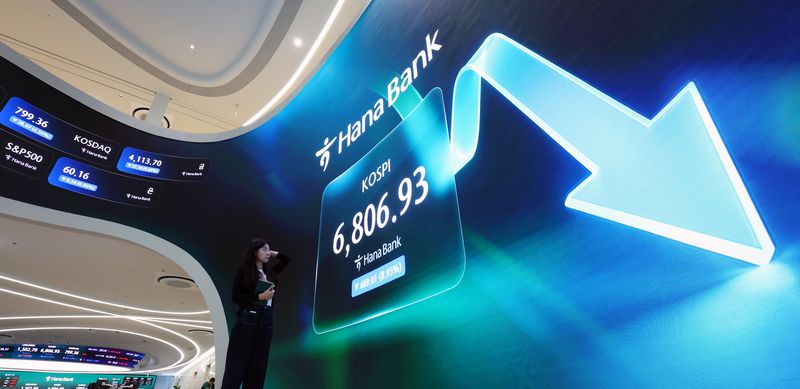
Six weeks later, that excitement turned into fear.The KOSPI triggered circuit breakers for two straight days and lost nearly 40% from its previous peak.Investors screamed as the pace of the crash defied imagination.Even when everyone else was gripped by pessimism, the only thing still sounding upbeat about the market was securities firm reports./Photo=Newsis [Financial News] On June 18, the number "9000" appeared on the board for the first time in history, and cheers spread that the era of a "KOSPI 10,000" was just around the corner.
Whether the market was rising or collapsing, those reports kept recommending "buy.
/Photo=Newsis [Financial News] On June 18, the number "9000" appeared on the board for the first time in history, and cheers spread that the era of a "KOSPI 10,000" was just around the corner." That is why investors have long joked, with bitter irony, that securities firm reports are something to "trust and skip.
" So why do securities firms keep repeating the same call to buy? The investment value of reports vanished after 2013 Two reports on analysts published by Kim Joon-seok, a senior research fellow at the Korea Capital Market Institute, in January and May offer clues to the answer.
In his January report, titled "The Investment Value of Analysts' Recommendations and Target Prices," Kim concluded that securities firm reports lost their investment value starting in 2013 after a full analysis of about 700,000 listed-company research reports issued by domestic analysts from 2000 to 2024.According to the report, from 2000 to 2012, portfolios built from stocks with high consensus recommendations or high implied expected returns in target prices showed statistically significant excess returns.This means analysts' recommendations and target prices actually contained information about future changes in corporate value.
However, Kim said that the investment value of recommendations and target prices disappeared beginning in 2013.In the data after 2013, no portfolio using recommendation or target-price information produced statistically significant excess returns.In some periods, stocks with positive recommendations even posted negative excess returns.
This means that even long-term investing based on analysts' recommendations has become unlikely to beat the market average.Kim explained that this may reflect the effects of market efficiency and the quality of information embedded in recommendations and target prices.He added that long-term performance can deteriorate when analysts' informational edge weakens or when optimistic bias intensifies.
/Photo=Newsis [Financial News] On June 18, the number "9000" appeared on the board for the first time in history, and cheers spread that the era of a "KOSPI 10,000" was just around the corner.
/Photo=Newsis [Financial News] On June 18, the number "9000" appeared on the board for the first time in history, and cheers spread that the era of a "KOSPI 10,000" was just around the corner.
In his May report, "Analysts' Optimism, Accuracy and Informativeness," Kim analyzed 740,000 securities firm reports and found that 95 out of every 100 reports that presented target prices assumed stock gains, yet the actual target-price achievement rate was only 19%.
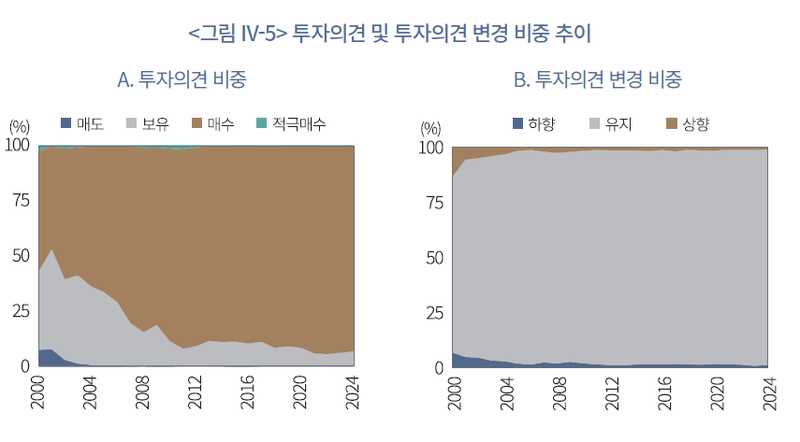
/Photo=Newsis [Financial News] On June 18, the number "9000" appeared on the board for the first time in history, and cheers spread that the era of a "KOSPI 10,000" was just around the corner.He also noted that more than 90% of recommendations were skewed toward "buy," leaving sell and underweight opinions virtually absent from the market.Another problem was that 69% of the research reports focused on the top 200 companies by market capitalization, while only 23% of KOSDAQ-listed companies had reports published on them.This raises concerns about the reliability of the information being provided.As research reports have increasingly been issued right after companies announce earnings, analysts have become more dependent on company-provided information rather than generating independent insights.Some also argue that securities firm reports are trapped in a structure that cannot warn about overheating in the first place because of structural conflicts of interest and system limitations.Kim explained that "the optimism in recommendations and target prices appears to be linked to conflict-of-interest factors, such as improving securities firms' profitability and building friendly relationships with the companies under analysis." Research reports are used as a marketing tool to win investment banking mandates or attract stock-trading commissions from corporate clients.For that reason, it is not easy to issue "sell" or "underweight" ratings on companies that are seeking IB deals or on stocks held by institutional investors that generate large trading volumes.
Moreover, issuing a negative report may also risk cutting off access to information, which further increases the likelihood that the information provided will be optimistically biased.The cost of optimism bias, and the conditions for restoring trust What stands out is that, despite this optimism bias, analysts' information still has clear market influence.According to "Analysts' Optimism, Accuracy and Informativeness," changes in recommendations, target prices and earnings forecasts continued to trigger meaningful stock-price reactions and shifts in trading turnover.
View of Yeouido's securities district /Photo=Yonhap News Agency Still, upgrades in recommendations and cuts in target prices have limited informational value.The share of research reports that generate meaningful return changes is also below 10%.Kim said that "efforts are needed to restore analysts' credibility" and added that "in response to the structural contraction of the business, it is necessary to increase the amount of information provided and to expand the volume of information disclosed by listed companies.
" As conditions for restoring trust, he proposed introducing an analyst evaluation and compensation system linked to the accuracy, objectivity and usefulness of the information provided, along with greater disclosure of accuracy, objectivity and potential conflicts of interest.He argued that the vicious cycle of bias can be broken only if research departments become more independent and companies also help create a disclosure environment in which negative assessments are accepted as the result of objective analysis.Market participants, too, must receive analysts' information critically and objectively.
/Photo=Newsis [Financial News] On June 18, the number "9000" appeared on the board for the first time in history, and cheers spread that the era of a "KOSPI 10,000" was just around the corner.
Kim stressed that "investors must take into account the optimistic bias and potential conflicts of interest in analysts' information" and that "listed companies and investors should recognize analysts' negative assessments and outlooks as the result of objective work, rather than criticizing or excluding them.
/Photo=Newsis [Financial News] On June 18, the number "9000" appeared on the board for the first time in history, and cheers spread that the era of a "KOSPI 10,000" was just around the corner./Photo=Newsis [Financial News] On June 18, the number "9000" appeared on the board for the first time in history, and cheers spread that the era of a "KOSPI 10,000" was just around the corner.

"
[email protected] Kim Hee-sun Reporter