July exports hit $98.89 billion, the second-highest on record; semiconductors top $40 billion for a second straight month
- Input
- 2026-08-01 10:38:17
- Updated
- 2026-08-01 10:38:17
[Financial News]
South Korea's exports fell short of $100 billion last month, but still posted the second-highest monthly total on record, extending their strong momentum from the first month of the second half. Semiconductors led the way by topping $40 billion for the second consecutive month, while non-semiconductor exports also grew at a double-digit pace, showing a broader expansion in export strength. However, the government said it will step up trade responses as external uncertainty remains high, including additional U.S. tariffs, rising protectionism, and instability in the Middle East.
According to the "July Export and Import Trends" released by the Ministry of Trade, Industry and Energy (MOTIE) on the 1st, exports last month rose 62.8% from a year earlier to $98.89 billion. That was the second-highest monthly export figure ever, following June's $102.2 billion. Imports increased 26.5% to $68.56 billion, and the trade balance posted a $30.32 billion surplus, staying above $30 billion for a second straight month.
Exports were driven by semiconductors. Semiconductor exports jumped 178.8% year on year to $41.01 billion, surpassing $40 billion for the second month in a row after June. It was also the second-highest monthly result on record, behind only June's $44.8 billion.
The gains were supported by continued increases in fixed prices for memory chips and sustained demand for AI servers. MOTIE said prices kept rising despite variables such as Apple's possible adoption of Chinese-made memory chips and the launch of new AI models in China.
Other categories also posted broad-based growth. Computer exports surged 404% to $4.79 billion, helped by stronger demand for enterprise SSDs. Wireless communication devices rose 51% on solid sales of the Samsung Galaxy S26, while displays continued to increase on the back of shipment effects from new iPhone Ultra foldable models.
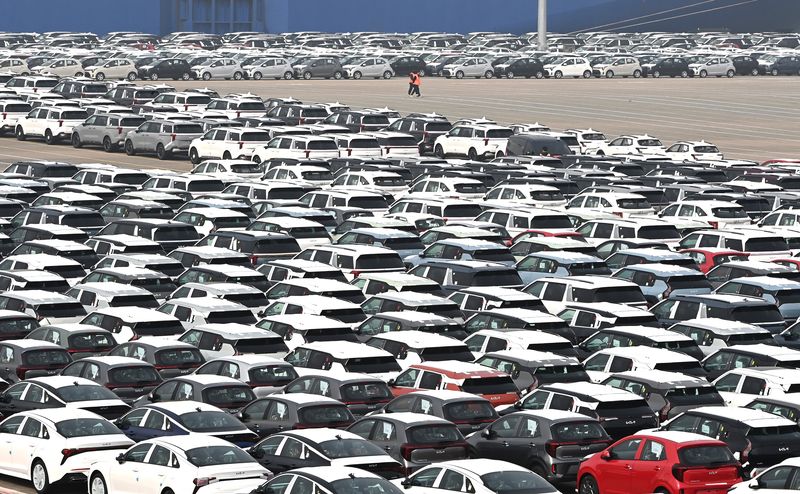
Automobile exports rose 7% to $6.24 billion, supported by stronger hybrid vehicle sales and a base effect from summer vacation schedules that were concentrated at the end of last year but shifted to early August this year. Ship exports climbed 46.9% as deliveries of LNG carriers and tankers increased, marking six straight months of growth.
Petroleum products and petrochemicals rose 34.1% and 10.3%, respectively, as higher international oil prices lifted export unit prices. However, volumes fell 8.8% and 9.1%, respectively, indicating that price gains were the main driver of the improved results.
Steel exports increased for a second consecutive month despite the European Union's new steel import system, or TRQ, supported by demand from U.S. AI data centers and pipeline replacement projects. Electrical equipment, biopharmaceuticals, cosmetics, and agricultural and marine products all set new July records. Overall, 19 of the 20 major export items rose, with home appliances the only exception.
By region, most markets also performed well. Exports to China, led by semiconductors, climbed 96.2% to $21.68 billion, topping $20 billion for a second straight month and extending their growth streak to nine months since last November.
Exports to the United States rose 68.7% to $17.43 billion. Semiconductors, computers, electrical equipment, and steel all increased sharply on the back of greater investment in AI data centers, while automobile exports declined due to expanded local production in response to U.S. tariffs.
Exports to ASEAN reached a record $18.8 billion, while exports to the EU also hit an all-time high at $9.38 billion. Exports to the Middle East also turned positive for the first time this year, helped by strong sales of general machinery, petrochemicals, and wireless communication devices.
Imports were heavily affected by higher crude oil prices. Crude oil import volumes rose 7%, while import unit prices jumped 44%, pushing crude oil imports up 54.2% to $9.3 billion. Total energy imports increased 50.1% to $14.48 billion. Imports of non-energy items, including semiconductor equipment and petrochemical products, also rose.
Minister of Trade, Industry and Resources Kim Jung-kwan said, "July exports posted a strong result in the first month of the second half, reaching the $90 billion range." He added, "As the semiconductor boom continues, 19 of the 20 major export items increased, and non-semiconductor exports also rose 26%, showing that our export competitiveness is expanding."
He also said, "Export conditions are expected to remain difficult due to new tariff measures under Section 301 of the Trade Act of 1974, stronger protectionism in major countries, and uncertainty in the Middle East." He added, "The government will closely monitor conditions by item and market, and mobilize all available policy tools so companies can respond in a timely manner to changes in the trade environment, including tariff and non-tariff barriers."
[email protected] Park Ji-young Reporter