Slow charging rates go down, ultra-fast rates go up... What will change in EV charging fees? [Lee You-beom's Eco & Energy]
- Input
- 2026-08-01 06:00:00
- Updated
- 2026-08-01 06:00:00
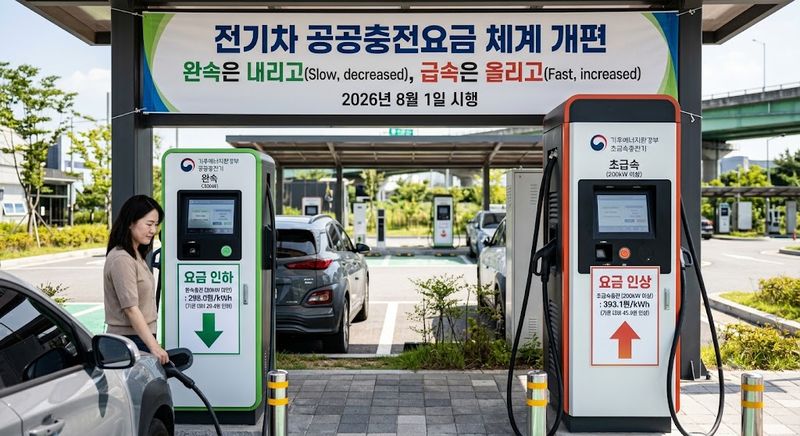
[Financial News] The public EV charging fee system will be broken down into five tiers from the 1st, up from the current two. Fees for slow chargers will be lowered, while rates for ultra-fast chargers will be raised. Drivers who mainly use slow charging are expected to save about 9,000 won a month, or roughly 100,000 won a year, automatically. By contrast, drivers who frequently rely on ultra-fast charging at highway rest stops and similar locations are expected to pay about 13,000 won more per month, or around 160,000 won more per year.
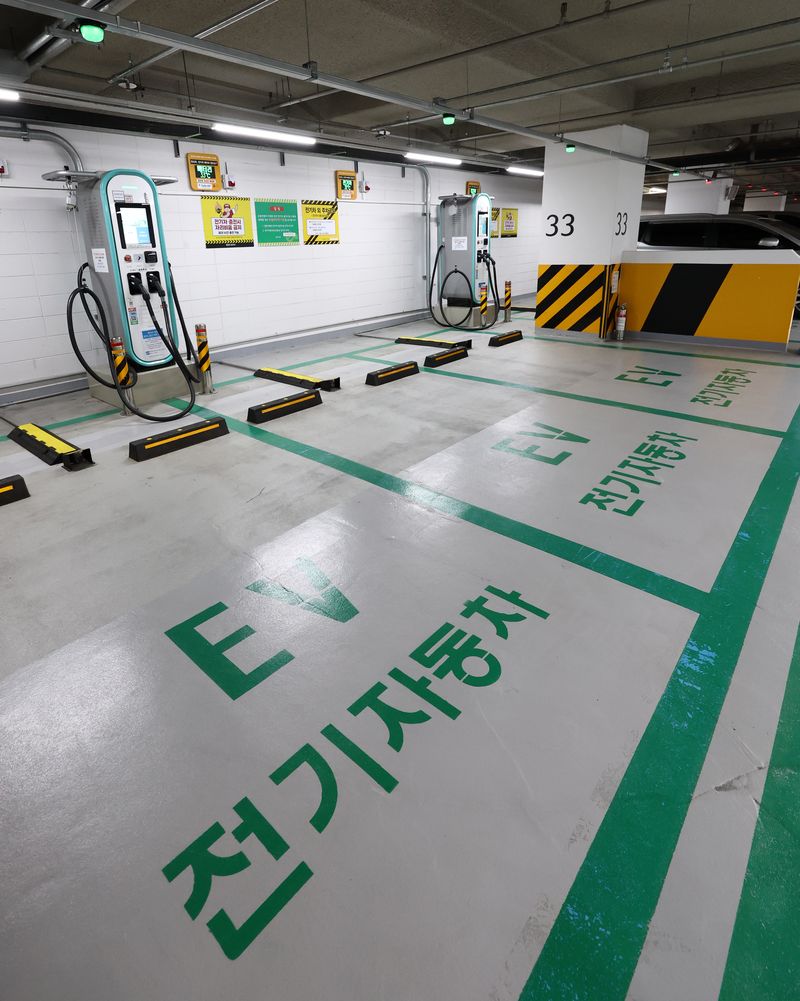
The rationale is to reflect actual costs, as recovery of investment in fast-charging equipment had been difficult.
According to the Ministry of Climate, Energy and Environment's finalized plan to revise the public EV charging fee system, slow chargers, which account for about 90% of all chargers and have a capacity of less than 30 kW, will see their per-kWh rate cut by 29.4 won, or about 9.1%, to 295.0 won. Ultra-fast chargers, which make up just 2.3% of the total and have a capacity of 200 kW or more, will rise by 45.9 won, or about 13.2%, to 393.1 won per kWh. The system will be divided into five categories: under 30 kW, 30-50 kW at 307.2 won, 50-100 kW at 325.6 won, 100-200 kW at 348.4 won, and 200 kW or more.
The ministry said the revision is based on actual operating costs, including electricity bills, operating expenses, and mandatory inspection fees. It also pointed to the fact that, despite the rapid growth of the fast-charging market thanks to technological advances, the fee structure had not been clearly updated. Under the previous system, chargers around the 100 kW range were broadly treated as a single category, making it difficult to recover the investment costs of ultra-fast equipment rated at 200 kW or above. Slow chargers make up the majority of charging infrastructure, so their operating efficiency is relatively high and there was room to lower fees. By contrast, the government said ultra-fast chargers of 200 kW or more cost more than twice as much to install and operate as 100 kW units, and continued investment in technology is needed to maintain service quality, including power distribution. A ministry official said EV users tend to use slow charging at apartment complexes and other residential locations, while relying on fast charging only briefly while on the road, so the overall burden on consumers is not expected to increase.
Jung Sun-hwa, director-general for green transition policy at the ministry, said the revision both brings charging costs in line with reality and sets a benchmark for the market. Public fast-charging fees were around 173.8 won per kWh in 2017, but they have steadily risen as special discounts ended and phased increases were introduced. With ultra-fast rates rising again under this revision, drivers who travel long distances often or depend heavily on external charging stations will continue to face a growing cumulative burden.
Next comes time-of-use pricing, linked to renewable energy output
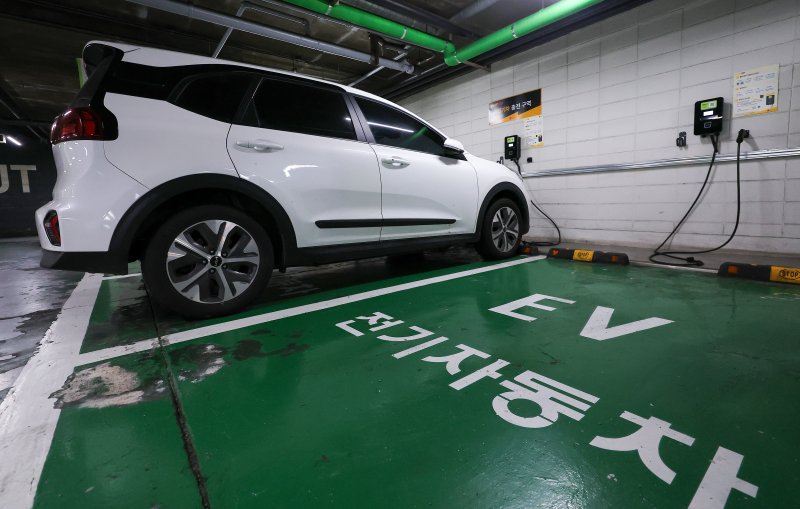
The ministry sees this revision as the starting point for a more advanced pricing system. Going forward, it plans to promote a time-of-use tariff that links electricity prices with EV charging fees, allowing users to charge more cheaply during periods of high renewable energy generation. The move is also tied to power grid policy aimed at absorbing charging demand to address output curtailment caused by concentrated solar generation during daytime hours. Consumer protection measures will be strengthened alongside the fee overhaul. To address so-called "hidden pricing" problems, charging stations at highway rest stops will be required to display fee signs outside, just like gas stations, and operators will face stronger obligations for regular inspections to prevent breakdowns. Detailed locations and real-time availability of charging facilities will also be disclosed through the Zero-Emission Vehicle Integrated Portal to improve accessibility. A discount of up to 15% is already applied between 11 a.m. and 2 p.m. on spring and autumn weekends and public holidays, and members of the ministry can save 50 to 140 won per kWh compared with non-members. Overnight home slow charging costs about 50 to 80 won per kWh, roughly one-fifth of the price of public fast charging.
A revision introduced amid controversy over a 'sharp rise in slow-charging fees'
The public charging fee revision comes as separate controversy over slow-charging fee increases continues. As operators switch to "smart control" slow chargers, which are being introduced to prevent fires, equipment replacement and operating costs have led to higher fees. In May, the office of Rep. Woo Jae-jun of the People Power Party and the Ministry of Climate, Energy and Environment co-hosted a forum titled "Sharp Rise in EV Slow-Charging Fees: What Is the Sustainable Solution?" At the event, an industry official said five of the top six charging operators by revenue remain in net loss, and that even with a fee of 290 won per kWh, the operator margin is effectively close to zero after electricity costs, maintenance, and depreciation are deducted. Rep. Lee Jong-wook said that during the rollout of smart-control slow chargers, replacement costs for existing equipment and operating expenses have pushed up fees, creating unexpected conflicts on the ground. He called for detailed institutional standards and support systems covering maintenance, power expansion costs, operator contract structures, and the basis for setting user fees. By contrast, Kim Seong-tae, chairman of the Korea EV Users Association, stressed that unilateral fee hikes that consumers cannot predict will ultimately backfire, slowing the EV market and delaying carbon neutrality. He argued that market structure reform and stronger user incentives should come before fee increases. The fact that this revision lowers fees in the slow-charging tier can also be read as a signal that, at least in public infrastructure directly managed by the government, consumer costs will not be raised amid the controversy. However, fees for non-roaming chargers operated by private companies are moving separately from this revision, so the total charging burden felt by users may vary depending on which chargers they mainly use.
The key issue is operator profitability and consumer trust
With the cumulative number of EV registrations in South Korea already exceeding 1 million, there is concern that the shift to electric vehicles could slow if the government fails to improve both the predictability of the fee system and the reliability of charging infrastructure. Whether this revision restores market confidence will depend on two factors. One is the profitability of charging operators. As most of the top revenue-generating charging companies remain in the red, industry sources warn that lower fees in the slow-charging segment could prompt operators to cut back on maintenance and new installations, eventually leading to poorer service quality. The other is consumer trust. Having already gone through a round of controversy over fee hikes during the transition to smart-control slow chargers, the government must convincingly show consumers that this revision is not a case of lowering fees in one area while raising them elsewhere, but a rational adjustment based on actual costs. Whether the follow-up measures the government has announced, including time-of-use pricing, mandatory fee signage, and real-time disclosure of charging station information, are implemented as planned will be the next test of whether this revision becomes a sustainable pricing system rather than a stopgap fix.
[email protected] Lee You-beom Reporter