"TSMC's Kumamoto plant would see only a 0.03% hit to sales even if it stopped for a week; aftershocks are the biggest variable"
- Input
- 2026-07-31 18:05:05
- Updated
- 2026-07-31 18:05:05
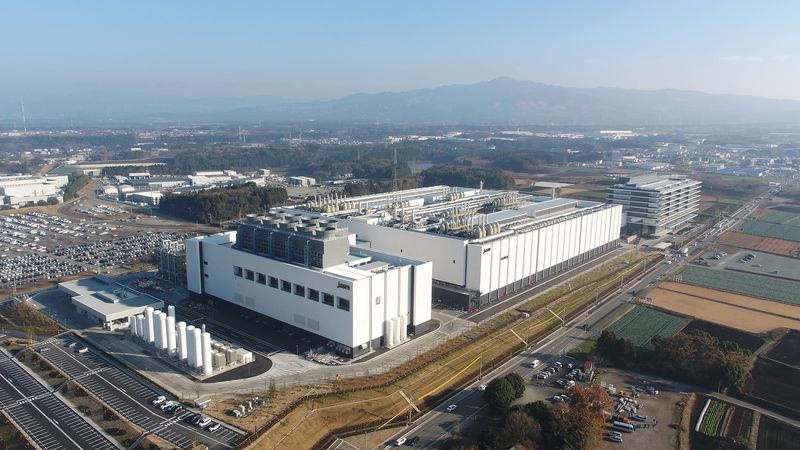
[Financial News] TSMC, the world's largest semiconductor foundry, temporarily suspended operations at its Kumamoto plant in Japan after a strong earthquake struck Kumamoto Prefecture, but analysts say the impact on third-quarter sales would be limited to about 0.03% even if the plant remained shut for a week.
According to Taiwan's China Times and other media outlets on the 31st, analyst Huang Jian-zhi of the Taiwanese tech media outlet DigTimes said production disruptions at TSMC Plant 1 in Kikuyo Town, Kumamoto Prefecture, which was temporarily shut down after the magnitude 7.1 quake on the 28th, were likely to be limited.
Huang explained that the strong quake triggered an evacuation under emergency procedures after the plant reached its evacuation threshold, and workers were moved outside as a precaution. He said the building itself did not suffer structural damage, but ultra-precise equipment used in semiconductor production is sensitive to vibration, so automatic protection systems were activated.
Before the equipment can be restarted, it must go through safety inspections, calibration and reference-point resets. Production can resume only after various test results meet internal standards.
Huang said, "In the early stages of restart, production begins with lower-risk products while yield and defect rates are continuously monitored." He added, "Even if most equipment is restored within hours, it could still take days to weeks, or even months, for the process to fully normalize."
TSMC is currently sending engineers from its headquarters to Japan to help inspect and adjust equipment, while also assessing the impact on customer deliveries and production schedules.
The Kumamoto plant produces Sony CMOS image sensors and automotive semiconductors using 12-, 16-, 22- and 28-nanometer processes. Because these products must pass strict customer certification procedures, it is not easy to shift production to another plant in the short term.
Huang said aftershocks are the biggest factor in determining how quickly the plant can return to normal. Still, he expects the production disruption to have only a limited effect on earnings. He explained, "The Kumamoto plant's actual monthly output is only about 20,000 12-inch wafers. Assuming an average selling price of $3,000 per wafer, the earthquake-related sales loss is estimated at about $2 million per day, or roughly $14 million over a week."
That amounts to only about 0.03% of TSMC's third-quarter sales guidance of $45.2 billion, suggesting the impact on performance will be extremely limited.
Meanwhile, former Taiwan interior minister Lee Hong-yuan argued that Taiwan should use the quake as an opportunity to reexamine its disaster-prevention measures.
He warned, "If a magnitude 7.1 quake like the one in Kumamoto were to strike Taiwan's metropolitan area, where people and buildings are densely concentrated, at least 35,000 of the 1.8 million homes built before 1999 could suffer damage severe enough to leave them half-collapsed or worse."
He added, "The last major earthquake near Taipei dates back to the Qing dynasty under Emperor Kangxi, which means seismic energy has been accumulating for about 300 years." He stressed, "We cannot leave it to luck."
Taiwan lies on the Pacific Ring of Fire, a seismically active zone where earthquakes occur frequently. A magnitude 7.6 quake that struck Nantou in central Taiwan in September 1999 killed 2,415 people, and a magnitude 7.2 quake in Hualien County in April 2024 left 18 dead.
[email protected] Kim Kyung-min Reporter