"Did the warning about the 'curse of compounding' work? ... Trading volume in leveraged ETFs plunges on first day"
- Input
- 2026-08-01 07:00:00
- Updated
- 2026-08-01 07:00:00
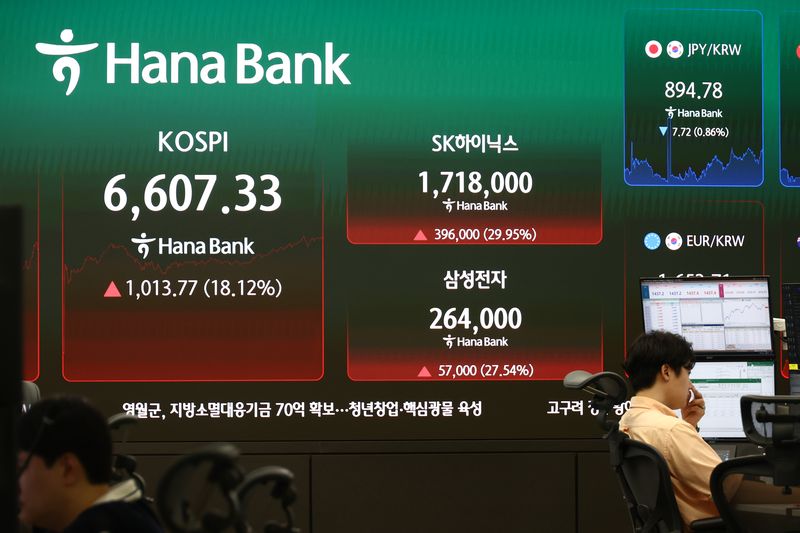
[Financial News] As financial authorities' new rules to raise the entry barrier for single-stock Leveraged Exchange-Traded Fund (Leveraged ETF) investment took effect on the 31st of last month, more retail investors are voicing self-criticism, saying they should "rethink a market that was closer to speculation than investment." The view that an investment culture focused on volatility rather than corporate value distorted the market is spreading through online communities.
On that day, when the new rule requiring a 30 million won cash deposit as the base margin was implemented, trading volume and trading value in single-stock Leveraged ETFs fell to about one-fourth of the previous trading day.
However, as Samsung Electronics and SK hynix shares surged, Leveraged ETF prices jumped 50% to 60%, showing a divergence between investor sentiment and market movements.
"They made Republic of Korea companies vulnerable to leverage and short-term trading"
Recently, online stock communities have been filled with criticism that single-stock Leveraged ETFs have turned the domestic stock market into a speculative arena.
One investor, who described himself as a "1 billion won exit, shareholder with assets in the 100 million won range," posted an article on the 27th titled "A Night of Agony, Thinking About the Republic of Korea Capital Market." He pointed out that "the stock market is a place where companies raise funds and investors take part in their growth, but at some point daily volatility became more important than corporate earnings."
He criticized the market, saying, "A vicious cycle emerged as leveraged money poured in, short-term trading followed, and then more funds came in to chase volatility again." He added, "The market has become one where participants analyze and trade volatility itself, not companies."
He was especially concerned that Samsung Electronics and SK hynix are the underlying assets of Leveraged ETFs. He argued that if global investors keep seeing Republic of Korea's flagship companies shaken not by earnings or competitiveness but by leverage and short-term speculation, they may demand a higher risk premium for the Korean market.
Another investor said, "It was not SK hynix's competitiveness that collapsed; the market structure shook the company's fundamentals first." He added, "ETF rebalancing, leveraged liquidation, and overheated investor sentiment have created a market where prices are determined by value less than by corporate fundamentals."
Netizens also agreed with the posts. Comments such as "I hope this becomes a market judged by corporate value," "If leveraged ETFs are not curbed, the market will become a speculative arena," and "Supply and demand have been distorted since leveraged products appeared" continued to appear.
Kim Eun-yu, a lawyer at Kangsan law firm who is known for his work in real estate and finance, also described the risks of Leveraged ETFs as the "curse of compounding" and said investors should be cautious.
Kim said, "The curse of compounding is Leveraged ETFs." He emphasized, "They may be good when prices rise, but if they turn negative, it is never easy to recover the principal."
Leveraged ETFs are designed to track, in general, twice the daily return of an underlying asset rather than its cumulative return. Because the reference price is recalculated every day when the underlying asset fluctuates, long-term returns can differ from a simple multiple of the asset's cumulative return.
For example, if an underlying asset falls 10% and then rises 11.1% the next day, it returns to its original level. But a product that tracks twice the daily move would still fall short of the original investment even if it drops 20% on the first day and then rises about 22.2% the next day. In volatile markets, losses can accumulate.
Trading falls, prices soar ... a mixed first day for the new rules
Market participants say the higher base deposit requirement somewhat restrained investor sentiment on the first day.
From that day, individual retail investors who want to buy single-stock Leveraged ETFs or ETN products, either for the first time or as additional purchases, must hold 30 million won in cash as the base deposit.
According to the Korea Exchange, trading value for 16 Samsung Electronics and SK hynix single-stock leveraged and inverse ETF products fell to about 300 billion won, roughly one-fourth of the previous day's 1.24 trillion won. Trading volume also dropped sharply for the flagship product, KODEX SK Hynix Single Stock Leverage ETF, from 488.89 million shares to 116.92 million shares.
By contrast, prices surged.
As SK hynix hit the daily upper limit and Samsung Electronics rose more than 26%, the SK Hynix single-stock Leveraged ETF jumped 58% to 60%, while the Samsung Electronics Leveraged ETF also climbed about 51%.
Market watchers said the result shows that "price gains and lower trading volume are separate issues."
Lee Sang-hyun, a researcher at Meritz Securities, said the drop in trading volume suggests that the policy had some effect. He added, however, that "other stocks have risen sharply instead of the leveraged names that used to top trading value rankings."
Some also said it is too early to judge the policy's impact.
Park Woo-yeol, a researcher at Shinhan Investment Corp., said, "Trading also naturally slowed as the underlying assets surged sharply from the opening bell." He added, "We need to watch the regulatory effect for a little longer."
[email protected] Seo Yoon-kyung Reporter