Assembly Passes Bill to Abolish Supplementary Investigative Powers and Dismiss Indictments; Opposition Calls for Veto
- Input
- 2026-07-31 17:05:39
- Updated
- 2026-07-31 17:05:39
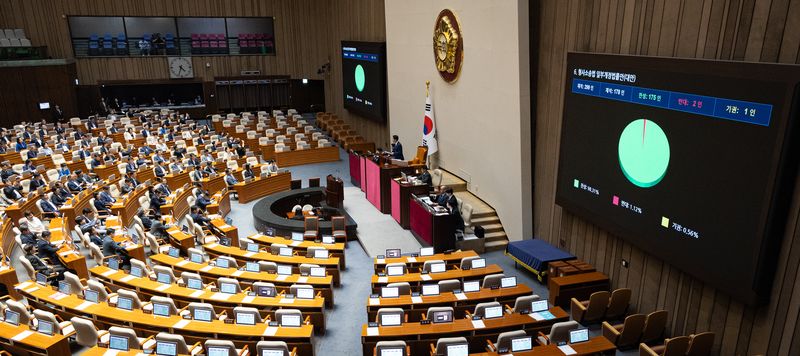
[Financial News] A revision to the Criminal Procedure Act of the Republic of Korea that would completely abolish prosecutors' supplementary investigative powers cleared the National Assembly plenary session. With the abolition of the Supreme Prosecutors' Office of the Republic of Korea (SPO) and the launch of the Serious Crime Investigation Agency and the Public Prosecution Office set for Oct. 2, the final stage of the so-called complete stripping of prosecutors' investigative powers has begun. The broader pro-ruling camp called it "a historic turning point that places prosecutorial power under the Constitution and the people's control," while the People Power Party warned that victims' rights would be undermined and sharply criticized it as a "sociopath regime."
Supplementary investigative powers to be fully abolished; move to require transfer of all seven major crime cases in August
The National Assembly convened a plenary session on July 31 and passed the revision to the Criminal Procedure Act of the Republic of Korea led by lawmakers from the broader pro-ruling camp. The People Power Party responded with a filibuster, but the broader pro-ruling camp used its majority to force an end to the filibuster after 24 hours. Of the 178 lawmakers present, 175 voted in favor, two opposed and one abstained. Within the Democratic Party, Kwak Sang-eon was the only member to vote against the bill, while Lee So-young abstained.
The key point of the revised Criminal Procedure Act is the complete abolition of prosecutors' supplementary investigative powers. It effectively marks the end of the ruling bloc's long-sought separation of investigative and prosecutorial powers. As a result, prosecutors at the Public Prosecution Office will retain only the authority to request supplementary investigations from judicial police officers. Judicial police officers who receive such a request must carry out the supplementary investigation within up to two months. If they fail to comply without justifiable reason, disciplinary action may be requested against the investigator in charge, or another investigative agency may be designated to handle the supplementary investigation.
The ruling bloc said it has also prepared alternatives to protect victims' rights. Prosecutors will be able to hear opinions from parties involved in a case and request the submission of materials. Victims will also be granted the right to request access to and copies of investigative records, and complainants will be allowed to file objections.
The Democratic Party plans to pursue follow-up legislation requiring the transfer of all cases involving the seven categories of crimes against socially vulnerable groups: domestic violence, child abuse, sexual crimes, child sexual crimes, stalking, abuse of persons with disabilities and elder abuse. The party said it will revise and pass the relevant bills during the August extraordinary session.
Controversy over expanded grounds for dismissing indictments; opposition urges veto
The newly added provision expanding the grounds for dismissing indictments during the review of the Criminal Procedure Act of the Republic of Korea has also emerged as a major point of contention. It was inserted suddenly during the bill review process in the National Assembly Legislation and Judiciary Committee. The broader pro-ruling camp codified grounds allowing courts to dismiss indictments in cases involving "serious illegal investigations" and "indictments that significantly deviate from prosecutorial discretion." The opposition strongly objected, saying the clause was intended to secure dismissal of indictments in President Lee Jae-myung's trial.
At a Supreme Council meeting before the bill passed, Han Byung-do, acting party leader and floor leader of the Democratic Party, said, "With today's revision to the Criminal Procedure Act, a criminal justice system that has been centered on prosecutors for more than 70 years is being renewed and set right into a criminal justice system of the people, by the people and for the people." He added, "We will take full responsibility to ensure the Public Prosecution Office and the Serious Crime Investigation Agency launch smoothly on Oct. 2 by thoroughly handling follow-up laws and institutional reforms." The Democratic Party plans to hold a public briefing on Aug. 3 to explain in detail what will change under the revised Criminal Procedure Act and what follow-up measures will be taken.
The People Power Party said the revision to the Criminal Procedure Act would reduce victims' rights and accelerate efforts to erase President Lee Jae-myung's legal troubles. It also called on President Lee Jae-myung to exercise his request for reconsideration of a bill. Floor leader Jeong Jeom-sik said, "This is clearly tailor-made legislation for President Lee Jae-myung, who is in a situation where his trial should be suspended. If you do not want to be branded the 'Lee Jae-myung jailbreak law,' exercise your request for reconsideration of a bill. The People Power Party will pursue all means available, including a constitutional complaint."
Independent lawmaker Han Dong-hoon also pressed just before the bill passed, saying, "A government that pushes ahead with policies that unfairly harm and hurt the majority of the public without any rational basis will not be able to last." He added, "Minister of Justice Jung Sung-ho should stake his position and say that President Lee Jae-myung must exercise his veto."
However, the Blue House immediately said after the Criminal Procedure Act revision passed the plenary session that it "respects the National Assembly's legislative process and final judgment," and it is expected to promulgate the bill at the State Council meeting in August.
National Assembly Act revision to shorten fast-track review submitted to plenary session
Meanwhile, the ruling bloc submitted to the plenary session a revision to the National Assembly Act that would shorten the fast-track review period from a maximum of 330 days to 90 days. The move is seen as an attempt to push through bills under the jurisdiction of standing committees chaired by People Power Party lawmakers.
The People Power Party also filed for a filibuster on the National Assembly Act revision. Kim Mi-ae, the senior deputy floor leader for policy, took the first turn. Floor leader Jeong criticized the bill, saying, "In short, this is a National Assembly rubber-stamp law and a draconian measure that would turn the Assembly into a faster machine that simply raises its hand and obeys."
However, since the July extraordinary session ends on July 31, the filibuster is expected to be forcibly terminated at 11:59 p.m. The National Assembly Act revision will then be put to a vote at the first plenary session of the August extraordinary session. It is also expected to clear the plenary session under the leadership of the Democratic Party.
[email protected] Lee Hae-ram Reporter