Korea and Chile Upgrade Mineral Resources Partnership, Expand Cooperation on Critical Mineral Supply Chains
- Input
- 2026-07-31 14:26:44
- Updated
- 2026-07-31 14:26:44
[Financial News]
South Korea and Chile have agreed to significantly strengthen cooperation on critical mineral supply chains during President Lee Jae-myung's state visit to Chile. The two countries also agreed to upgrade their existing mineral resources cooperation into a ministerial-level "Mineral Resources Partnership" and broaden economic cooperation from critical minerals such as lithium and copper to investment and defense.
MOTIE said on the 30th local time that Kim Jung-kwan, Minister of Trade, Industry and Energy, and Chilean Economy and Mining Minister Daniel Mas Valdes signed a memorandum of understanding on the Korea-Chile Mineral Resources Partnership in Santiago, Chile. A Korea-Chile business roundtable was also held with companies from both countries, where participants discussed cooperation in critical minerals, Artificial Intelligence (AI), green energy, and defense.
The MOU expands and revises the existing mineral resources cooperation agreement signed in 2004. It goes beyond simple resource development and covers the entire mineral value chain, including exploration, development, processing and smelting, recycling, trade, and investment.
In particular, the two countries agreed to upgrade their existing vice ministerial resource cooperation committee into a ministerial-level "Mineral Resources Partnership Committee" and make it a regular body. They also decided to establish a working-level consultative group at the director-general level. Through this framework, they plan to continuously review agreements reached by the two leaders and systematically promote joint project discovery, technology cooperation, and personnel exchanges.
Korea asked Chile, the world's largest copper producer and holder of the world's largest lithium reserves, to ensure a stable supply of critical minerals such as copper, lithium, and zinc. In response, both sides agreed that long-term supply chain cooperation is necessary to secure key raw materials for future industries such as electric vehicles, batteries, and data centers.
The Korean government explained that, given Korea's world-class smelting technology and expertise in low-carbon smelting, byproduct recovery, and waste reduction, the country can be an ideal partner for upgrading Chile's mineral industry.
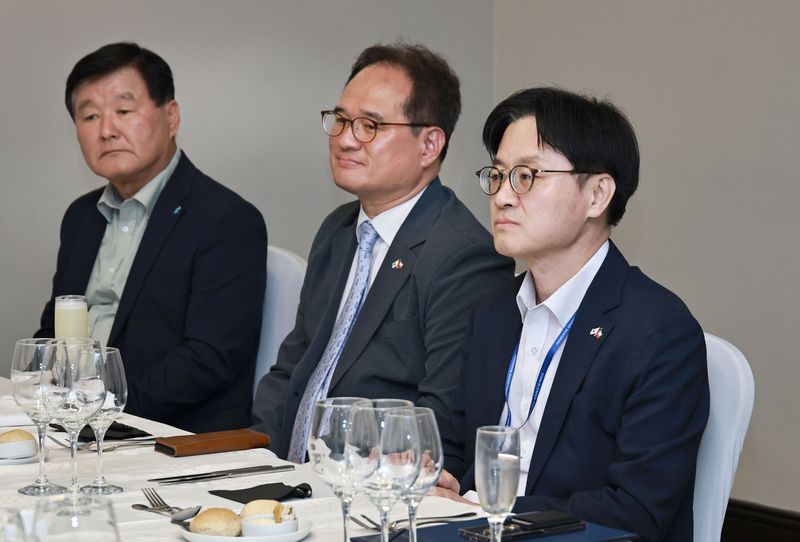
Before meeting with the Chilean ministers, Kim held a separate meeting with representatives from companies and institutions pursuing critical mineral projects in Latin America, including LS, Korea Zinc, Korea Mine Rehabilitation and Mineral Resources Corporation, and KOTRA, to review local investment difficulties.
The participating companies shared updates on their critical mineral investments and procurement activities in Latin America and asked the government for support to ensure stable business operations. Kim said he would meet with ministers in charge of critical minerals during his visits to Brazil, Chile, and Argentina, convey the companies' concerns, and work to improve the investment environment.
He stressed that "to secure critical mineral supply chains, the government and companies must work closely together in a '2 by 2' manner," and said he would actively use country-specific resource cooperation committees to build a public-private joint response system.
MOTIE and the Korea Chamber of Commerce and Industry (KCCI) also held a Korea-Chile business roundtable on the same day. The event was attended by major Korean business leaders, including OCI Holdings Chairman Lee Woo-hyun, POSCO Holdings Chairman Jang In-hwa, LS Group Chairman Koo Ja-eun, and Korea Zinc Chairman Choi Yoon-bum, along with representatives from Chile's industrial sector.
Participants discussed ways to expand cooperation centered on critical minerals, AI and digital technologies, and green energy, among future industries.
In the critical minerals sector, they agreed to expand cooperation across the entire supply chain, from exploration and development to eco-friendly smelting and battery materials, in response to supply chain restructuring. They also agreed to use the cooperation between LS MnM and Chilean state-owned copper producer Codelco as a representative model for further expansion.
In the AI and digital sector, Naver proposed cooperation on building Chile's "Sovereign AI" using AI technology, while Hanwha Ocean introduced possible technology cooperation in shipbuilding, marine industries, and defense.
In the green energy sector, OCI Holdings presented examples of renewable energy cooperation, and Hyundai Motor Company shared plans for collaboration in eco-friendly mobility. The two sides also discussed ways to expand trade in consumer goods such as K-beauty and food.
Economic cooperation also produced concrete results.
KOTRA signed an investment cooperation MOU with InvestChile. The two agencies agreed to jointly promote investment information sharing, promising project discovery, business networking, and the resolution of investment-related difficulties.
A Korean company also signed a contract with Chile to supply military vehicles. The government expects the deal to lead to additional defense cooperation, including follow-up procurement, training, and maintenance support.
In addition, MOTIE and KOTRA held a Korea-Chile business partnership export consultation session, where more than 120 meetings were arranged between Korean small and mid-sized companies and local buyers. The event led to contracts worth about $5 million.
Kim said, "Based on the cooperation built over the past 20 years since the Korea-Chile Free Trade Agreement (FTA) was signed, this has become an opportunity to draw up a blueprint for the next 20 years." He added, "The government will actively support corporate investment, technology cooperation, and supply chain building so that the two countries can develop into strategic partners in future industries such as critical minerals, AI and digital technologies, advanced manufacturing, and green energy."
[email protected] Park Ji-young Reporter