Tablo Says He Nearly Died After Going to the Bathroom 60 Times: This Disease Is Said to Feel Like Childbirth for Men [Health Talk]
- Input
- 2026-08-02 06:00:00
- Updated
- 2026-08-02 06:00:00

[Financial News] Tablo of the group Epik High said it took about five hours to receive treatment and prescription medication after he suffered severe pain from symptoms of a urinary stone while in London, England.
Urinary stone symptoms in London... "A 10-minute walk felt like 40 days."
Tablo recently uploaded a video to his YouTube channel titled "The story of how I almost died after going to London to meet Spider-Man."
He said the symptoms began on the flight to London, describing the pain as "like a meteor passing through a very narrow straw."
He tried to keep up with his schedule, but his condition worsened to the point that he had to go to the bathroom about 60 times a day.
The next day, he was scheduled to interview Tom Holland, Zendaya, and Jacob Batalon, the stars of the film Spider-Man. Tablo said he felt deeply guilty and afraid that his condition might disrupt the entire schedule.
In the end, he took a taxi for about 40 minutes to find an urgent care clinic that was open on the weekend. But the clinic told him that the doctor who treated those symptoms had already left for the day and could not see him.
Tablo pleaded, "I have an appointment, and I am dying right now. I need to see a doctor immediately," but he was eventually sent to another clinic. Although it was only a 10-minute walk, he recalled, "It felt like 40 days in the desert. I was at death's door."
He said, "It was an emergency, but nothing was handled urgently," adding that he was frustrated to have gone through all of it for five hours.
Higher risk in men than women, and in summer than in winter... Urinary stones can cause severe pain
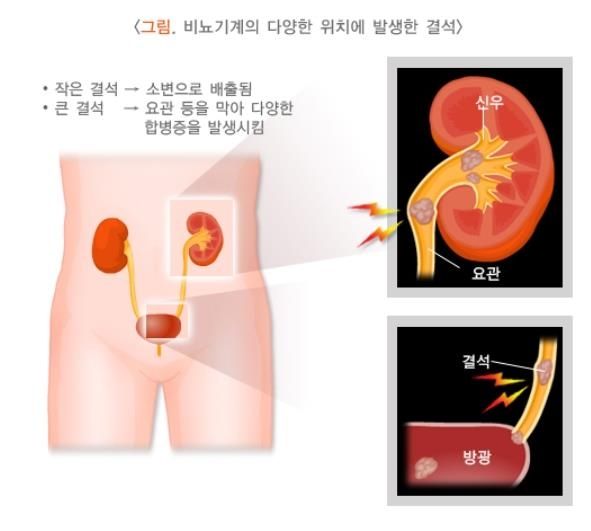
A urinary stone is a condition in which substances such as calcium, oxalate, and uric acid in urine crystallize and form stones in the urinary tract, including the kidneys and ureters. Depending on where the stone is found, it is classified as a kidney stone, ureteral stone, bladder stone, or urethral stone. It occurs more often in men than in women.
The most common symptom is severe flank pain. If the stone is in the upper ureter, back and side pain may be accompanied by nausea and vomiting. As the stone moves downward, the pain can spread to the lower abdomen, groin, testicles, or the area around the genitals. If the stone irritates the lining of the urinary tract, the urine may appear red or brown, and microscopic blood in the urine may also be present. In severe cases, kidney function can worsen and kidney failure may occur.
The risk is especially higher in summer, and the key factor is dehydration. When sweating increases but fluid intake does not keep up, urine becomes more concentrated, making it easier for stone-forming substances to crystallize. In addition to dehydration, excessive intake of animal protein, increased calcium excretion linked to higher vitamin D production, and family history can also contribute.
Treatment depends on the size and location of the stone, as well as whether there is urinary obstruction or infection. If the stone is small and likely to pass naturally, doctors monitor the condition while using pain relievers and medication that helps the stone pass. Otherwise, extracorporeal shock wave lithotripsy may be considered, which uses shock waves from outside the body to break the stone into smaller pieces so it can be passed in urine. If the stone is large and hard and cannot be treated with lithotripsy, ureteroscopy may be used to directly break it up and remove it.
[email protected] An Ga-eul Reporter