"The Worst Is Over, Heading to 9,300"...Brokerage Says 5,700 Is the Turning Point After KOSPI's Sharp Plunge
- Input
- 2026-07-31 08:30:59
- Updated
- 2026-07-31 08:30:59
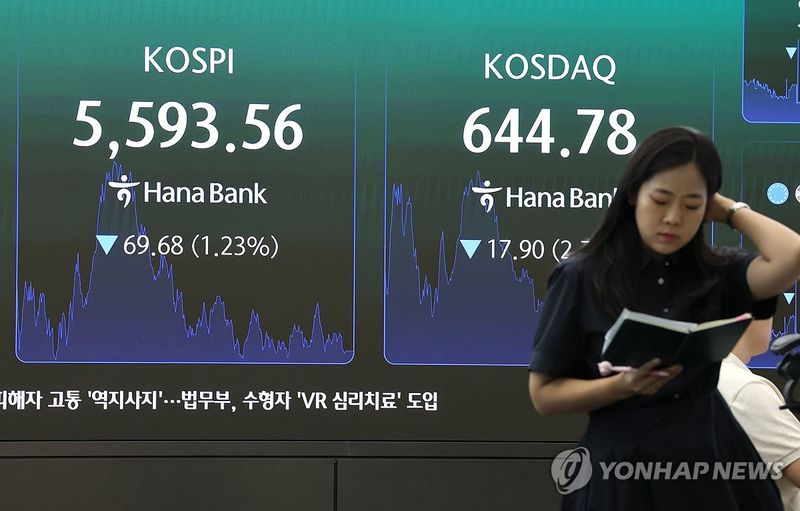
[Financial News] The KOSPI has fallen below the 6,000 mark after triggering circuit breakers for two straight days for the first time ever, but analysts say the market may have already passed its worst phase.
Daishin Securities: "Excessive decline"... Big tech and hyperscaler earnings in focus
According to Yonhap News Agency on the 31st, Lee Kyung-min, a researcher at Daishin Securities, said in a report released the previous day that "the current KOSPI level is judged to be an excessive decline both in terms of valuation and technicals."
He identified the 5,700-5,800 range as a key support level, explaining that "the 200-day moving average, the 50% retracement of the rise from the April 2025 low to the June 2026 high, and a forward price-to-earnings ratio of around 5 times are all concentrated in this range."
On the 29th, the KOSPI briefly dropped to 5,262.77 intraday, fueling speculation that the 5,000 level could also break. Volatility was extreme, with circuit breakers triggered for two consecutive days for the first time ever in both the KOSPI and KOSDAQ markets.
However, Lee said, "We believe the KOSPI is currently moving through the worst phase," adding that "if it stabilizes in the 5,700-5,800 range after short-term fluctuations, there is ample room for a recovery first to the 8,200 level, or 7 times forward PER, and then to 9,300, or 8 times forward PER."
Lee pointed to earnings results from big tech and hyperscaler companies, due to be released between late July and early August, as the next key factor to watch. He said investors could take comfort if those firms confirm expanded capital expenditure, and that a strong turnaround trigger could emerge if they also prove profitability gains through artificial intelligence (AI).
He also said concerns over interest-rate hikes have eased somewhat as the market has gone through the Federal Open Market Committee (FOMC). He added that if tensions between U.S. President Donald Trump and Iran also move toward de-escalation, oil prices, inflation and bond yields could stabilize one after another, easing the investment burden on hyperscalers.
"The scale of leveraged liquidation is in the trillions of won... it is estimated to end in early to mid-August"
Meanwhile, Daishin Securities also released a separate market analysis report on the day, written using its economic analysis AI model, JAEMINI.
The report described the recent plunge as "an event in which Korea's own leveraged liquidation was layered on top of a global semiconductor re-rating." During the same period, Taiwan's stock market fell 16.1% and the Nasdaq dropped 8.2%, while the KOSPI and KOSDAQ plunged 37.9% and 45.4%, respectively. The report said the gap was largely due to leverage.
The report noted that "the two layers end at different times." It said the scale of leveraged liquidation can be counted in the trillions of won, so it is estimated to end around early to mid-August, but the global semiconductor re-rating is not something that can be measured numerically.
As a result, it said the timing of a sharp drop caused by leveraged liquidation can be predicted, but it is difficult to say exactly when the decline will fully stop as the semiconductor re-rating runs its course.
For that reason, the report advised investors to unwind single-stock leveraged exchange-traded funds (ETFs) before the 31st of this month, when trading could weaken due to higher deposit requirements, and to avoid new purchases, averaging down or buying on rebounds while waiting for the situation to settle. It also said that if the market appears to have stopped falling around early next month, investors could then begin buying in stages, focusing on index products.
"What investors should buy now is not stocks, but time," the report said. "In a phase that has occurred only six times in 45 years, with a 20-trading-day cumulative return of minus 25% or worse, the most painful failure is not being wrong about the direction, but being right and still not having an account left by then."
Daishin Securities said the report was produced using generative AI technology and is unrelated to the official views of its research center.
[email protected] Kim Soo-yeon Reporter