As the 'semiconductor throne' wobbled, Chey Tae-won stepped in. Hynix, down 48%, and the real reason [Why are stocks moving?]
- Input
- 2026-07-31 05:00:00
- Updated
- 2026-07-31 05:00:00
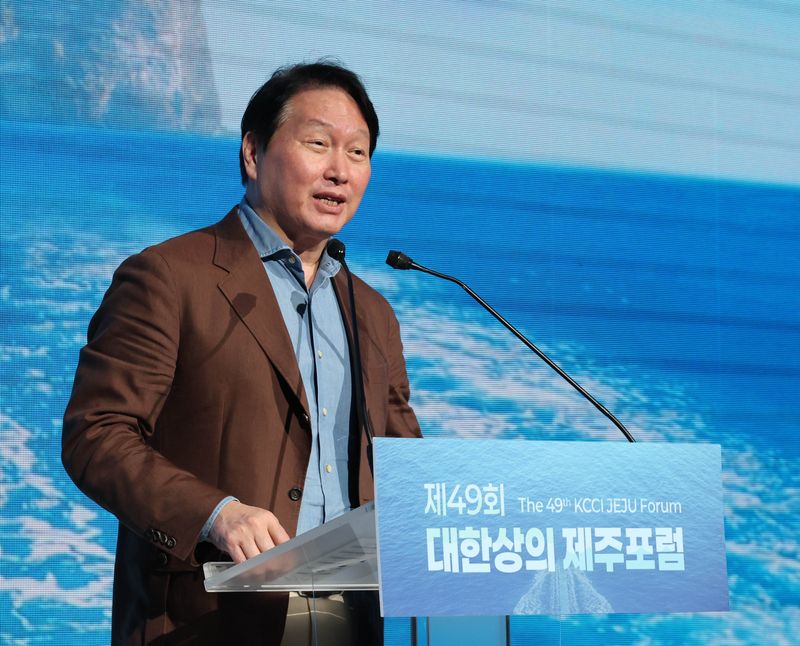
[Financial News] Chey Tae-won, chairman of SK Group, bought 3,620 shares of SK hynix on the open market. The purchase was worth about 480 million won. This is the first time Chey has bought SK hynix shares on the open market since the company went public.
SK hynix's stock price fell by about 48% in July. Even after reporting record quarterly earnings for the second quarter, major brokerages cut their target prices across the board. Still, they all said there had been no major change in the company's value.■Stock price cut in half despite record earningsAccording to the Korea Exchange on the 31st, SK hynix shares plunged 48.4% in a month, falling from 2.56 million won on the 1st to 1.322 million won on the 30th. Over the same period, its market capitalization also dropped by about 859 trillion won, from roughly 1,825 trillion won to 966 trillion won.
Brokerages continued to lower their target prices for SK hynix. Mirae Asset Securities cut its target from 4.2 million won to 2.8 million won, while Shinhan Investment Corp. lowered it from 4.2 million won to 2.7 million won. Hanwha Investment & Securities (4.3 million won to 3.15 million won), NH Investment & Securities (4.1 million won to 3.4 million won), Daishin Securities (3.9 million won to 3.2 million won), Samsung Securities (4 million won to 3 million won), and BNK Investment & Securities (1.85 million won to 1.48 million won) also all reduced their estimates.
However, analysts generally said the lower target prices reflected a reset in market expectations rather than a deterioration in corporate value. Lee Jong-wook, an analyst at Samsung Securities, said, "The recent stock decline was driven by concerns over the sustainability of data center investment and the concentration of money in memory stocks, but the core growth drivers, such as expanded AI data center investment and server DRAM demand, have not changed." He maintained his 'buy' rating.
Kim Hyeong-tae, chief analyst at Shinhan Investment Corp., said, "Excessive concerns have been priced into the stock amid extreme volatility." He added, "The supply shortage environment is likely to continue through 2027." He also noted that memory inventories remain at low levels and that the current share price is in oversold territory.■One day after disappointment over shareholder returns, the owner stepped in directlyChey's open-market purchase also drew attention because it came right after the market expressed disappointment over SK hynix's shareholder return policy.
At its second-quarter earnings conference call on the 29th, SK hynix gave an answer on further expansion of shareholder returns that fell short of market expectations. Investor sentiment weakened sharply, and the stock fell nearly 10% that day.
By contrast, Samsung Electronics said during its earnings conference call on the 30th that it would "maximize shareholder returns," and its shares strengthened intraday.
A brokerage industry official said, "Chey's first open-market purchase came at a time when market disappointment over shareholder return policy was growing, and it showed confidence in the company's value through action." The official added, "Brokerages lowered their target prices but kept their buy ratings, which can be seen in the same context, as it reflects weaker investor sentiment rather than damage to fundamentals."■The market structure has changed too. Now stock prices move 24 hours a dayDuring the selloff, it also became clear that changes in market structure, apart from SK hynix's fundamentals, can amplify stock volatility. In this environment, Chey's first open-market purchase is being viewed as a symbolic move that could help stabilize investor sentiment.
On the 28th, when one share of SK hynix was temporarily executed at the daily lower limit in the NextTrade premarket, about $57.4 million, or 82 billion won, in long positions were liquidated in overseas on-chain derivatives markets that referenced the move. It was a case in which a temporary price distortion in the domestic spot market spread into overseas derivatives markets.
Industry watchers see the episode as evidence that volatility may increase because of changes in market structure rather than changes in corporate fundamentals. In the past, price swings in the domestic stock market were mostly absorbed within Korea. Now, however, the spot market and overseas 24-hour derivatives markets are linked in real time, making it more likely that even small price moves will trigger a chain of trades and forced liquidations. Analysts say SK hynix shares are now influenced not only by earnings and supply-demand conditions, but also by movements in global derivatives markets.
Park Sung-je, an analyst at Shinhan Investment Corp., said, "The key point in this case is not how much the stock fell, but that a small shock was amplified far more than expected through the interconnected market structure." He added, "As stock-based perpetual futures products (TradFi) expand, the domestic stock market is likely to become even more tightly linked with overseas 24-hour derivatives markets, increasing mutual influence."
[email protected] Choi Doo-sun Reporter