KOSDAQ Market Cap Evaporates by 275 Trillion Won... Government Offers Only a 'Leverage' Stopgap [KOSDAQ Is Disappearing 3]
- Input
- 2026-07-31 06:00:00
- Updated
- 2026-07-31 06:00:00
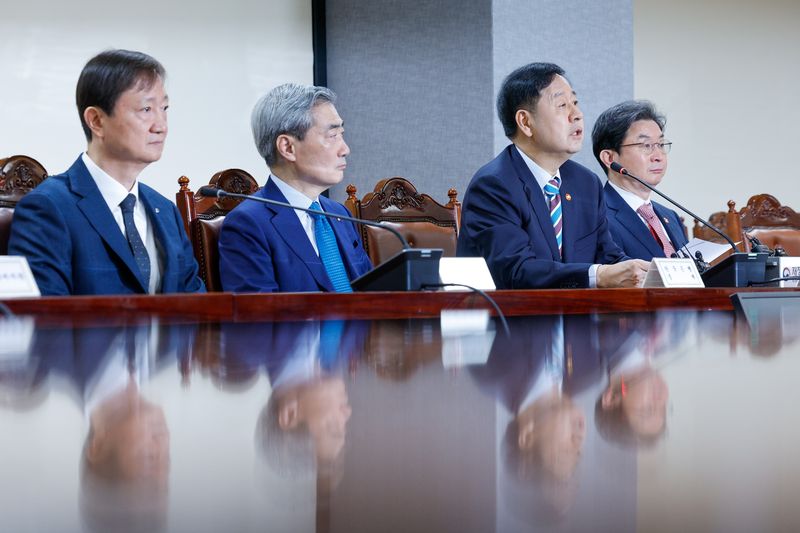
[Financial News] KOSDAQ lost 275 trillion won in market capitalization in just two months. That is nearly three-quarters of the market's current total value. The financial authorities have belatedly moved to regulate single-stock leveraged exchange-traded funds (ETFs), acknowledging the 'excessive concentration of funds,' but they have not announced any separate recovery measures for the KOSDAQ market, which has lost liquidity.■ From 633 trillion won to 359 trillion won... A market disappearedAccording to the Korea Exchange on the 31st, KOSDAQ's market capitalization stood at 633.3859 trillion won on May 27, when the single-stock leveraged ETF was listed. By the 30th, however, it had fallen to 358.7117 trillion won. In just two months, 274.6743 trillion won, or 43.4%, vanished.
The lost market capitalization amounts to about 77% of KOSDAQ's current total market cap. One market source said the figure shows more than a simple stock-price correction, noting that it indicates a sharp contraction in the market's overall size.
Over the same period, the KOSDAQ Index fell from 1,133.13 to the 640 range, while trading volume, turnover, and margin loan balances all declined. The market appears to be trapped in a vicious cycle of falling trading activity, investor outflows, and worsening liquidity.
Since the start of the year, KOSPI has risen 34.4%, while KOSDAQ has fallen 28.7%. The performance gap between large-cap and small- and mid-cap stocks has widened to more than 60 percentage points. Lee Jae-won, a researcher at Yuanta Securities Korea Co., Ltd., said, "KOSPI at least saw profit-taking after hitting record highs, but KOSDAQ has been falling even when KOSPI rises, and falling together with it when KOSPI declines."
The starting point of KOSDAQ's weakness is the exit of individual investors, who had been the key net buyers. Since the beginning of the year through that day, individuals bought a net 112.8293 trillion won in KOSPI, but sold a net 9.865 trillion won in KOSDAQ.
Lee Jae-won explained, "As large-cap semiconductor stocks with confirmed memory-price gains and earnings improvement showed relative strength, the launch of the single-stock leveraged ETF also shifted individual investors' high-beta demand to Samsung Electronics and SK hynix, leaving KOSDAQ in what could be called a funding desert."■ Financial authorities admit 'excessive concentration'... Their response is leverage regulationOn the 16th, the Financial Services Commission (FSC) announced supplementary measures, including raising the base deposit for single-stock leveraged ETFs from 10 million won to 30 million won and suspending the listing of new products. The 30 million won cash deposit requirement took effect immediately that day.
As the background for the measures, the FSC officially cited 'excessive concentration of funds in a small number of stocks' and 'increased market volatility.' In fact, trading surged after the single-stock leveraged ETF was listed, especially in Samsung Electronics and SK hynix. The financial authorities have acknowledged that this trend could weigh on market stability.
However, the securities industry says the policy focus is on protecting leverage investors and regulating products, while there is effectively no response for the KOSDAQ market, which lost liquidity sharply over the same period.
One securities industry source said, "The financial authorities have effectively admitted that funds are overly concentrated," adding, "If so, they should also discuss follow-up measures on how to revive the market that has seen money flow out."■ Regulation has begun... but what will revive KOSDAQ?Market experts point out that by the time the leverage rules were implemented, KOSDAQ's trading decline and market-cap contraction were already well underway. They say it will not be easy for regulation alone to redirect funds that had concentrated in specific stocks back into KOSDAQ.
The securities industry is calling for a broader package of measures to revitalize the market, including tax incentives, greater participation by institutional investors, and stronger incentives for investment in small- and mid-cap stocks.
One investment industry source said, "Tightening leverage products may be a necessary step to reduce market volatility," adding, "But KOSDAQ's liquidity has already shrunk significantly, so unless separate revitalization policies are put in place to restore market function, it will be difficult to fundamentally ease the concentration of funds."
[email protected] Choi Du-seon Reporter