Seoul Home Prices Pause Ahead of Tax Reform, While Outlying Areas Stay Strong
- Input
- 2026-07-30 14:00:00
- Updated
- 2026-07-30 14:00:00
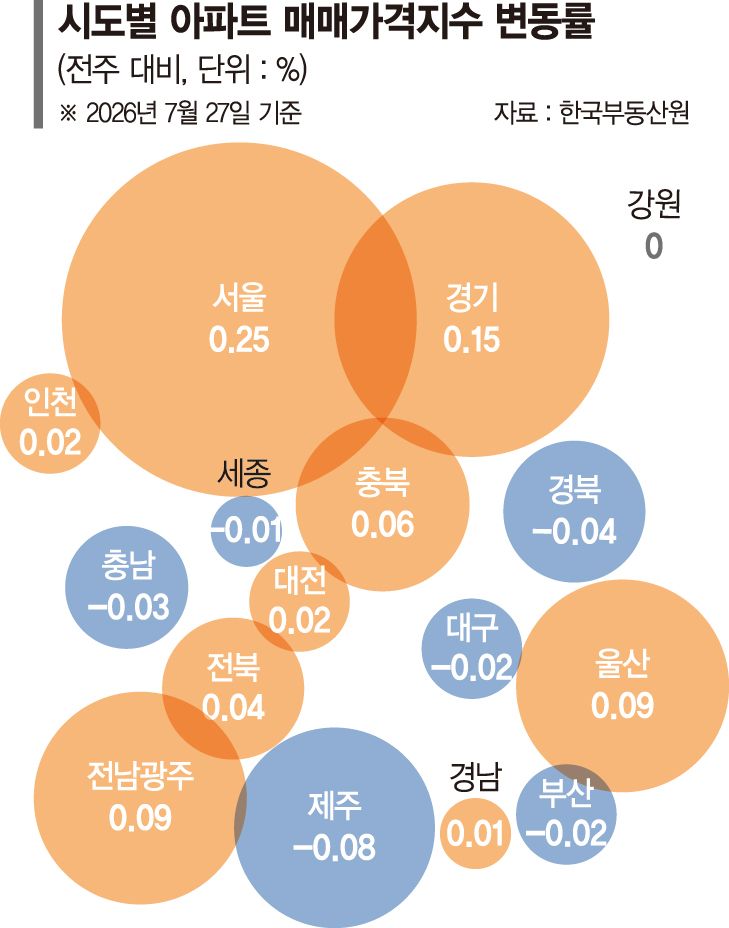
According to the Korea Real Estate Board (KREB) on the 30th, apartment sale prices in Seoul rose 0.25% in the fourth week of July, as of the 27th. The increase was down 0.02 percentage points from 0.27% the previous week, but prices have continued to rise for 77 consecutive weeks.
By area, Gangbuk region stood out. Jungnang-gu posted the sharpest rise in Seoul at 0.53%. It was followed by Nowon District at 0.46%, Seongbuk District at 0.39%, Jung-gu at 0.36%, and Geumcheon-gu at 0.35%.
By contrast, the Gangnam area showed relatively modest gains. Gangnam District and Seocho District rose 0.07% and 0.05%, respectively, while Songpa District slowed to 0.20% from 0.29% the previous week.
Nationwide apartment sale prices rose 0.08%, while the Capital Region gained 0.16%. Gyeonggi Province and Incheon increased 0.15% and 0.02%, respectively.
In Gyeonggi Province, Gwangmyeong City and Giheung District in Yongin both rose 0.45%, leading the market. They were followed by Gwonseon District in Suwon at 0.40% and Suji District, Yongin at 0.38%.
Dongtan District in Hwaseong, which has led the gains in southern Gyeonggi Province with a cumulative rise of 15.75% this year, rose 0.15% this week. That was down 0.10 percentage points from 0.25% the previous week. Guri also saw its increase narrow to 0.20% from 0.27% over the same period.
Jungwon District in Seongnam slowed sharply to 0.20% from 0.49% the previous week, while Bundang-gu fell to 0.32% from 0.58%.
Nam Hyuk-woo, a researcher at Woori Bank Real Estate Research Institute, said, "In the southern Gyeonggi residential areas that started with Dongtan, prices are still maintaining double-digit gains, but overall the pace of increase is slowing." He added, "In Giheung District, Yongin, relatively affordable apartments are still concentrated, so end-user demand continues to flow in steadily."
The nationwide apartment jeonse price index rose 0.10%. By region, the increase was 0.17% in the Capital Region, 0.25% in Seoul, 0.14% in Gyeonggi Province, and 0.09% in Incheon.
[email protected] Choi Ga-young Reporter