Panic Selling Pushes Penny Stocks to 221 Companies, and More Firms Fall Within Delisting Range [Shaken K-Stock Market]
- Input
- 2026-07-30 18:18:33
- Updated
- 2026-07-30 18:18:33
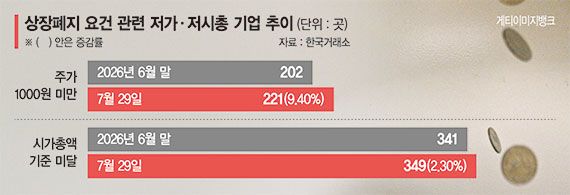
According to the Korea Exchange on the 30th, a total of 221 listed companies on KOSPI and KOSDAQ were trading below 1,000 won as of the previous day. That was up 19 companies, or 9.4%, from 202 at the end of June. By market, the number rose from 46 to 50 on KOSPI and from 156 to 171 on KOSDAQ. With volatility in the stock market widening recently, more companies with weaker financial structures, especially small and mid-sized firms, appear to be falling below the 1,000-won level.
The number of companies failing to meet market capitalization requirements also increased. On KOSPI, firms with market caps below 30 billion won rose from 105 to 108. On KOSDAQ, the number of companies below 20 billion won increased from 236 to 241. Combined, the number of companies falling short of market cap standards on KOSPI and KOSDAQ climbed from 341 to 349, further increasing the burden on firms that must meet listing maintenance requirements.
As the strengthened delisting system took effect this month and the market correction continued, more listed companies have moved into the delisting danger zone. Under the revised rules, a listed company is designated as an administrative issue if its stock price stays below 1,000 won for 30 consecutive trading days. If it then fails to recover above 1,000 won for at least 45 trading days within the next 90 trading days, it will enter delisting procedures. The market capitalization threshold was also raised this month, from 20 billion won to 30 billion won on KOSPI and from 15 billion won to 20 billion won on KOSDAQ. It will be tightened again in January next year to 50 billion won and 30 billion won, respectively.
Administrative issue designations tied to market cap shortfalls are also continuing. Over the past month, 13 companies in total, including three on the Korea Exchange Main Board and 10 on the KOSDAQ market, were designated as administrative issues for failing to meet market capitalization requirements. Analysts say the stronger listing maintenance standards are now making market cap management just as important as stock price performance.
Market participants expect that if the recent sharp decline continues, the burden on low-priced, low-cap companies to maintain their listings will last longer. Even after being designated as administrative issues, companies must satisfy both stock price and market cap requirements for a certain period of time, making it difficult to eliminate delisting risk with only a temporary rebound.
A securities industry official said, "The recent regulatory changes have made listing maintenance requirements much stricter, so companies now face greater pressure to meet both stock price and market cap standards at the same time." The official added, "In particular, small and mid-sized listed companies that struggle to raise funds may face even stronger restructuring pressure than before."
Ultimately, analysts say the effectiveness of the tougher rules will depend on how precisely regulators can distinguish troubled companies from those hit only by temporary market shocks. There is broad agreement with the goal of removing weak companies in a timely manner to improve market trust. But in a sharp market downturn like the current one, supply-demand conditions and investor sentiment can influence stock prices and market capitalization more than fundamentals.
There are also concerns that companies whose stock prices and market caps have been damaged by temporary market shocks could still come under delisting pressure, hurting small shareholders and worsening financing conditions for businesses. Critics say regulators should look not only at rigid standards, but also at each company’s financial condition, recovery potential, and broader market conditions.
A capital market expert said, "I agree with the purpose of the system, which is to improve market trust by removing weak companies in a timely manner." The expert added, "However, when the entire market is falling sharply, the system needs to be operated more carefully so that temporary liquidity problems can be distinguished from structural weakness in a company."
Meanwhile, KOSPI closed at 5,593.56 on the day, down 69.68 points, or 1.23%, from the previous trading session. During the session, it had risen as much as 5.54% to 5,976.82, but it gave up those gains and turned lower.
[email protected] Baek Han-geul Reporter