"Long-term contracts with 10 big tech firms" ... Samsung takes on peak fears and China’s challenge head-on [Samsung posts record second-quarter results]
- Input
- 2026-07-30 18:15:35
- Updated
- 2026-07-30 18:15:35
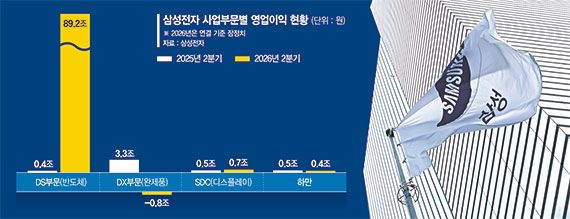
Samsung Electronics said on the 30th that it plans to operate up to 70% of its total semiconductor production capacity under long-term contracts, unusually disclosing detailed information about its memory chip LTA status with global big tech firms. It also revealed plans to build a second plant in Taylor, Texas, with construction targeted to begin by the end of this year, following the first Taylor plant, which is scheduled to start operations this year. The move appears aimed at easing market concerns over slowing AI memory demand on Wall Street and the KOSPI selloff triggered by ChangXin Memory Technologies (CXMT)'s listing event in China, by sharing current conditions in the memory chip and foundry markets.
■ Memory shortages to deepen through 2028
Kim Jae-jun, executive vice president and head of strategy and marketing at Samsung Electronics Memory Business Division, said during the second-quarter earnings conference call that "unmet demand caused by this year's memory supply shortage will be pushed into next year, making the shortage even worse than this year, and the shortage will continue in 2028 as well." He added that "as demand for securing infrastructure for long-term AI services is surging, and market expectations are spreading that memory shortages will persist for an extended period, many customers are requesting multi-year supply contracts."
Samsung Electronics is aiming to run 60% to 70% of its current production capacity under LTAs. It has already signed contracts with five major global data center customers. Industry watchers believe those customers include Amazon Web Services (AWS), Microsoft, Google, Meta Platforms, and Oracle Corporation. The company is also in the final stage of negotiations with five major AI-related customers. The long-term contracts are structured around a five-year base term, with one-year extensions each year, in a strategy designed to secure stable demand.
Advance payments for contract execution are also included in the terms. Vice President Kim said, "We have already received about one-quarter of the total advance payments, and if additional contracts are signed, the amount of advance payments will increase further." He added, "As the number of customers seeking long-term contracts keeps rising, we plan to continue discussing additional agreements."
The high-bandwidth memory business has also entered a full-fledged growth phase. Samsung Electronics expects HBM4 sales in the third quarter to more than triple from the previous quarter as customer certification from NVIDIA nears completion, and it projects that HBM4 will account for more than 60% of total HBM sales in the second half. The company aims to raise its HBM market share in the second half to a level comparable to its overall DRAM share, which stood at 38% in the first quarter, ranking first in the industry. Samsung Electronics is also accelerating preparations for next-generation HBM, becoming the first in the industry to ship HBM4E samples to customers.
■ Groundbreaking for Taylor second plant in the second half
Samsung Electronics' foundry business, long considered its weak spot, plans to expand production capacity by breaking ground on a second Taylor plant in the United States by the end of this year and to strengthen its push into the AI chip market by increasing 2-nanometer orders. The foundry business is still in the red, but a recovery is expected within the year. The first Taylor plant, which will serve as the core base of the foundry business, is being prepared for launch this year, while the second Taylor plant is scheduled to break ground at the end of this year for mass production in 2030. With customer inquiries about the 1.4-nanometer process rising recently, the company is also considering securing additional fabs.
Kang Suk-chae, vice president of Samsung Electronics' foundry division, said, "We have secured 2-nanometer projects from major cloud service providers (CSPs) and AI customers, and customers have begun product design." He added, "We are continuing to expand new orders for advanced-node processes by discussing various projects with major customers, including Broadcom Inc." He stressed that "profitability will improve significantly from a year earlier as higher utilization, better yields, and price increases work together," and noted that "it is difficult to specify when the foundry business will turn profitable, but we expect it to be possible in the near future."
Meanwhile, Samsung Electronics' board on the day approved a second-quarter cash dividend of 374 won per common and preferred share. The dividend will be paid in August, bringing the quarterly payout to about 2.45 trillion won. Samsung Electronics has maintained an annual regular dividend of 9.8 trillion won from 2024 through this year. Chief Financial Officer Park Soon-cheol said, "We will faithfully carry out the shareholder return policy we have already promised," adding, "We will also update the details of our future shareholder return policy soon."
[email protected] Lim Subin Reporter