"Up to 4.7 million won possible" vs. "1.48 million won reasonable" — diverging forecasts for SK hynix stock
- Input
- 2026-07-30 18:06:41
- Updated
- 2026-07-30 18:06:41
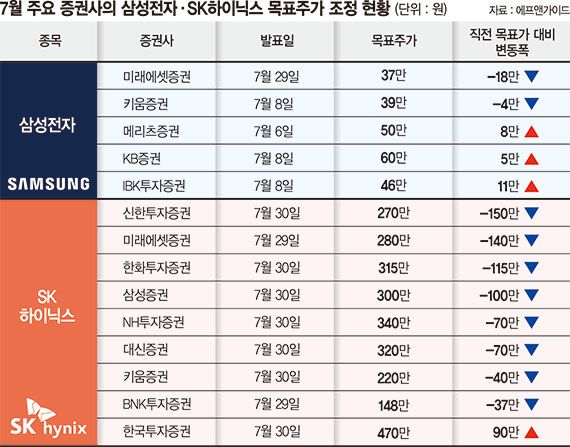
According to FnGuide on the 30th, Mirae Asset Securities cut its target price for Samsung Electronics from 550,000 won to 370,000 won on the 29th, a 33% reduction. It also lowered its target for SK hynix from 4.2 million won to 2.8 million won, a cut of 1.4 million won. BNK Investment & Securities also reduced its target for SK hynix from 1.85 million won to 1.48 million won.
The downward revisions continued on the same day. Shinhan Investment Corp. cut its target for SK hynix from 4.2 million won to 2.7 million won, Hanwha Investment & Securities lowered it from 4.3 million won to 3.15 million won, NH Investment & Securities reduced it from 4.1 million won to 3.4 million won, and Daishin Securities cut it from 3.9 million won to 3.2 million won. Samsung Securities also lowered its target price from 4 million won to 3 million won.
Not all brokerages reached the same conclusion, however. Even after the stock's correction, many still see strong long-term growth potential. Korea Investment & Securities raised its target price for SK hynix to 4.7 million won, while KB Securities kept its existing target at 4.2 million won. Daol Investment & Securities, Kyobo Securities, Hana Securities, and SK Securities also left their targets unchanged, saying AI memory demand and earnings momentum remain intact. As a result, forecasts for the same stock now range from 1.48 million won to 4.7 million won, showing a much wider gap in views among brokerages.
Market watchers say the revisions reflect a combination of factors, including the possibility that U.S. Big Tech may slow the pace of AI investment, concerns over the profitability of high-bandwidth memory (HBM), worries about expanding supply of conventional DRAM, heavy foreign selling of semiconductor shares, and valuation resets triggered by the recent market slump.
The wide divergence in target prices, however, stems from different views on the AI cycle. Some expect semiconductor conditions to weaken as AI investment slows more sharply, while others argue that the recent stock decline has been excessive relative to fundamentals and has pushed valuations too low. Industry observers say future capital expenditure plans from Microsoft (MS), Meta Platforms, and Amazon, along with NVIDIA's earnings and shifts in foreign investor flows, will be key variables for the semiconductor outlook and further target-price revisions.
Noh Dong-gil, an analyst at Shinhan Investment Corp., described the latest revisions as "a correction in confidence, not in earnings." He said estimates for semiconductor companies' results have not been significantly damaged yet, but valuations are being pulled down first as the market's confidence in continued AI investment, HBM profitability, and the potential expansion of DRAM supply weakens.
He said, "A slowdown in AI investment demand has not yet been confirmed in the real economy," and added, "Future capital spending by Big Tech and NVIDIA's earnings will serve as important tests for judging the industry outlook."
Jo Jae-un, an analyst at Daishin Securities, said the recent plunge cannot be explained by the global semiconductor cycle alone. He noted that the valuation reset in the global AI and semiconductor sector was compounded by liquidations in domestic single-stock leveraged exchange-traded funds (ETFs) and margin financing, which deepened the losses.
He said, "This decline is the result of Korea-specific leverage unwinding layered on top of a global semiconductor re-rating," and added, "Leverage unwinding may ease over time, but the direction of the semiconductor cycle will ultimately be determined by Big Tech investment and trends in the memory market."
[email protected] Choi Du-seon Reporter