"There’s a Reason It’s Hard to Keep Up Even When Prices Rise"... Phone Component Costs Surge 80% [IT Item of the Day]
- Input
- 2026-07-31 06:00:00
- Updated
- 2026-07-31 06:00:00
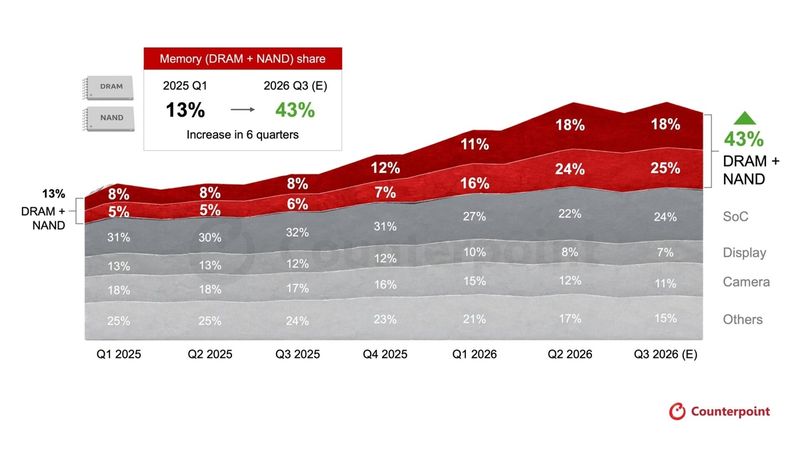
[Financial News] Global smartphone component costs have nearly doubled over the past three months, driven by a sharp rise in memory chip prices amid expanding artificial intelligence (AI) investment.
According to Counterpoint Research’s memory price tracking report released on the 31st, memory prices for smartphones in the second quarter of this year jumped more than 80% from the first quarter.
Low-end smartphones were hit hardest by the surge in memory prices. Based on the same specifications, component costs for low-end smartphones in the second quarter rose 70% from a year earlier.
The report found that the increase in memory prices accounted for most of the cost burden. Counterpoint Research said smartphone makers are sharply cutting orders for entry-level models and adjusting their product portfolios to respond to weaker short-term profitability.
Component costs for mid-range smartphones rose 52% from a year earlier. In this segment, rising costs are prompting manufacturers to downgrade processor and camera system specifications.
Component costs for premium smartphones climbed by about 50% year on year. In particular, DRAM has overtaken the system-on-chip (SoC) as the most expensive single component.
The heavier cost burden is beginning to push up retail prices for premium models.
Compared with the 1TB iPhone 17 Pro Max released last year, component costs for the same-capacity iPhone 18 Pro Max, set to be unveiled in September, are estimated to rise by about $300, or roughly 433,000 won.
As component costs continue to rise, smartphone makers are also seeing weaker earnings.
Samsung Electronics’ Mobile Experience and Network divisions posted a combined operating loss of 700 billion won in the second quarter of this year.
Bai Shenghao, a senior researcher at Counterpoint Research, said, "Rising component costs for premium smartphones are also slowing the adoption of new display- and camera-related technologies." He added, "Even if next-generation flagship smartphones raise their selling prices, gross margins are expected to remain slightly below those of comparable models launched last year."
[email protected] Jang Min-kwon Reporter