Asan Medical Center Successfully Performs Two-to-One Living-Donor Liver Transplant on Moroccan Father and Two Sons Who Flew 10,000 km
- Input
- 2026-07-30 09:59:20
- Updated
- 2026-07-30 09:59:20
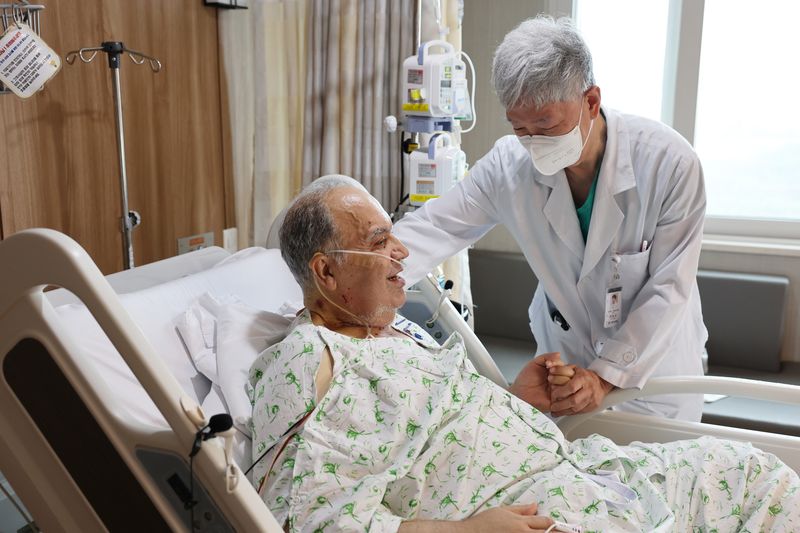
[Financial News] A Moroccan patient who had been too ill for even a liver transplant because of end-stage liver failure and advanced liver cancer has regained a new life through a "two-to-one living-donor liver transplant" in which portions of his two sons' livers were transplanted at the same time.
To save their father, the sons personally researched liver transplant centers around the world and chose Asan Medical Center. The Moroccan family then flew about 10,000 km to Korea.
The liver transplant team at the Organ Transplant Center of Asan Medical Center said on the 30th that it had successfully performed a two-to-one living-donor liver transplant for 64-year-old Mohamed El Ketani, who was suffering from end-stage liver failure and advanced liver cancer.
The surgery, performed on May 22, lasted about 17 hours, and both the recipient, Mohamed, and the two donors recovered smoothly.
Mohamed began suffering from hepatitis C about 20 years ago. He was cured of the infection through antiviral treatment 10 years ago, but long-term liver damage led to cirrhosis and liver failure. Even with about 85% of his liver damaged, he had managed to survive with the remaining liver tissue.
Then, while undergoing tests in France in late 2025 to register for a liver transplant waiting list, doctors discovered liver cancer. The initial tumor was treated with embolization, but a follow-up exam in February this year found a new 6 cm tumor. The tumor had invaded the intrahepatic portal vein and was progressing rapidly.
French medical staff determined that the cancer was highly likely to recur early after transplantation and excluded him from the transplant list. With no time to wait for a deceased-donor liver transplant, the only remaining option was a living-donor liver transplant.
At that point, his two sons stepped forward. Omar, the younger son who works as a cardiovascular surgeon in France, began reviewing research papers from major liver transplant centers around the world with his older brother, Hashim. They eventually found Asan Medical Center, which has extensive experience in living-donor liver transplantation.
Since its first liver transplant in 1992, Asan Medical Center became the first single medical institution in the world to reach 9,000 liver transplants in early 2025. It also performs about 400 living-donor liver transplants a year and has the world's largest experience in two-to-one living-donor liver transplants, with 664 cases.
Mohamed initially refused to travel to Korea because he was worried about his two sons donating part of their livers. But the sons persuaded him by emphasizing Asan Medical Center's experience and donor safety, and the three of them left for Korea in early April.
After detailed examinations at Asan Medical Center, the surgery presented several challenges. Mohamed weighed nearly 135 kg, making it difficult to secure enough liver volume with the liver from just one donor.
As a result, Asan Medical Center decided to apply the two-to-one living-donor liver transplant method, in which partial livers from two donors are transplanted. This technique is used when a single donor liver cannot provide enough graft volume or when the amount of liver left behind for donor safety must be considered.
The two-to-one living-donor liver transplant was first devised in 2000 by Lee Seung-gyu, distinguished professor in the Department of Liver Transplantation and Hepatobiliary Surgery at Asan Medical Center. The hospital has since performed 664 such procedures, the most in the world.
The younger son, Omar, also had a different blood type from his father. However, Asan Medical Center has performed more than 1,100 blood-type-incompatible liver transplants, allowing the team to overcome the blood-type mismatch during the transplant process.
The surgery began at 8 a.m. on May 22 in three operating rooms at the same time. The older son donated the left lobe of his liver, while the younger son donated the right lobe. For the donor operations, minimally invasive and laparoscopic techniques were used to reduce recovery time and postoperative burden.
Mohamed's surgery was carried out by distinguished professors Lee Seung-gyu and Moon Deok-bok. Because cirrhosis had significantly reduced the size of his liver and fluid had accumulated in his abdomen, and because the liver cancer was suspected of invading the portal vein, the team removed the entire liver using a no-touch technique to minimize stimulation of the tumor.
There were also difficulties during the transplant itself. The space below the patient's diaphragm was too narrow to accommodate the two donated livers. The medical team moved the right kidney downward to create room for the grafts and successfully transplanted both donors' liver portions.
The operation ended at 2 a.m. the next day, after about 17 hours. Although it was a highly complex procedure, Mohamed and his two sons all recovered stably and regained the condition needed to return to daily life.
Lee Seung-gyu, distinguished professor in the Department of Liver Transplantation and Hepatobiliary Surgery at Asan Medical Center, said, "The fact that the Moroccan family traveled all the way to Korea to save their father shows that the world recognizes the level of liver transplantation in our country." He added, "We will continue working so that patients with end-stage liver disease and liver cancer around the world can regain their health at Asan Medical Center and return to their home countries to begin new lives."
Omar said, "I was deeply impressed not only by the outstanding medical technology and hospital system, but also by the humane way the staff treated patients with genuine care." He added, "I would like to train at Asan Medical Center someday."
[email protected] Kang Jung-mo Reporter