Despite U.S. High Tariffs, China Advances: Expands Market Share in 40% of Major Global Product Categories
- Input
- 2026-07-30 09:38:18
- Updated
- 2026-07-30 09:38:18
[Financial News, Tokyo = Seo Hye-jin, correspondent] A survey found that Chinese companies increased their market share last year in about 40% of major global product and service categories, despite the high tariffs imposed by the Donald Trump administration. As Chinese firms continue to make gains not only in electric vehicles and batteries but also in digital products such as smartwatches and tablets, analysts say U.S. efforts to contain China have had only a limited effect.
On the 30th, Nikkei, Inc. surveyed the market shares of the top five companies in 67 product and service categories that are important to the global economy. Chinese companies ranked among the top five in 37 categories, and in 25 of them, or about 70%, they expanded their share. That accounts for roughly 40% of the total categories surveyed.
The United States had the largest number of No. 1 rankings, with 23 categories, though that was down from 27 the previous year. China rose by one to 19, while Japan also increased by one to 10.
The area where China’s share growth was most notable was electric vehicle batteries.
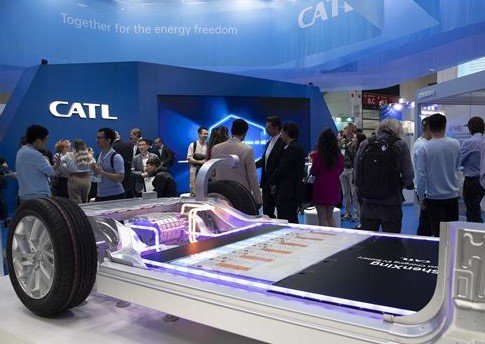
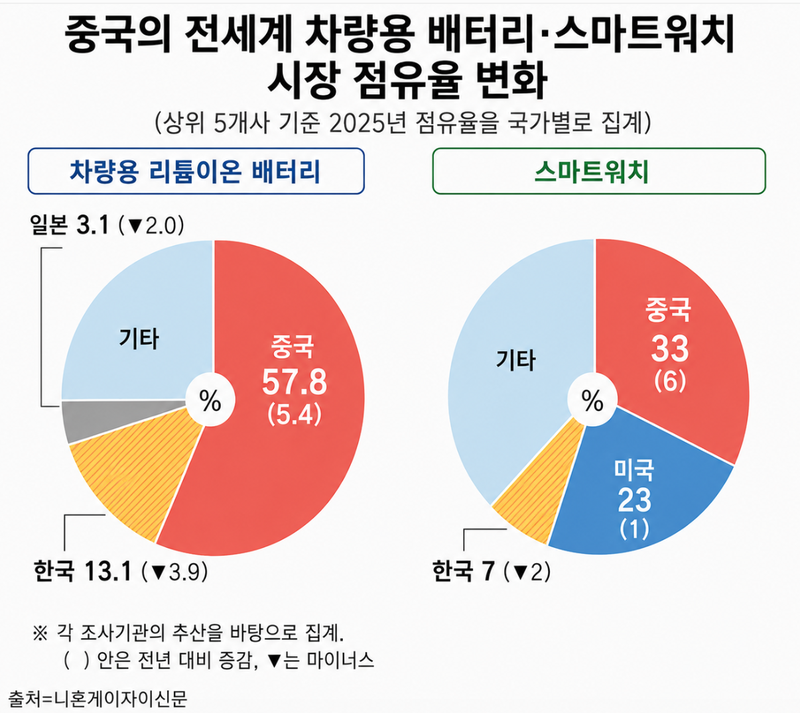
In the vehicle lithium-ion battery market, CATL held on to the top spot with a 40.8% share, up 4.2 percentage points from a year earlier, while BYD Company Limited (BYD) followed with 17.0%, up 1.2 points. In contrast, LG Energy Solution and Japan’s Panasonic Energy saw their shares decline. As a result, the combined share of Chinese companies rose 5.4 percentage points over the year to 57.8%.
In the electric vehicle market, BYD posted a 14.5% share, overtaking Tesla’s 11.3% to take the global No. 1 position. Geely Automobile, which ranked third, also increased its share. Although the United States’ 100% tariff has effectively blocked Chinese-made EVs from entering the U.S. market, Chinese companies are expanding overseas sales, especially in Asia. In Thailand, Chinese EV brands such as BYD have captured more than 20% of the market.
Chinese companies have also become more prominent in digital devices.
In the smartwatch market, Huawei raised its share to 17%, narrowing the gap with Apple, which remained No. 1 at 23%, to 3 percentage points. In the tablet market, Apple’s 35% share and Samsung Electronics’ 19% share were flat or lower, while Huawei, Lenovo Group Ltd. and Xiaomi each expanded their shares by 1 to 2 percentage points.
The number of product categories in which Chinese companies lost share fell to 11, down from 15 a year earlier. However, in the surveillance camera market, where four of the top five companies are Chinese, their combined share fell 1.9 percentage points amid security concerns and other issues.
Last year, U.S. President Trump imposed tariffs of as much as 145% on Chinese-made products at one point, but Chinese companies absorbed the blow by expanding exports to regions other than the United States. China’s trade surplus last year reached about $1.2 trillion, a record high.
By contrast, U.S. companies saw their shares decline in 26 of the 42 categories where an American company was among the top five. Competitiveness weakened not only in EVs but also in routers and servers. Japan increased its share in 12 categories, and its long-struggling shipbuilding industry also returned to growth.
Naotaka Sonoda, chief economist at PwC Consulting, said, "In China, many companies are being pushed out by excessive competition among firms, known as 'neijuan,' but the survivors are targeting the global market by improving both quality and price competitiveness."
Experts, however, said it remains unclear whether Chinese companies’ share gains will continue. Naoto Saito, a senior researcher at Daiwa Institute of Research, said, "Countries may strengthen safeguard measures to protect their domestic industries, which could slow the pace of China’s market share gains."
[email protected] Seo Hye-jin Reporter