"No Bottom in Sight"...KOSPI Faces Possibility of Falling Below 5,000
- Input
- 2026-07-30 08:02:34
- Updated
- 2026-07-30 08:02:34
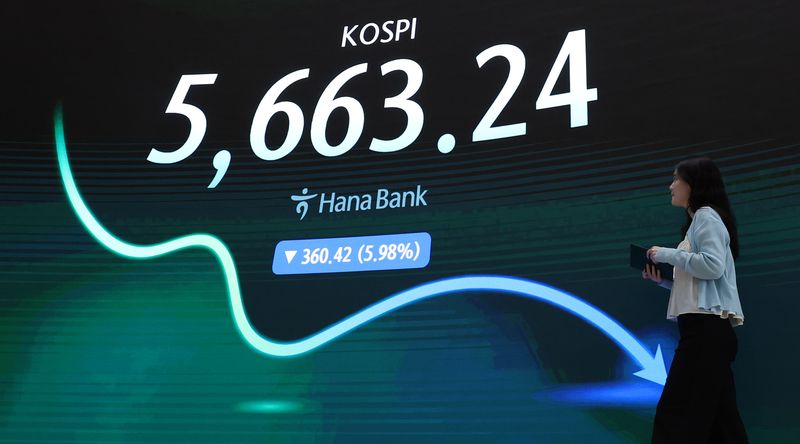
[Financial News] As the KOSPI plunged, some market forecasts have turned increasingly pessimistic. Even inside securities firms that had expected a rebound, some are saying, "No bottom is in sight."
According to the Korea Exchange on the 29th, the KOSPI ended the session at 5,663.24, down 5.98% from the previous close. At one point in the afternoon, the index fell as much as 12.63% to 5,262.77. A sell-side sidecar was triggered at around 10:55 a.m., and a circuit breaker was activated at 12:32 p.m.
The KOSDAQ also closed down 6.12% at 662.68. It opened 1.11% higher at 713.71, but quickly reversed course. During the session, it dropped as much as 10.61% to 630.99 and ultimately failed to recover the 700 level. In the KOSDAQ market, a sell-side sidecar was also triggered in the morning, and a circuit breaker was activated around noon.
Experts interpreted the recent market as a kind of capitulation phase, in which investors are dumping stocks despite taking losses. Han Ji-young, a researcher at Kiwoom Securities, said, "It seems the essence of this crash is that most stockholders are locking in losses and panic selling." She added, "As investor sentiment has cooled to the bone, doubts are widespread that the current index level is not the bottom."
Earlier, Goldman Sachs identified the 6,800 level on the KOSPI as a key support line that would shape the market's future direction in a report released on the 14th. At the time, Goldman Sachs warned that if 6,800 were broken, the next support would be 6,500, and if that level also gave way, the index could fall further to 6,000.
Now that the KOSPI has fallen below 6,000, those earlier support forecasts need to be revised. Some in the market also say the sharp decline was triggered by the strong debut of ChangXin Memory Technologies (CXMT), China's largest semiconductor company, on the Shanghai Stock Exchange (SSE), along with news that a Chinese state-owned firm is developing deep ultraviolet (DUV) lithography equipment.
As Chinese semiconductor firms rise, concerns are growing that the market dominance of Samsung Electronics and SK hynix could weaken. Combined with deteriorating investor sentiment, that has widened the losses.
"Be mindful of the risk of a sharp stock-price drop"...concerns over a downward break below the 5,300-5,700 range
Against this backdrop, DB Securities identified the 5,300-5,700 range as a key support zone for the KOSPI. In a report titled 'Scenario Response Based on the KOSPI Supply-Demand Crossover Zone' released on the 29th, Seol Tae-hyun, a researcher at DB Securities, said, "A strong supply wall has formed in the 5,300-5,700 range on the KOSPI." He added, "If continued downward pressure causes even this massive supply zone to break to the downside, investors should be aware of the risk of a short-term undershoot, or sharp price drop."
Seol focused on supply and demand by investor group rather than corporate earnings or valuation. He explained, "In supply-demand analysis, it is important to identify in advance the potential resistance zones and reversal points of major market participants." He added, "By precisely tracking structural changes in supply-demand flows, we can establish practical standards for risk management and entry timing."
On the other hand, he pointed to the 7,000-7,100 range as a short-term resistance zone, where the estimated average purchase prices of foreign and institutional investors are concentrated. If the index rises to that level, investors who have recovered their losses may sell, creating resistance.
Seol said, "The 7,000-7,100 point range is highly likely to act as a liquidation resistance zone during a technical rebound." He added, "As concerns ease, short covering and a shift to net buying by foreign investors could become turning points, so a strategy that sets 6,900-7,000 points as a short-term target is valid."
He went on to say, "If trading volume accompanies a strong breakout above the 7,100-point supply resistance zone in the future, it can be regarded as a signal of additional upside led by foreign and institutional investors, and the next profit-taking target can be raised to the 8,500-9,000 point range." He added, "We should make use of reversal signals in foreign investor flows that emerge at the 7,000-point resistance line and the 5,300-5,700 point support zone."
[email protected] Han Seung-gon Reporter