Despite the Fed's Rate Hold, Treasury Yields Surge... Market Says More Tightening Is Needed
- Input
- 2026-07-30 07:13:53
- Updated
- 2026-07-30 07:13:53
the Federal Open Market Committee (FOMC) maintained a hawkish hold stance." Even after the rate decision, markets sold off long-term U.S. Treasuries as they priced in the possibility of additional tightening, sending Treasury yields sharply higher.
Strong economy... rates held again
The Fed decided on the 29th, local time, to keep the benchmark rate unchanged at 3.50% to 3.75% after holding a meeting of the FOMC. It cited a solid economy and a stable labor market as the reasons for the decision.
the Federal Open Market Committee (FOMC) maintained a hawkish hold stance." Even after the rate decision, markets sold off long-term U.S. Treasuries as they priced in the possibility of additional tightening, sending Treasury yields sharply higher.
The Fed said that
the Federal Open Market Committee (FOMC) maintained a hawkish hold stance." Even after the rate decision, markets sold off long-term U.S. Treasuries as they priced in the possibility of additional tightening, sending Treasury yields sharply higher.despite high uncertainty stemming from the conflict in the Middle East, economic activity continues to expand at a solid pace." It said employment continued to rise steadily even as the labor force declined, and unemployment remained stable with little change. Still, with inflation remaining above target, the committee reaffirmed that it "will achieve price stability," while keeping its previous wording on inflation unchanged.
Three dissenting votes... hawkish voices grow louder
The officials who dissented in favor of a 0.25 percentage point rate hike at this FOMC meeting were Beth Hammack, president of the Federal Reserve Bank of Cleveland, Neel Kashkari, president of the Federal Reserve Bank of Minneapolis, and Lorie K. Logan, president of the Federal Reserve Bank of Dallas. The statement released after the meeting said they preferred raising the benchmark rate by 0.25 percentage point. They have repeatedly argued that additional tightening is needed given inflation that has remained above the Fed's 2% target for more than five years.
Kay Haigh, chief investment officer for fixed income and liquidity solutions at Goldman Sachs Asset Management, told CNBC that "having as many as three members vote against a rate hold shows that the Fed's internal hawkish tilt is strengthening" and that "the recent escalation in armed conflict in the Middle East may have reinforced that mood."
the Federal Open Market Committee (FOMC) maintained a hawkish hold stance." Even after the rate decision, markets sold off long-term U.S. Treasuries as they priced in the possibility of additional tightening, sending Treasury yields sharply higher.
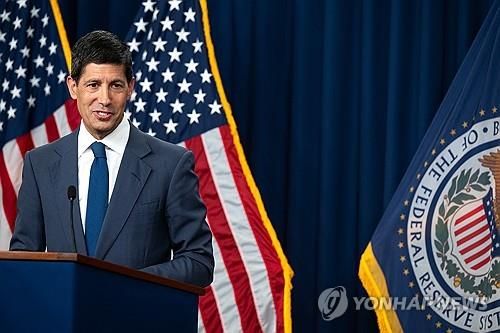
At a press conference that day, Chair of the Federal Reserve Kevin Warsh described the FOMC as a "good family fight." He stressed that while there were differences over the rate decision, members broadly shared the same goal of price stability and the policy direction needed to achieve it. He added, "This meeting has increased my confidence that we are a team that can win the fight against inflation."
the Federal Open Market Committee (FOMC) maintained a hawkish hold stance." Even after the rate decision, markets sold off long-term U.S. Treasuries as they priced in the possibility of additional tightening, sending Treasury yields sharply higher.Differences in views on the path of rates were also clear inside the Fed. John Williams, president of the Federal Reserve Bank of New York (FRBNY), said current monetary policy alone could bring inflation back to target. By contrast, Logan said "a modest additional rate increase is needed," while Hammack has also emphasized the need for tighter policy, saying persistent price increases are weighing on households.
Bond market warns the Fed
In the bond market, long-term Treasury yields surged after Warsh's press conference as investors priced in the possibility of further tightening. The yield on the 30-year U.S. Treasury rose 0.11 percentage point from the previous session to 5.21% shortly after the close of the New York stock market, the highest level since July 2007. The benchmark 10-year U.S. Treasury yield, the global benchmark for bond yields, also touched 4.7% intraday, rising by nearly 0.1 percentage point.
Experts interpreted the move as a signal that the bond market is demanding a stronger response to inflation from the Fed. The analysis is that the so-called Bond Vigilantes sold U.S. Treasuries to test the Fed's commitment to fighting inflation.
Jeffrey Gundlach, CEO of DoubleLine Capital, told CNBC that day, "If you really want to reach the 2% inflation target, I think you need to raise rates."
the Federal Open Market Committee (FOMC) maintained a hawkish hold stance." Even after the rate decision, markets sold off long-term U.S. Treasuries as they priced in the possibility of additional tightening, sending Treasury yields sharply higher.
the Federal Open Market Committee (FOMC) maintained a hawkish hold stance." Even after the rate decision, markets sold off long-term U.S. Treasuries as they priced in the possibility of additional tightening, sending Treasury yields sharply higher.
the Federal Open Market Committee (FOMC) maintained a hawkish hold stance." Even after the rate decision, markets sold off long-term U.S. Treasuries as they priced in the possibility of additional tightening, sending Treasury yields sharply higher.
the Federal Open Market Committee (FOMC) maintained a hawkish hold stance." Even after the rate decision, markets sold off long-term U.S. Treasuries as they priced in the possibility of additional tightening, sending Treasury yields sharply higher.
[email protected] Lee Byung-chul Reporter