[Editorial] Urgent Need to Restore Order to a Stock Market That Has Turned Into a Gambling Pit After Rallying Cries
- Input
- 2026-07-29 18:35:35
- Updated
- 2026-07-29 18:35:35
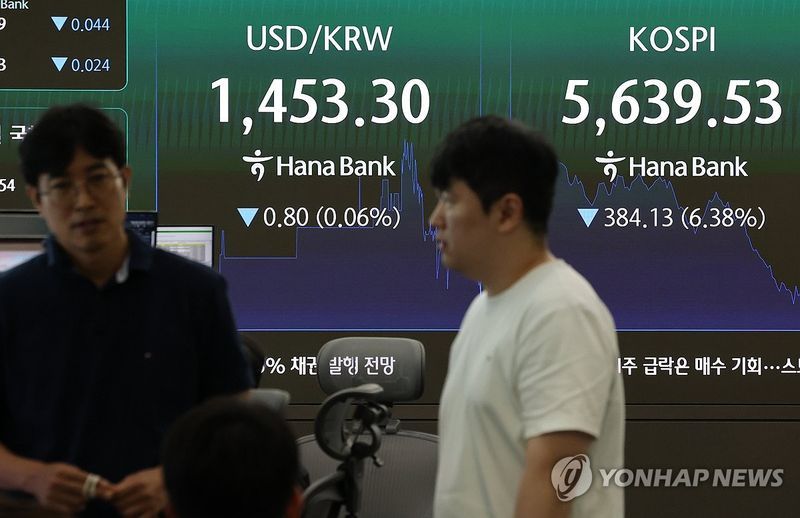
Above all, market volatility has gone too far. Of the last 13 trading days, sidecar was triggered on 12 in the KOSPI and KOSDAQ (Korea Securities Dealers Automated Quotations) markets. As soon as trading opened, sidecar was activated, and in more severe cases, the circuit breaker mechanism was also triggered. Even those safeguards failed to stabilize the market. Critics are now saying the stock market has become a gambling pit. Retail investors who sold U.S. stocks and returned to the domestic market in April and May are heading back to the U.S. market again. Foreign investors, too, have net sold nearly 200 trillion won worth of KOSPI shares this year alone.
The recent plunge stems from concerns over overheated artificial intelligence investment by U.S. big tech firms and intensifying competition as China's semiconductor technology advances rapidly. In the market, the government’s excessive efforts to prop up stocks are also being cited as one cause. The Lee Jae Myung administration pushed a 'productive finance' policy aimed at redirecting funds concentrated in real estate into the capital market to foster advanced industries. The direction was right, but the pace was too fast.
Examples include the expansion of the National Pension Service (NPS)'s limit on domestic stock investments and the introduction of leveraged exchange-traded funds (leveraged ETFs) tied to Samsung Electronics and SK hynix. With the two semiconductor giants accounting for more than 50% of KOSPI, allowing single-stock leverage without sufficient review has drawn criticism for being hasty. The NPS also now exceeds its target allocation for domestic stocks, making it difficult to expect it to play its former role as a 'savior in falling markets.'
The government appears to see things differently. Kim Yong-beom, Chief Presidential Secretary for Policy, who is accompanying President Lee Jae Myung on a state visit to Brazil, said that 'it was not just us' and noted that stock markets around the world moved together. He added, 'It is not all because of leveraged ETFs,' pointing to the structure of the domestic market and the share of financial derivatives as contributing factors. That is not an unreasonable assessment. The structural weakness of the derivatives market has long been a problem. Still, it is hard to deny that leveraged ETFs acted as a catalyst that amplified those weaknesses.
The government has already responded with one round of corrective measures. President Lee also instructed officials to prepare additional steps. To revise and supplement policy, the first step is to acknowledge its limits. Only then can more precise measures emerge. Authorities are currently considering a plan to cap individual investment in single-stock leveraged products at 20%. Even so, some leveraged ETFs plunged nearly 30% in a single day on the 28th. Compared with their peak, they have fallen more than 70%.
Market reform is also urgently needed. The capital market must be transformed into a place where household wealth and corporate growth advance together, not a gambling table for short-term retail trading and speculative financial derivatives. The base of institutional investors focused on long-term investment should be expanded, and among individual investors, a culture that is not swayed by short-term swings must take root. A rise in stock prices without structural reform is nothing more than a mirage. Shedding the stigma of 'Roller KOSPI' is the true starting point for revitalizing the stock market.