Lee Eok-won Says He Takes Responsibility Seriously, Warns of Further Measures if the Market Does Not Stabilize [Is There a Leverage Policy?]
- Input
- 2026-07-29 18:31:44
- Updated
- 2026-07-29 18:31:44
■Reviewing limits on trading to professional investors
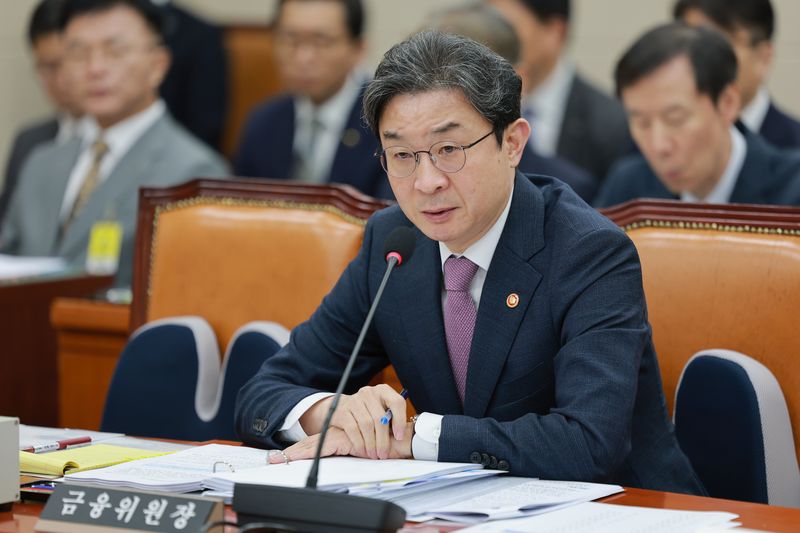
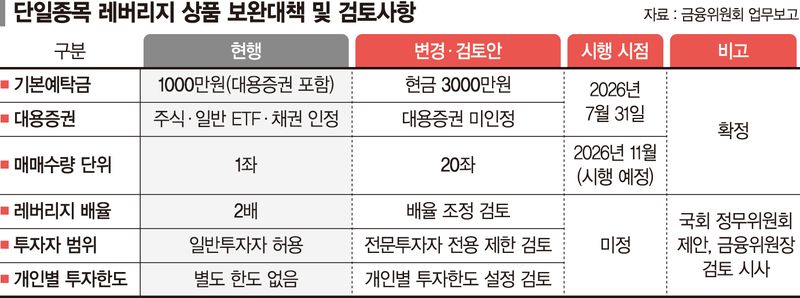
At a plenary session of the National Policy Committee on the 29th, Lee Eok-won, Chairperson of the Financial Services Commission, responded to a question from Democratic Party of Korea lawmaker Kim Hyun-jung about single-stock leveraged products, saying, "Adjusting leverage ratios would likely help reduce volatility." He added, "We will also consider additional measures, such as allowing new purchases only for professional investors and setting individual investment limits."
Lee said the recent rise in market volatility was "the result of multiple factors, including uncertainty in the global semiconductor industry," but added, "We acknowledge that the rebalancing process for single-stock leveraged products has had a significant impact on market volatility."
When asked whether the introduction of single-stock leveraged products and the response measures came too late, he replied, "It took time to gather expert opinions and prepare the measures." He added, "We are taking the current situation very seriously and will strengthen the supplementary measures."
Lee Chan-jin, Governor of the Financial Supervisory Service, also addressed criticism that the financial authorities should be held responsible for the heightened market volatility, saying, "The Financial Supervisory Service is also taking this responsibility seriously, and we will do our utmost to minimize volatility."
Among the supplementary measures announced on the 16th, the financial authorities will bring forward the strengthened basic deposit requirement and begin enforcing it from the 31st. Investors seeking to buy single-stock leveraged products will have to meet a 30 million won cash deposit requirement, up from the previous 10 million won threshold that could include cash, stocks, ETFs, and bonds. Substitute securities such as stocks, regular ETFs, and bonds will not be accepted. The authorities also plan to address the problem of institutional investor, liquidity provider, and asset management company rebalancing orders clustering near the end of the trading session.
Around November, the authorities plan to expand the trading unit for domestic single-stock leveraged products from one unit to 20 units. They will also tighten the domestic ETF tracking error management standard for LPs from the current 3% to 2%, and establish a basis for restricting new LP duties if intentional misconduct or gross negligence is confirmed. They are also considering limiting new ETF listings for fund managers that violate the appropriate tracking error threshold.
■Focused review of structural factors behind stock market volatility
According to the report submitted by the Financial Supervisory Service to the National Policy Committee, 16 single-stock leveraged products based on Samsung Electronics and SK hynix were launched on May 27, and by the 21st of this month, cumulative net buying by individual investors had reached 14.1 trillion won. Of the combined net buying of 16.3 trillion won by individual, foreign, and other investors, individuals accounted for about 87%. Over the same period, institutional investors posted net sales of 16.3 trillion won.
The average daily trading value of single-stock leveraged products was 11.8 trillion won, equal to 49.1% of the 24.1 trillion won average daily trading value of Samsung Electronics and SK hynix common shares. The average daily turnover rate was 107.9%.
However, Kim Yong-beom, Chief Presidential Secretary for Policy, drew a line on the issue, saying that the recent instability in the domestic stock market, which has seen sharp declines day after day, means that "we need to examine the overall situation, not just single-stock leveraged products."
Speaking to reporters at a press center in São Paulo on the same day, Kim, who is accompanying President Lee Jae Myung on a state visit to Brazil, said, "The market is being affected because the debate over the future of semiconductor and artificial intelligence stocks continues." He added, "The Financial Services Commission and the Financial Supervisory Service will look into the structural factors behind the unusually pronounced volatility in the Korean stock market."
[email protected] Reporter