Worst Crash on Record... Retail Investors Gripped by Fear Dumped 3 Trillion Won [Second Day of Panic in the Stock Market]
- Input
- 2026-07-29 18:31:30
- Updated
- 2026-07-29 18:31:30
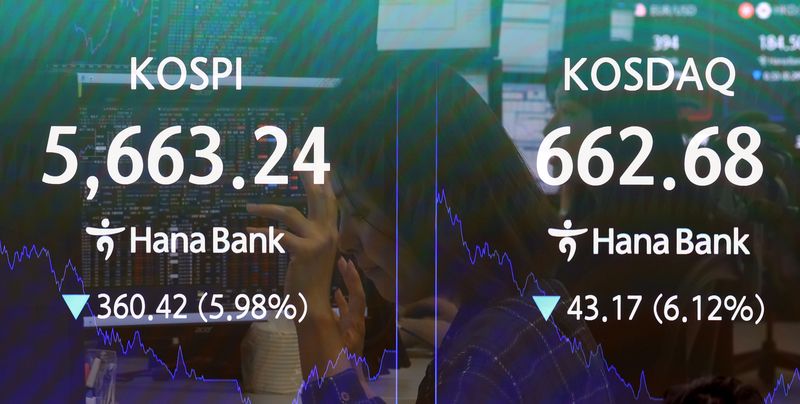
At one point, it fell to 5,262, the lowest level in four months
According to the Korea Exchange on the 29th, the KOSPI has plunged 34.08% so far this month. During intraday trading, it dropped as low as 5,262.77, marking its lowest level in about four months. Based on the intraday low, the index was down 38.75% for the month. For the first time ever, circuit breaker mechanism was triggered on both the KOSPI and KOSDAQ for two consecutive days, underscoring the extreme volatility.Retail investors have traditionally stepped in to absorb foreign selling during sharp declines. On the 24th, when foreigners sold a net 326.83 billion won, individual investors bought a net 517.82 billion won. On the 27th, they also bought 197.88 billion won while foreigners sold 288.11 billion won. But on this day, individuals turned to net selling of about 300 billion won, suggesting that bargain-hunting sentiment also weakened.
Brokerage analysts say the recent plunge is driven less by isolated negative news than by distorted supply-demand conditions and a collapse in investor confidence. Concerns over a slowdown in the semiconductor cycle, tensions between the U.S. and Iran, and the possibility of higher U.S. interest rates all surfaced at once, but analysts say none of them alone can explain the recent slide. As the index falls further, more investors rush to cut losses, which in turn pushes prices down again and creates a vicious cycle.
Cho Suhong, head of the research center at NH Investment & Securities, explained, "In a situation where there is no single clear negative factor, supply and demand have been driving the market rather than fundamentals." He added, "Repeated sharp declines have weakened investor sentiment, pushing volatility to a level that exceeds what was seen during the financial crisis."
The losses were also amplified by a wave of foreign selling and leveraged-product selling at a time when trading participation was already weak. Analysts said the decline was further intensified by the structure of single-stock leveraged Exchange-traded fund (ETF)s, which force additional selling of the underlying assets in a falling market. Yang Ji-hwan, head of the research center at Daishin Securities, said, "Foreign selling intensified as trading value fell amid a wait-and-see mood ahead of leveraged product liquidations and the implementation of basic deposit regulations." He added, "With mechanical selling layered on top, the market reacted far more strongly than the size of the negative news would suggest."
The sharp drop in semiconductor stocks is seen as reflecting weaker confidence in future earnings rather than an immediate decline in profits. The market is lowering the valuation it assigns to future earnings for Samsung Electronics and SK hynix, reflecting concerns over possible memory capacity expansion by Chinese companies and worries that AI investment may have peaked.
Jonghyung Lee, head of the research center at Kiwoom Securities, said, "Semiconductor profits are still rising, but concerns over a memory peak and debate over AI investment cuts have undermined confidence in future earnings."
Stocks have fallen too far relative to corporate earnings, raising hopes for a rebound
However, some analysts say the recent losses have been excessive compared with the scale of downward revisions to earnings estimates, suggesting that share prices could recover in the months ahead. Park Yeon-ju, head of the AI research center at Mirae Asset, said, "If supply-demand pressures ease and excessive concerns about the sustainability of AI investment and Chinese expansion subside, the market could recover."Whether the market rebounds will likely depend on earnings from domestic semiconductor companies and U.S. Big Tech. Investors are watching to see whether the results of Big Tech's AI investments can help remove uncertainty over the semiconductor industry and support a broader recovery.
[email protected] Bae Hangeul Reporter