Stock Market in 'Panic Selling' as 921 Trillion Won Wiped Out in Two Days [Second Day of Market Panic]
- Input
- 2026-07-29 18:31:27
- Updated
- 2026-07-29 18:31:27
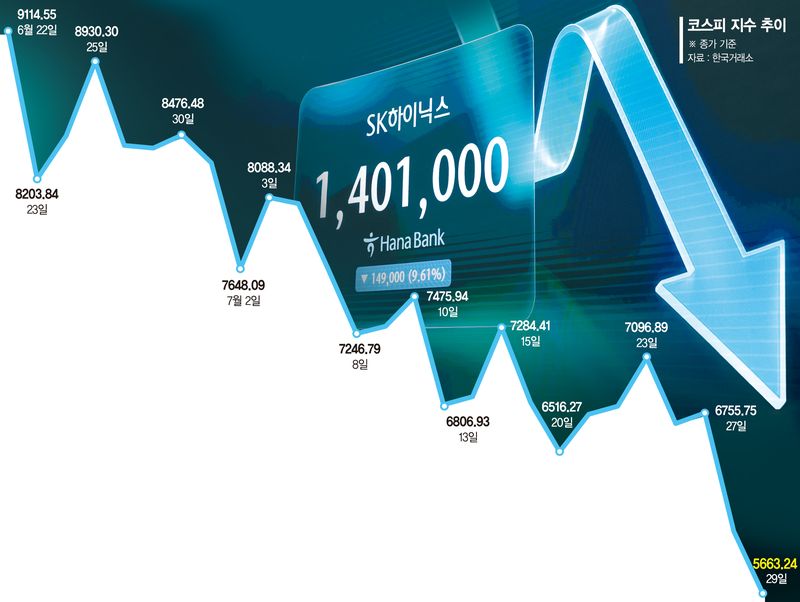
According to the Korea Exchange on the 29th, the KOSPI closed at 5,663.24, down 5.98% from the previous session, while the KOSDAQ ended at 662.68, down 6.12%. Selling pressure intensified from the opening bell, triggering sidecars on both markets in the morning. When losses widened beyond 8%, circuit breaker mechanisms were activated in the afternoon, briefly halting trading. On the Korea Exchange Main Board, a sidecar was triggered at 10:55 a.m., and on the KOSDAQ market at 10:56 a.m. The first-stage circuit breaker mechanism was then activated on the KOSDAQ market at 12:19 p.m. and on the Korea Exchange Main Board at 12:32 p.m. It was the first time circuit breaker mechanisms had been triggered on both the KOSPI and KOSDAQ for two consecutive days. A circuit breaker mechanism is a market stabilization tool that suspends trading in all stocks for 20 minutes if the KOSPI or KOSDAQ falls 8% or more from the previous day for at least one minute. After trading resumes, a single-price auction is conducted for 10 minutes.
The latest circuit breaker activation came a day after the previous one. On the prior day, the KOSPI and KOSDAQ plunged 10.84% and 7.72%, respectively, and circuit breaker mechanisms were triggered on both markets at the same time. Based on Korea Exchange records, this was also the first time the two markets had both seen circuit breaker mechanisms activated on consecutive days.
The circuit breaker on the Korea Exchange Main Board was triggered for the 15th time in history and the ninth time this year. For the KOSDAQ, it was the 14th time overall and the fourth this year. The KOSDAQ has previously seen consecutive activations, including during the Global Financial Crisis (GFC) in 2008 and when the United States was downgraded in 2011. But there has never been a case in which both the KOSPI and KOSDAQ halted trading on the same two consecutive days.
The shock was also evident in the scale of the market-capitalization losses. The KOSPI's market value fell from 5,533.6 trillion won on the 27th to 4,669.1 trillion won on the 29th, a drop of about 864.5 trillion won. The KOSDAQ lost about 56.5 trillion won over the same period, falling from 425.2 trillion won to 368.7 trillion won. Combined, the two markets shed roughly 921 trillion won in just two days. That is equivalent to about one-third of last year's nominal GDP (Gross Domestic Product).
Brokerages said the sharp drop was not simply the result of profit-taking. Instead, they said investor sentiment deteriorated rapidly as adjustments to expectations for the semiconductor industry coincided with external uncertainties. Experts said selling pressure centered on semiconductors, the market's leading sector, quickly spread from large-cap stocks to mid- and small-cap names.
Kang Jin-hyuk, senior researcher at Shinhan Investment & Securities, said, "SK hynix posted results that beat market expectations, but it failed to meet the heightened bar. It also disappointed investors in its conference call on shareholder returns, which widened the sell-off." He added, "Weakness in U.S. semiconductor stocks and geopolitical risks in the Middle East fueled a broader wave of panic selling centered on semiconductors."
Kim Joo-yeon, a researcher at Mirae Asset Securities, said, "The domestic market opened with gains, but gave back all of them. In the semiconductor sector as well, volatility stood out more than bargain hunting after the steep decline." She added, "Risk-off sentiment across the market still appears to be strong."
[email protected] Choi Du-seon Reporter