Stocks That Rose the Most Fell the Hardest: Large Caps Plunge 34% This Month
- Input
- 2026-07-29 18:24:16
- Updated
- 2026-07-29 18:24:16
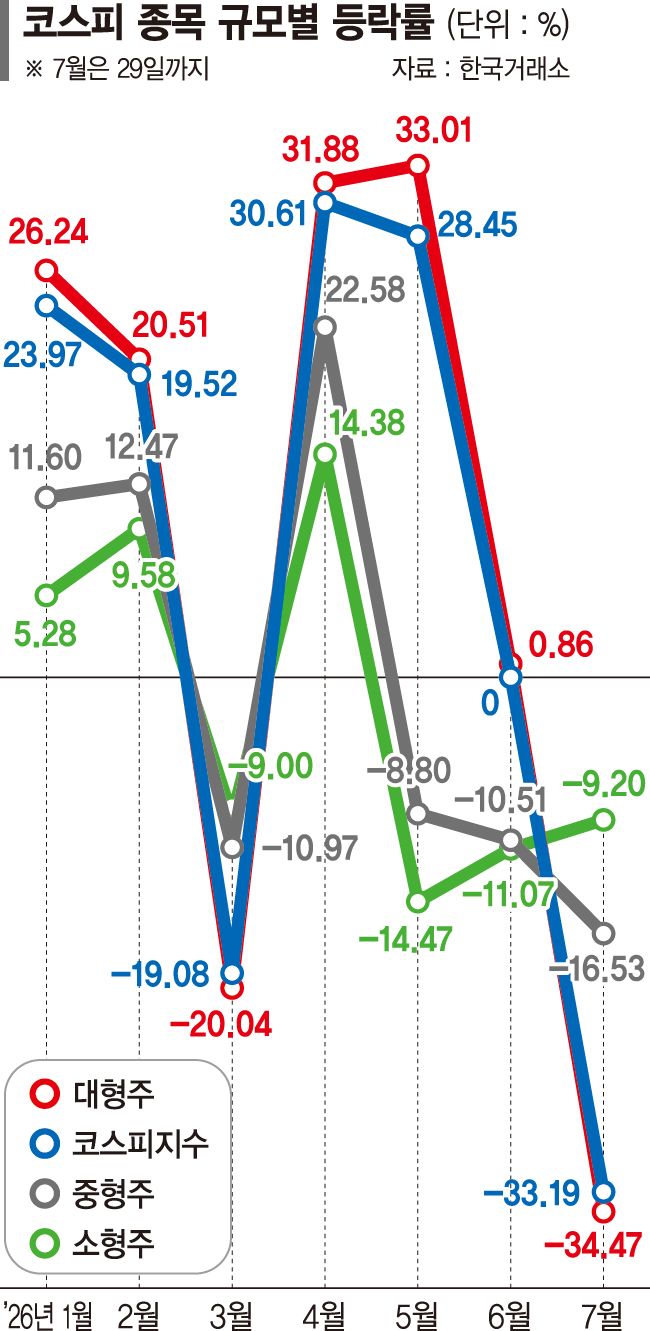
According to the Korea Exchange on the 29th, KOSPI large-cap stocks had plunged 34.47% so far this month, a much steeper decline than mid-cap stocks (-16.53%) and small-cap stocks (-9.20%). In the first half of this year alone, large caps surged 115.22%, while mid-cap stocks rose just 11.79% and small caps fell 8.67%. On a monthly basis, the gap widened further in May, when large caps jumped 33.01% while mid-cap and small-cap stocks fell 8.80% and 14.47%, respectively.
The reasoning is that large caps rose much more during the rally, so they are now seeing a deeper correction as profit-taking orders pile up in a falling market. In March, when the market swung on the Middle East conflict, large caps also dropped 20.04%, far more than mid-cap stocks (-10.97%) and small-cap stocks (-9.00%).
This month, the biggest drag came from the leading semiconductor names. As uncertainty mounted over geopolitical risks, interest-rate hikes and other factors, and as noise surrounding semiconductors continued, the correction was especially severe in large-cap names such as Samsung Electronics and SK hynix.
Concerns that semiconductors have already peaked spread as doubts grew over whether Big Tech companies in the United States could sustain their AI capital spending. Although the expansion in capital investment has been confirmed, worries have emerged over whether they can keep investing as cash reserves shrink. The tightening environment for bond issuance and other financing has also deepened those concerns.
As investor sentiment deteriorated, risks from China triggered a sell-off. Market caution intensified after ChangXin Memory Technologies (CXMT), China’s largest DRAM maker, successfully listed on the SSE, and after reports that a state-owned Chinese company had begun mass production of deep ultraviolet (DUV) lithography equipment for semiconductor manufacturing.
Even taking those concerns into account, brokerage analysts say the market has entered oversold territory. The KOSPI 12-month forward price-to-earnings ratio is around 5 times, below the 6.27 times low seen during the global financial crisis, suggesting valuations have fallen too far.
Han Ji-young, an analyst at Kiwoom Securities, said, "Even if concerns remain about a memory peak, Chinese competitors gaining market share, and the Federal Reserve's rate hikes, the market is clearly in oversold territory." She added, "Given current valuations, it is reasonable to see the KOSPI as being in a zone where it is trying to find a bottom."
Kim Dong-won, Head of Research at KB Securities, said, "Big Tech companies in the United States believe that underinvestment in AI is a greater risk than overinvestment. If they have enough financial capacity, they are likely to continue investing in AI infrastructure for years, even if that means increasing external borrowing." He added, "Industrial bubbles have typically formed only after investment reached 5% to 7% of U.S. GDP. This year's figure is just 2.5%, so it is still too early to talk about a bubble."
He also said, "Samsung Electronics and SK hynix have already been cut in half from their peaks, and their 12-month forward PER has fallen below 4 times, meaning much of the concern is already priced in." He added, "This correction is an extreme drop driven by sentiment rather than fundamentals, and it could instead become the foundation for a strong rebound."
Still, some say a recovery in stock prices will be difficult unless liquidity conditions improve, given the sharp deterioration in investor sentiment. Kim Seok-hwan, an analyst at Mirae Asset Securities, said, "It is difficult to judge a trend reversal based on a low PER alone. What matters now is not whether valuations fall further, but whether semiconductor earnings forecasts and liquidity conditions stabilize." He added, "A short-term rebound on oversold conditions is possible, but that does not mean the trend has reversed."
[email protected] Reporter Seo Min-ji Reporter