Foreign Visitors Spent 5 Trillion Won in Seoul, Shopping in Myeong-dong and Getting Procedures in Gangnam
- Input
- 2026-07-29 18:17:45
- Updated
- 2026-07-29 18:17:45
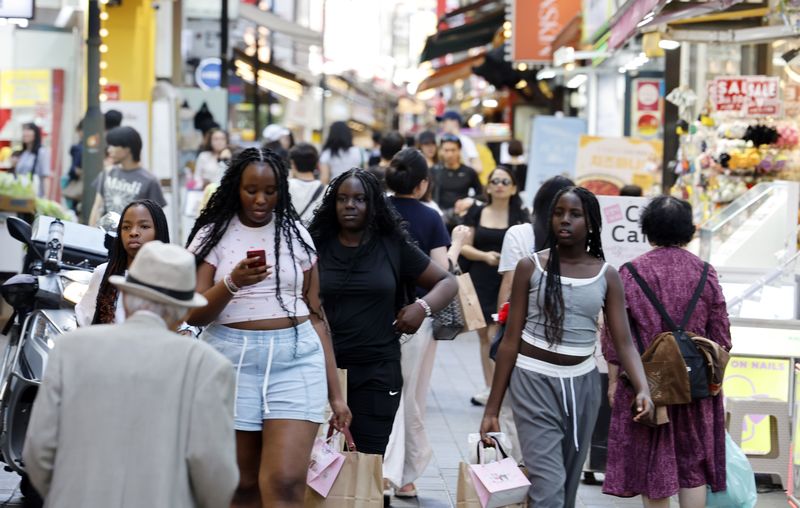
According to the Seoul Metropolitan Government on the 29th, the number of foreign tourists who visited Seoul from January to June rose 21.3% from a year earlier. By nationality, China ranked first with 2.47 million visitors, followed by Japan with 1.5 million, Taiwan with 880,000, and the United States with 620,000.
During the same period, foreign tourists' card spending rose 56.8% from a year earlier. Monthly card spending first exceeded 1 trillion won in April and then stayed above that level for three straight months in May and June.
The increase in spending has been even steeper than the rise in tourist arrivals. The city said more visitors are not just touring major attractions, but are also directly experiencing Seoul's culture and daily life through K-content, festivals, the Han River, and food, beauty, and wellness offerings. It added that their length of stay and spending opportunities have expanded as well.
By sector, shopping accounted for 46.4% of total card spending, the largest share. Medical and wellness services followed at 24.4%. Together, the two sectors made up 70.8% of total spending, showing that shopping and medical and wellness services are the two main pillars of foreign tourist spending in Seoul. Food and beverage accounted for 13.1%, while lodging made up 10.7%.
Spending rose sharply across major sectors. Spending at large shopping malls jumped 73.2% from 706.3 billion won in the first half of last year to 1.2234 trillion won this year, marking the biggest increase.
Medical tourism spending rose 63.3% from 556.3 billion won to 908.4 billion won. Restaurant spending increased 54.5% from 378.2 billion won to 584.3 billion won, while beauty-related spending climbed 40.0% from 331.1 billion won to 463.7 billion won.
By district, Gangnam District accounted for 29.3% of all foreign card spending, the largest share. Jung District, Seoul, followed with 28.4%, and Seoul Hongdae with 7.3%. The three areas together accounted for 65.0% of total spending.
The city said the trend shows that foreign visits and spending are spreading. It added that Myeong-dong, Dongdaemun, and the Gangnam area are forming the core of shopping and medical tourism, while areas such as Hongdae and Seongsu-dong offer visitors a chance to experience Seoul's everyday life and local culture.
The Han River is also evolving into a stay-oriented tourism space that combines performances, festivals, transportation, and hands-on experiences. The Seoul Spring Festival 2026, which expanded its event areas across the Han River, drew 7.06 million visitors, including 1.17 million foreigners. Sales at businesses located at Hangang Bus piers also rose 257% from a year earlier during the event period.
In the second half of the year, the city plans to extend foreign tourists' stay into the night through efforts to boost the night economy. To turn the increase in visitor numbers into real tourism revenue and local economic growth, it will also accelerate the development of high-value tourism industries such as medical tourism, MICE, and premium tourism.
In the medical tourism sector, the city will build a one-stop platform linking medical services, visas, lodging, and tourism. It will also expand the number of medical tourism interpretation coordinators from 108 to 1,000.
It also plans to expand bleisure tourism programs for MICE visitors and nurture the premium tourism sector. At Explore Seoul with Connections, luxury tourism buyers from 11 countries took part and completed a total of 620 business consultations.
Cho Seong-ho, director of the Seoul Metropolitan Government's Tourism and Sports Bureau, said, "As the number of foreign tourists visiting Seoul continues to rise steadily, we will keep expanding diverse tourism content to sustain the growth of Seoul tourism." He added, "In the second half of the year, we will more closely link experiential tourism content with local commercial districts so that visitors can enjoy Seoul in every corner of the city and the benefits can spread to neighborhood businesses and the broader local economy."
[email protected] Lee Chang-hoon Reporter