"Samsung Electronics Falls Below 200,000 Won, SK hynix Below 1.3 Million Won"...Retail Investors Left Reeling After Two Straight Days of Plunges
- Input
- 2026-07-30 04:40:00
- Updated
- 2026-07-30 04:40:00
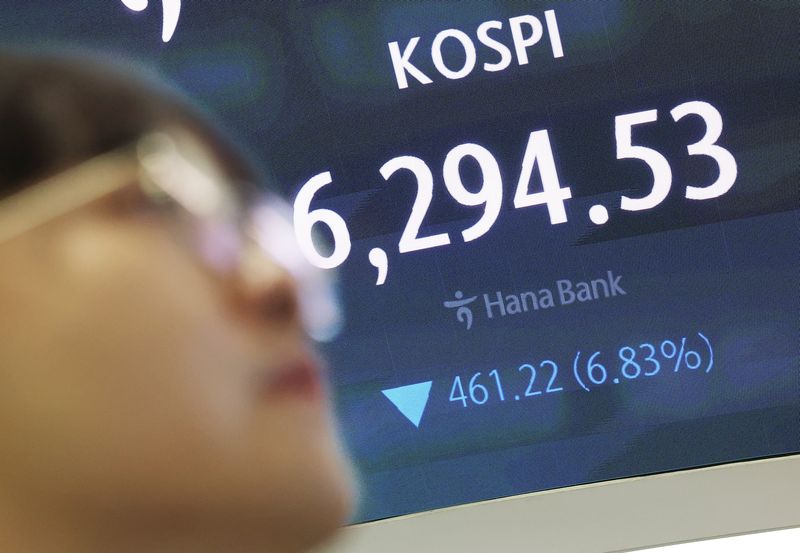
[Financial News] The domestic stock market saw a severe panic-driven session, with circuit breaker mechanisms being triggered on both markets for two consecutive days amid a plunge in semiconductor heavyweights and weakening investor sentiment. As volatility reached extreme levels, questions are also growing over the effectiveness of the market's safety device, the sidecar.
According to the Korea Exchange on the 29th, the KOSPI and KOSDAQ (Korea Securities Dealers Automated Quotations) markets opened higher in early trading, but then reversed sharply as heavy selling hit semiconductor stocks. The circuit breaker mechanism was activated in the KOSDAQ market at 12:19 p.m. and then in the KOSPI market at 12:32 p.m. It was the first time in history that circuit breakers were triggered on both markets for two straight days since the stock market opened.
At one point during the session, the KOSPI plunged more than 11% to 5,262.77. It later recovered some of its losses as bargain hunting emerged, and by 2 p.m. it was trading around the 5,600 level, down about 7% from the previous day. Institutions stepped in with net purchases worth 2.7 trillion won, but that was not enough to offset the combined selling by retail investors, who sold 1.9 trillion won, and foreigners, who sold 840 billion won.
At the center of the market rout were the semiconductor leaders. SK hynix, which announced record-high earnings that day, plunged more than 17% intraday and fell below the 1.3 million won mark. Samsung Electronics also dropped 11%, slipping below 200,000 won. The previous night's sharp declines in major memory chip companies on Wall Street, including Micron (-8.85%) and SanDisk (-14.25%), further dampened investor sentiment in the domestic market.
Experts say the selloff was driven by a combination of weaker-than-expected earnings, external uncertainty, and panic selling by investors.
Kang Jin-hyuk, a senior analyst at Shinhan Investment & Securities, said, "SK hynix's second-quarter results fell short of market expectations, and disappointment over shareholder return policies in the conference call added to the pressure." He added, "Uncertainty over U.S.-Iran talks and caution ahead of the Federal Open Market Committee (FOMC) also weighed on investor sentiment."
Han Ji-young, an analyst at Kiwoom Securities, said, "The essence of the selloff was that hopes for a rebound after the previous day's plunge faded, prompting a wave of forced selling to lock in losses." Josh Gilbert, chief analyst at eToro, also noted that "SK hynix increased capital spending but stayed silent on shareholder returns and long-term contract pricing, which heightened investor anxiety," pointing to the structural vulnerability of the KOSPI, which is heavily concentrated in large-cap stocks.
Meanwhile, as the market continues to tumble day after day, criticism is also mounting over the usefulness of the sidecar, the market's safety mechanism. A sell-side sidecar was triggered in both the KOSPI and KOSDAQ markets earlier in the day. The sidecar is a system that suspends the effectiveness of program trading orders for five minutes when futures prices swing sharply, in order to ease the shock transmitted to the spot market.
This year alone, the sidecar has been triggered 41 times on the KOSPI and 24 times on the KOSDAQ, setting new records. Still, it is being criticized for showing clear limits in controlling market volatility. That is because the sidecar only temporarily breaks the automatic downward spiral between the futures and spot markets, and cannot stop ordinary retail trading or the broader market downtrend itself.
Experts say the entire market stabilization framework needs to be redesigned to fit the changed market environment. Kim Dae-joon, chief analyst at Korea Investment & Securities, said, "A market where the sidecar is triggered all the time cannot be considered normal." He added, "It is time for practical emergency measures, such as a stock market stabilization fund or a temporary ban on short selling, that can curb panic selling and one-sided trading."
[email protected] Moon Young-jin Reporter