The U.S. has now blocked even Chinese robots... The AI supremacy battle expands into humanoids
- Input
- 2026-07-29 11:49:56
- Updated
- 2026-07-29 11:49:56
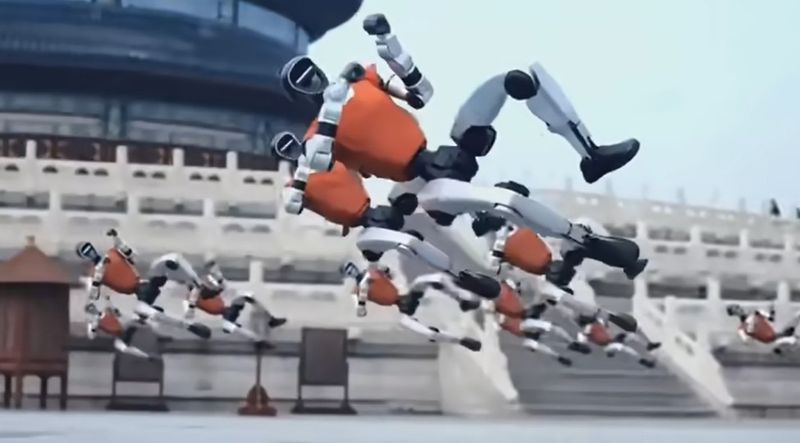
[Financial News] The United States has imposed a sweeping ban on new imports of humanoid robots, Quadruped Robots, and power inverters. The move goes beyond restrictions on Chinese semiconductors and AI chips, extending control to Embodied AI hardware and the power infrastructure that supports data centers. As Washington sees the core of the AI race shifting from semiconductors to robots and power grids, analysts say pressure on China's advanced manufacturing sector is likely to intensify.
"Blocking the body after the AI brain"... humanoid robots and inverters face simultaneous regulation
The Federal Communications Commission (FCC) announced on the 28th, local time, that it would ban new imports of advanced robots, including humanoid robots and Quadruped Robots. Power inverters that connect renewable energy facilities and batteries to the electrical grid and data center systems were also added to the same regulatory scope.
The FCC said advanced robots could collect video footage, location data, and other sensor information that foreign intelligence agencies might exploit. It also warned that hackers could remotely control robots or use them to disrupt industrial facilities. Power inverters, it added, could become a channel for grid disruption and attacks on data centers through remote access.
FCC Chairman Brendan Carr said, "This is a measure to protect America's key supply chains under the leadership of President Donald Trump," adding, "We will work with national security agencies to protect America's critical infrastructure."
Although the measure does not name any specific country, it is widely seen as targeting Chinese companies. In particular, Unitree Robotics, one of the global leaders in the humanoid robot market, is expected to be directly affected.
According to market research firm Counterpoint Research, Unitree Robotics holds nearly 20% of the global humanoid robot market. The company has also recently teamed up with NVIDIA to develop next-generation robots equipped with the NVIDIA Blackwell architecture AI chip.
Chinese inverter makers such as Huawei and Sungrow are also likely to fall under the restrictions. Chinese companies already dominate the global solar and battery inverter market, and the latest move is expected to affect efforts to reshape the supply chains for U.S. AI data centers and power infrastructure.
However, products that have already been approved and existing devices purchased by consumers may continue to be used. Products procured by the federal government or approved by the Department of Defense and the Department of Homeland Security (DHS) are also exempt. The government also left open the possibility of exemptions for manufacturers that relocate production facilities to the United States.
Drone to semiconductor to robot... a new front in the U.S.-China technology war
The latest measure is significant because it shows that U.S. restrictions on advanced Chinese technology have expanded from AI semiconductors to humanoid robots.
The United States has already restricted exports of NVIDIA's most advanced AI semiconductors to China and has also introduced additional measures to block indirect shipments through overseas subsidiaries of Chinese companies.
In June, it also added Unitree Robotics, Alibaba Group, Baidu, YMTC, and CXMT to the U.S. Department of Defense's list of "Chinese military-linked companies," increasing the pressure further.
Last month, the U.S. Congress also introduced the GUARD Act, which defines Chinese robots as a national security threat and seeks to restrict their imports. The FCC's move is the first case in which such efforts have turned into actual regulation.
Industry observers say Washington is treating the AI race as an ecosystem connected by "semiconductors-data centers-robots" and is trying to restructure supply chains around the United States. They add that the strategy is meant to encourage domestic production and pull the AI manufacturing ecosystem into the United States, especially as China rapidly gains ground in the global humanoid robot market.
The Chinese government has not yet issued an official response, but analysts expect the move to further intensify the U.S.-China rivalry for technological supremacy.
[email protected] Kim Kyung-min Reporter