Government Conducts Emergency Review After Kumamoto Earthquake Swarm, Says "We Cannot Be Reassured Even Without Direct Damage at Home"
- Input
- 2026-07-29 12:00:00
- Updated
- 2026-07-29 12:00:00
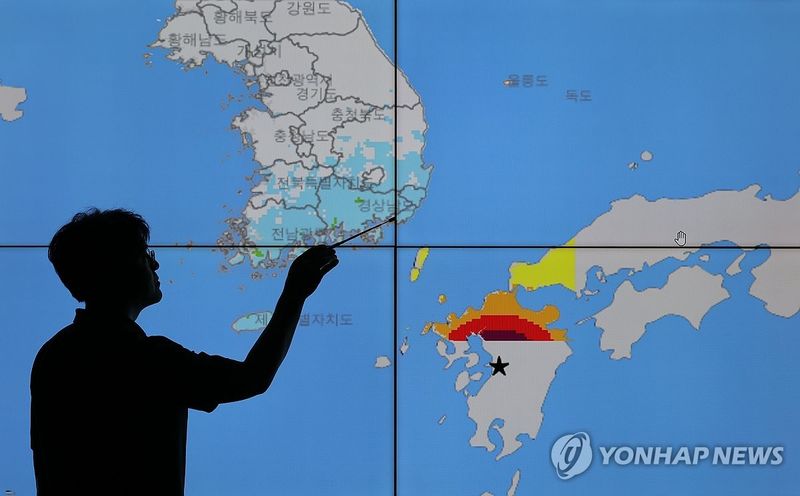
[Financial News] The government held an emergency review of domestic earthquake and tsunami preparedness after a series of strong quakes struck Kumamoto Prefecture, Japan. Although no direct damage was reported in South Korea, authorities decided to strengthen monitoring and preparedness after receiving 789 reports of tremors, mainly from Busan and South Gyeongsang Province.
On the 29th, the Ministry of the Interior and Safety held an expert advisory meeting on the Kumamoto Prefecture earthquakes, with specialists from the Korea Meteorological Administration (KMA), the National Disaster Management Research Institute, the Korea Institute of Geoscience and Mineral Resources (KIGAM), and Pusan National University in attendance.
The meeting followed the previous day's twin strong quakes of magnitude 7.1 and 6.1 in Kumamoto Prefecture. Participants analyzed the causes of the earthquakes and their impact on South Korea, while also reviewing domestic earthquake and tsunami preparedness, public guidance on emergency response, and coordination among relevant agencies.
Experts said continued monitoring is necessary, as the effects of earthquakes in neighboring countries have also been detected in South Korea. They stressed the need to expand surveys of active faults, improve the seismic resilience of national infrastructure such as power and telecommunications networks, and repeatedly conduct evacuation drills for real-world emergencies.
The government is promoting seismic reinforcement projects with the goal of raising the earthquake resistance rate of public facilities from 82.7% in 2025 to 100% by 2035. It is also providing cost subsidies and tax incentives to help private facilities improve their seismic performance.
Across the country, 11,366 outdoor evacuation sites for use during earthquakes and 680 emergency tsunami shelters have been designated, bringing the total to 12,046. From April to June, the government carried out a nationwide inspection of evacuation sites to check the condition of facilities, signs, and other management measures.
It is also holding the 'Earthquake Safety AI Video Contest' to promote earthquake safety guidelines. In addition, it is providing on-site safety education for vulnerable groups and combining that with earthquake experience programs and evacuation drills.
Kim Kwang-yong, head of disaster and safety management at the Ministry of the Interior and Safety, said, "There was no direct damage in South Korea from this earthquake, but this is by no means a situation in which we can feel at ease." He added, "We will once again thoroughly review our preparedness and response posture for domestic earthquakes and tsunamis."
[email protected] Lee Bo-mi Reporter