Weak yen drives rush to exchange money as rate falls into the 800-won range per 100 yen; yen exchanges hit a 19-month high and deposits jump by 600 billion won
- Input
- 2026-07-29 11:10:19
- Updated
- 2026-07-29 11:10:19
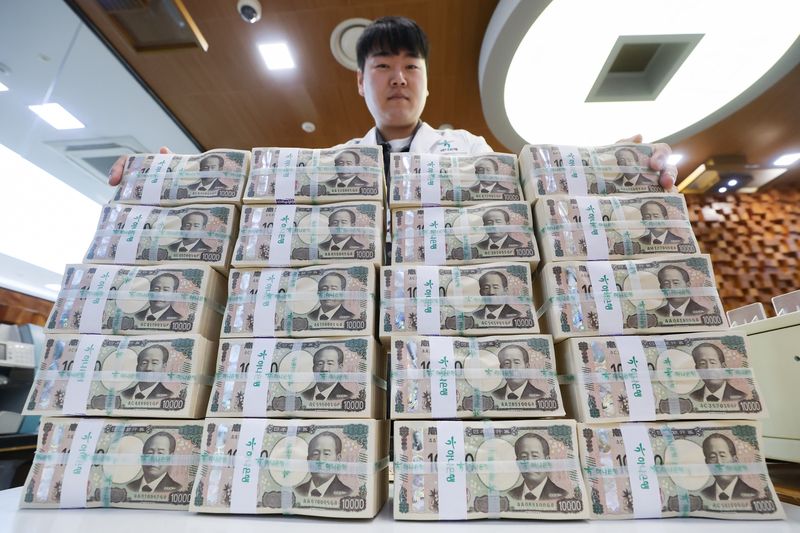
[Financial News] As the won-yen benchmark exchange rate fell into the 800-won range per 100 yen, demand for Japanese yen exchanges hit its highest level in 19 months. With more travelers heading to Japan during the summer vacation season and investors also betting on a rebound in the yen through currency speculation, yen deposits rose by more than 600 billion won this month alone.
According to the financial sector on the 29th, the amount of Japanese yen sold by the five major banks — KB Kookmin Bank, Shinhan Bank, Hana Bank, Woori Bank and Nonghyup Bank — totaled 31.5 billion yen from the 1st to the 27th of this month. Based on the won-yen benchmark exchange rate of 893.38 won per 100 yen on the 28th, that amounts to about 281.4 billion won.
Yen sales refer to the amount of yen banks provided to customers in exchange for won. This month's sales volume rose by 7.8 billion yen from the previous month, marking the largest level in 19 months since December last year, when it reached 32.2 billion yen.
Cumulative yen sales this year have reached 178.3 billion yen, equivalent to 68% of last year's annual exchange volume of 263.7 billion yen. By month, sales stood at 24.7 billion yen in January and 21.2 billion yen in February, then rose in March and April before slowing in May and June. They surged again this month.
The surge in yen exchanges is being driven by the decline in the won-yen benchmark exchange rate. On the 24th, the rate fell to 889.83 won per 100 yen, its lowest level in about two years since July 2024.
In the foreign exchange market, the Korean won has strengthened while the Japanese yen has weakened, causing the two currencies to move in opposite directions. The US dollar–South Korean won exchange rate has fallen to the 1,470-won range, while the USD/JPY exchange rate has remained in the 160-yen range per dollar. On the 23rd, the USD/JPY exchange rate even rose to 163.986 yen, the highest level in about 40 years.
Market watchers say improved supply and demand conditions in the domestic foreign exchange market are behind the won's strength.
Demand for currency exchange increased after SK hynix's American Depositary Receipt (ADR) listing in the United States, while higher hedging volumes from shipbuilders and a slowdown in foreign investor net selling of Korean stocks also helped expand dollar supply. By contrast, the yen has been weighed down by fading expectations for further interest rate hikes by the Bank of Japan (BOJ), concerns over Japan's fiscal health, trade deficits and capital flows centered on overseas investment.
More investors are also viewing the weak yen as a buying opportunity. As of the 27th, yen deposit balances at the five major banks stood at 978.1 billion yen, up 69.3 billion yen so far this month. Converted into won, that is worth about 619.1 billion won.
The market is viewing the Bank of Japan's monetary policy meeting scheduled for the 31st as a turning point for the yen's direction. While a hold on the benchmark rate appears most likely, the BOJ's message on the pace of future rate hikes is seen as a key factor that will shape the yen's trajectory.
[email protected] Seo Yoon-kyung Reporter