"Are They Only Blocking Leverage While Leaving the Market Alone?" Calls Grow for Stabilization Fund and Short-Selling Ban [Why Are Stocks Falling?]
- Input
- 2026-07-29 07:10:20
- Updated
- 2026-07-29 07:10:20
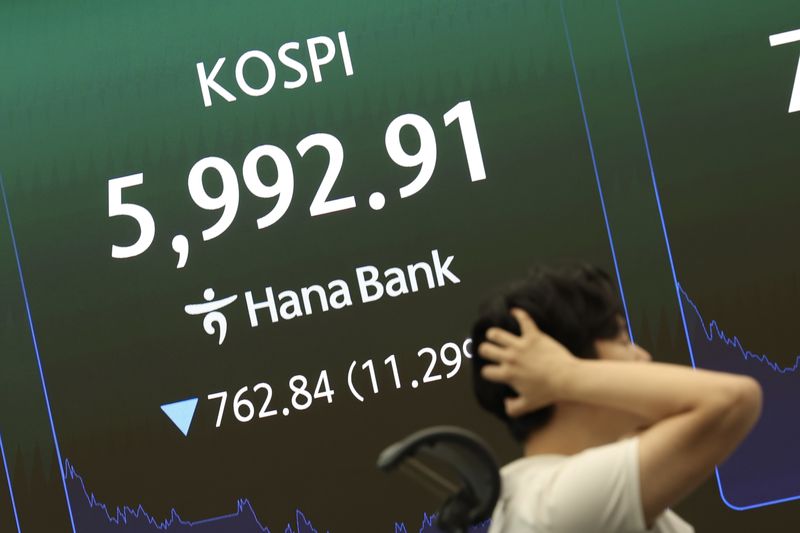
[Financial News] The KOSPI plunged more than 10% in a single day, briefly breaking below the 6,000 mark, while the KOSDAQ also fell under 700 intraday. As a result, calls are growing for the financial authorities to step in with market-stabilization measures. Critics say the authorities moved quickly to regulate leveraged exchange-traded funds (leveraged ETFs) tied to individual stocks, but have not responded aggressively enough to the broader liquidity crisis in the market.
According to the Korea Exchange on the 29th, the KOSPI closed the previous day at 6,023.66, down 732.09 points, or 10.84%, from the previous session. It was the second-largest point drop on record, following the 910.71-point plunge on the 23rd of last month. By percentage, it was the fourth-largest decline ever. During the session, it fell as low as 5,992.91, widening the loss to 11.29%.
The KOSDAQ also closed at 705.85, down 59.01 points, or 7.72%. Intraday, it dropped as low as 697.45, slipping below 700 for the first time in about one year and three months since April last year. In both markets, a sell-side sidecar was triggered early in the session, followed by a circuit breaker mechanism, effectively creating a panic market.■ "When Will the Stabilization Fund Be Used?" — Calls for Market Stability IntensifyAfter the sharp market decline, retail investors have turned their frustration toward the financial authorities. According to the securities industry, online communities and the National Assembly’s public petition platform have seen a series of posts calling for the reactivation of the Securities Market Stabilization Fund and a temporary ban on short selling.
One investor said, "I've never seen a market like this," adding, "Instead of blaming already distorted supply and demand, the authorities should first determine whether the market can recover on its own or whether this is an emergency that requires government intervention."
Another investor warned, "The authorities keep talking about leveraged products, but the KOSDAQ and non-semiconductor sectors are collapsing regardless of earnings and industry outlook," and added, "If this continues, domestic non-semiconductor industries could lose their presence in the stock market beyond structural undervaluation."
Investors are particularly concerned that this slump is not just a price correction but a collapse in liquidity. During the 2008 Lehman Brothers collapse, the cumulative declines in the KOSPI and KOSDAQ from October to November were about 26% and 30%, respectively. Over the past two months, however, the KOSPI and KOSDAQ have fallen by about 29% and 38%, respectively. Some investors said the shock feels even greater than during the global financial crisis.
In particular, while the KOSPI is still posting a positive return for the year, the KOSDAQ is down more than 20% from the start of the year, making the impact feel much more severe, investors said. As money has concentrated in AI and semiconductors, trading in non-semiconductor sectors such as biotechnology, Materials, Parts, and Equipment Industry, and small and mid-sized manufacturers has sharply declined, weakening market functions.
A securities industry official said, "If this is not an AI bubble, semiconductors will eventually find balance over time. But liquidity itself is drying up in the KOSDAQ and non-semiconductor industries," adding, "We need measures that can restore market sentiment, such as deploying the stabilization fund or expanding the National Pension Service's domestic stock allocation."■ "Curbing Excess and Stabilizing the Market Are Different" — The Absence of a Buying ForceExperts say the essence of the recent stock market plunge lies not in corporate earnings, but in tightening liquidity.
Joain, a researcher at Samsung Securities, said, "This correction is the result of external uncertainty dampening investor sentiment in a liquidity-constrained environment, rather than damage to corporate fundamentals." She added, "The KOSPI has technically entered an oversold zone, but investor deposits fell from about 140 trillion won in early June to around 106 trillion won at the end of July. With limited room for additional buying by individuals and only a weak return of foreign and institutional demand, there is no clear buying force in the market."
Market participants say the financial authorities' recent measures focused on cooling overheated leveraged ETFs tied to individual stocks, but failed to provide a safety net that could restore overall investor sentiment. The Financial Services Commission has raised the base deposit requirement to 30 million won in cash, suspended new product listings, and is even reviewing a plan to cap investment at a certain percentage of total financial investment assets, such as 20%. By contrast, it has left it to the industry to decide on spreading out rebalancing dates and improving the operation of liquidity providers.
A financial investment industry official said, "Measures to curb excess and measures to stabilize the market are different in nature." He added, "When buying interest has weakened to the point that circuit breakers are being triggered, we need to discuss ways to reinforce liquidity as well, such as reactivating the stabilization fund, temporarily restricting short selling, and expanding the role of public pension funds in market stabilization."
[email protected] Choi Doo-sun Reporter