"Japanese stocks swing with Samsung Electronics and SK hynix"... Nikkei says "highest volatility since the Lehman collapse"
- Input
- 2026-07-29 06:00:00
- Updated
- 2026-07-29 06:00:00
[Financial News] Japan's stock market volatility has continued for three straight months for the first time since the global financial crisis, and one of the causes has been identified as the movement of Korean semiconductor stocks. Analysts say swings in the share prices of Samsung Electronics and SK hynix are quickly spreading to Japanese AI and semiconductor-related stocks, adding to volatility in the Nikkei average.
On the 28th, Nikkei, Inc. reported that sharp intraday swings centered on AI-related stocks have become routine in the Japanese market, and said synchronization with the Korean market is one of the reasons behind the trend.
How did the Japanese market move?
On the 27th, the Nikkei average on the Tokyo Stock Exchange closed up 320 yen at 64,931 yen from the previous session. But during the day, it surged by more than 600 yen before falling by more than 400 yen, showing extreme swings throughout the session.
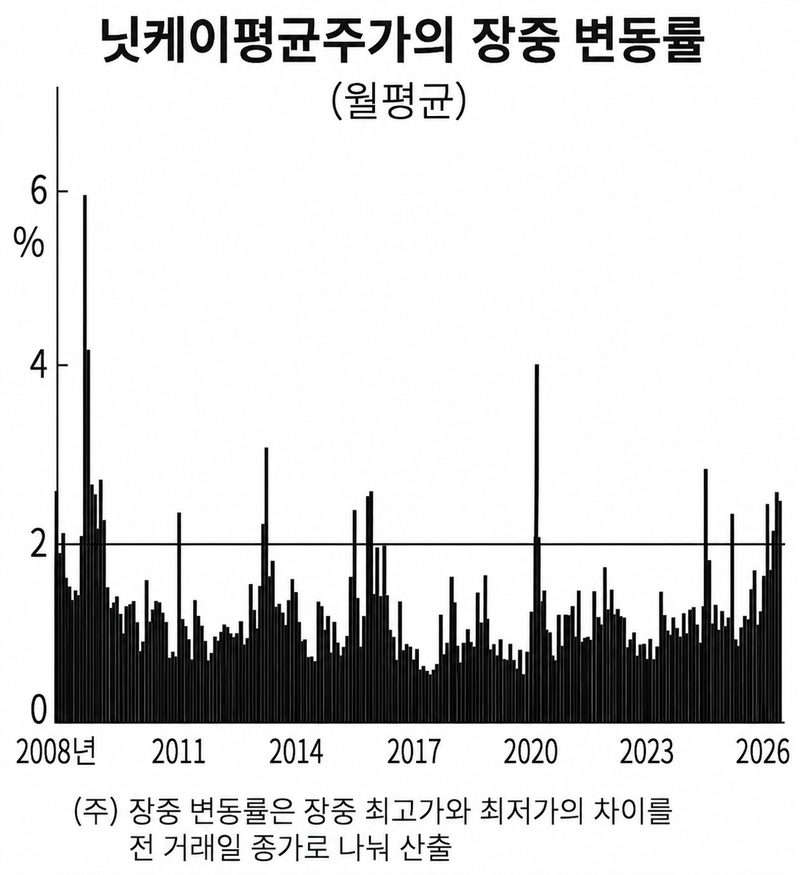
According to Nikkei, Inc.'s analysis of the 'intraday volatility' — calculated by dividing the gap between the day's high and low by the previous day's closing price — the July average came to 2.5%. That followed 2.1% in May and 2.6% in June, marking three consecutive months above 2%.
This is the first time the Nikkei average's intraday volatility has exceeded 2% for three straight months since the eight-month stretch from September 2008 to April 2009, immediately after the Lehman Brothers collapse.
Nikkei, Inc. noted that while high volatility also appeared temporarily during the COVID-19 pandemic and the sharp selloff in August 2024, it usually subsided within one or two months. This time, however, volatility has persisted even without an external shock large enough to rattle financial markets.
"The movement of Korean semiconductor stocks is spreading in real time to Japanese AI stocks"
Nikkei, Inc. pointed to the Korean stock market as one of the key factors behind the widening volatility.
Because Japan and South Korea are in the same time zone and their trading hours overlap for most of the day, moves in the Korean market are easily reflected in Japan in real time.
In particular, the growing popularity of leveraged ETFs that track twice the daily returns of Samsung Electronics and SK hynix has amplified volatility in Korean semiconductor stocks, while Japanese AI and semiconductor-related names such as Kioxia Holdings have increasingly moved in tandem, the report said.
Indeed, on the 27th, the newspaper said the KOSPI (Korea Composite Stock Price Index) and the Nikkei average nearly stopped rising and turned lower at almost the same time.
"Retail margin debt hits an all-time high, further boosting volatility"
Aggressive short-term trading by individual investors has also been cited as a factor increasing market volatility. Margin trading balances at Japanese securities firms have climbed above 6 trillion yen, reaching a record high.
Shota Yamafuji, an analyst at Tokai Tokyo Intelligence Lab, said, "As margin trading in Kioxia shares, which have a high share price, has become more active, it is contributing to the Nikkei average's high volatility."
Kei Sano, managing director at Nomura Securities, also said, "As investors who used to trade actively in the futures market move into the cash market, volatility in individual stocks is becoming even greater."
Nikkei, Inc. warned that while high volatility can create profit opportunities for short-term traders, it also raises the risk that inexperienced retail investors will suffer large paper losses soon after investing, which could ultimately lead to a pullback in investment or an exit from the market.
[email protected] Seo Yoon-kyung Reporter