Foreign Investors' 197 Trillion Won 'Sell Korea' Spree Sends KOSPI Tumbling — Is a Rebound Possible?
- Input
- 2026-07-29 06:03:00
- Updated
- 2026-07-29 06:03:00
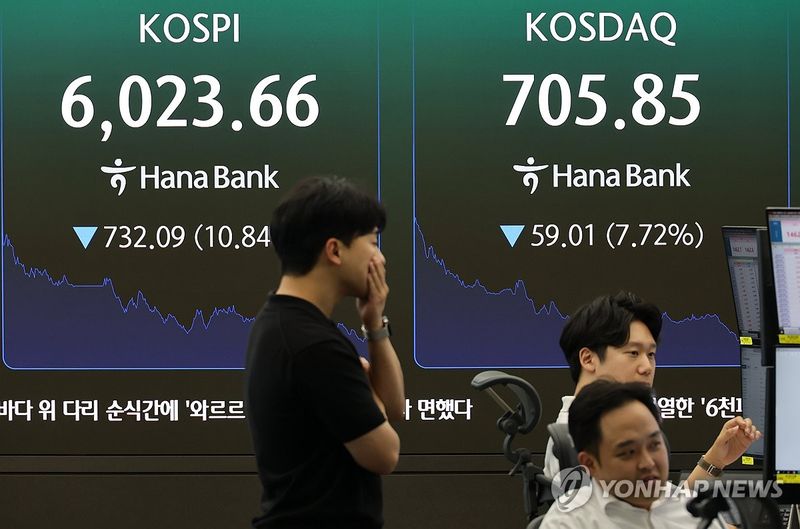
According to KOSCOM CHECK on the 29th, foreigners net sold 197.2 trillion won worth of shares in the KOSPI market from the start of the year through the 28th. The figure combines trading on the Korea Exchange and NextTrade, an alternative trading system (ATS). That is about 22 times last year's annual net selling total of 9 trillion won.
In particular, foreigners net sold 574 billion won worth of shares on the KOSPI alone on the 28th. As a result, the KOSPI plunged 10.84%, marking a steeper drop than during the Global Financial Crisis (GFC) in 2008, when it fell 10.57%. It was the fourth-largest daily decline on record, after the United States-Iran War (-12.06%), the September 11 attacks (-12.02%), and the Dot-com bubble burst (-11.63%).
Market watchers say the immediate trigger for the selloff was a combination of negative factors surrounding the semiconductor sector.
Lee Kyung-min, a researcher at Daishin Securities, said, "News that NVIDIA would provide $250 billion in financial guarantees related to OpenAI's data center investment reignited concerns about circular financing in the AI ecosystem." He added, "As doubts spread that large-scale AI investment may be based on overly optimistic demand forecasts rather than actual end demand, confidence in the broader AI investment cycle has weakened."
In addition, concerns over the listing and capacity expansion of Chinese memory maker ChangXin Memory Technologies (CXMT) have increased downward pressure on DRAM prices. Fears of expanded supply from China have also spread to the NAND flash memory market, as the possibility of an Initial Public Offering (IPO) by Chinese NAND flash maker Yangtze Memory Technologies Corp (YMTC) has been raised.
Still, some argue that the correction should be seen as a process of easing the concentration of capital flows and valuations in the semiconductor sector.
Yang Il-woo, a researcher at Samsung Securities, said, "The current correction phase is a process of unwinding the concentration of earnings and market capitalization in the semiconductor sector." He added, "It may take time, but the South Korean stock market is ultimately likely to rebound."
He explained, "In the short term, the Korean market may be insensitive to corporate earnings or valuations, but the current earnings scale is simply too large to be ignored by stock prices."
He went on to say, "Greater equity investment by companies such as NVIDIA could be positive for stock markets in a period of expanding global liquidity. If the market interprets longer-term contracts by semiconductor companies as improving hyperscalers' visibility on cash flows, global stock markets could resume their upward trend."
[email protected] Kim Hyun-jung Reporter