KOSPI Plunges 10% as Government Moves to Curb Leverage [Stock Market's 'Black Tuesday']
- Input
- 2026-07-28 18:40:12
- Updated
- 2026-07-28 18:40:12
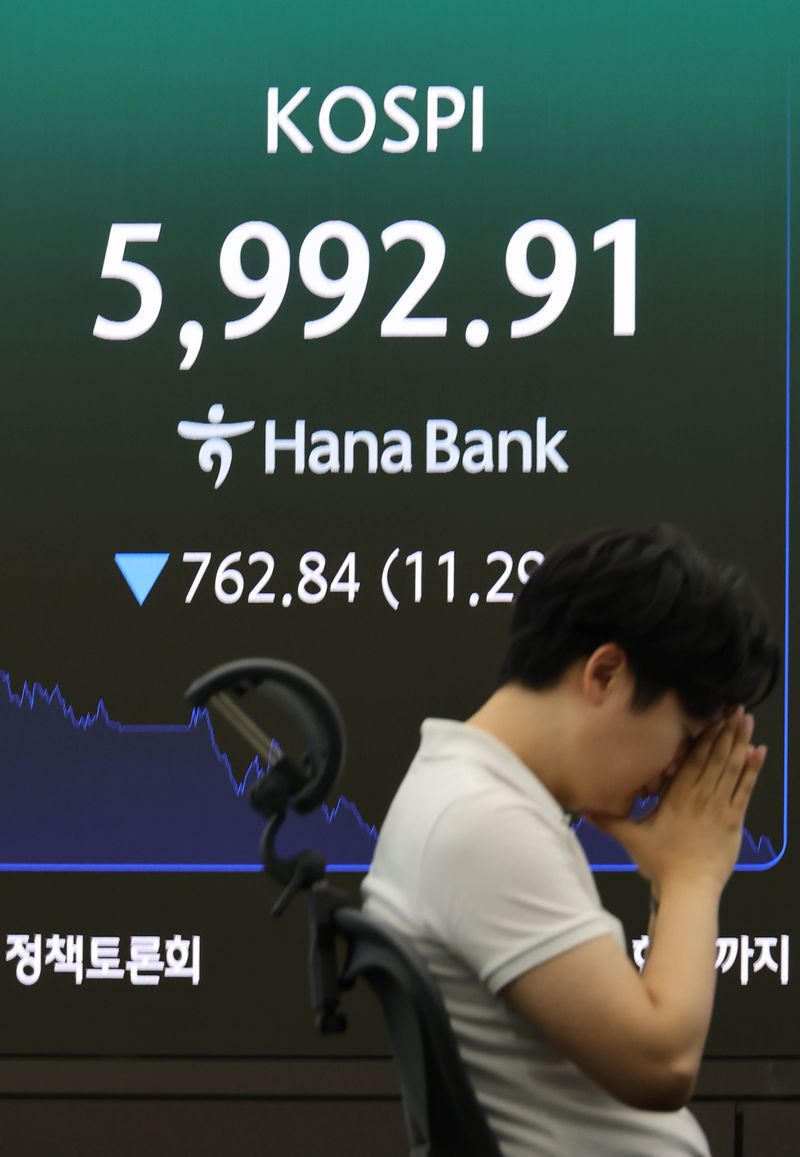
According to the Korea Exchange, KOSPI closed at 6,023.66 on the 28th, down 732.09 points, or 10.84%, from the previous session. It was the second-largest point drop on record, following the 910.71-point decline on the 23rd of last month. In percentage terms, it was the fourth-largest drop ever. The steepest decline on record was -12.06% on March 4 this year. KOSPI opened at 6,400.27 and fell as low as 5,992.91 during the session, with the decline reaching a maximum of 11.29%.
KOSDAQ closed at 705.85, down 59.01 points, or 7.72%. During the session, it fell to 697.45, slipping below the 700 mark for the first time in about one year and three months since April 16 last year. In the KOSPI and KOSDAQ markets, a sell-side sidecar was triggered early in the session, followed by circuit breakers. The KOSPI 200 Volatility Index, often called Korea's fear gauge, rebounded for the first time in seven trading days and broke above 80. VKOSPI jumped 7.58% from the previous day to close at 83.43. Foreign investors, who had been net sellers for three consecutive sessions, sold about 5 trillion won worth of shares on the day.
Concerns over vendor financing and circular funding surrounding NVIDIA also weighed on investor sentiment. In overnight trading on the New York stock market, NVIDIA shares closed at $196.51, down 4.99% from the previous day. The company's five-year credit default swap (CDS) premium also rose 14 basis points to 82 basis points. A higher CDS premium means the cost of protection against the company's default risk has increased. Samsung Securities said the rise in CDS premiums for major AI companies such as Oracle, Alphabet and Amazon suggests that financial burdens from AI infrastructure investment are beginning to be reflected in the credit market.
News that a Chinese semiconductor equipment maker had begun producing its own immersion DUV lithography equipment also fueled selling. The Shanghai listing of CXMT, a Chinese memory chip maker, further heightened concerns about future capital spending and supply expansion.
Seo Sang-young, executive director at Mirae Asset Securities, explained, "Rather than new negative factors, existing risks such as China's semiconductor self-reliance and the circular investment structure of the AI industry, combined with risk-off sentiment ahead of Big Tech earnings reports, led to panic selling."
Amid these concerns, Samsung Electronics and SK hynix closed at 220,000 won and 1.55 million won, respectively, down 13.39% and 14.65% from the previous session. Including these stocks, 878 issues fell on the KOSPI market, reducing the market capitalization to 4,933 trillion won.
As market volatility surged, especially in semiconductor stocks, authorities left open the possibility of additional regulations to stabilize demand for single-stock leveraged products and protect investors.
At a meeting with the financial investment industry held at the Korea Financial Investment Association in Yeouido, Seoul, on the day, Chairperson of the Financial Services Commission Lee Eok-won said, "If demand for single-stock leveraged products does not sufficiently cool, we will review and prepare additional measures, including raising investment requirements further and setting individual investment limits." The FSC decided to consider limiting investment in single-stock leveraged products to within a certain percentage of an individual's total financial investment assets. The commission suggested a 20% cap, but has not finalized the exact ratio, calculation method or implementation timing. Starting on the 31st, the base deposit required to buy domestic and overseas single-stock leveraged products will first be raised to at least 30 million won in cash.
[email protected] Kim Mi-hee Reporter