On U.S. and China Headwinds, Foreign Investors Dumped Samsung Electronics and SK hynix by 6.8 Trillion Won in Two Days [Stock Market 'Black Tuesday']
- Input
- 2026-07-28 18:33:32
- Updated
- 2026-07-28 18:33:32
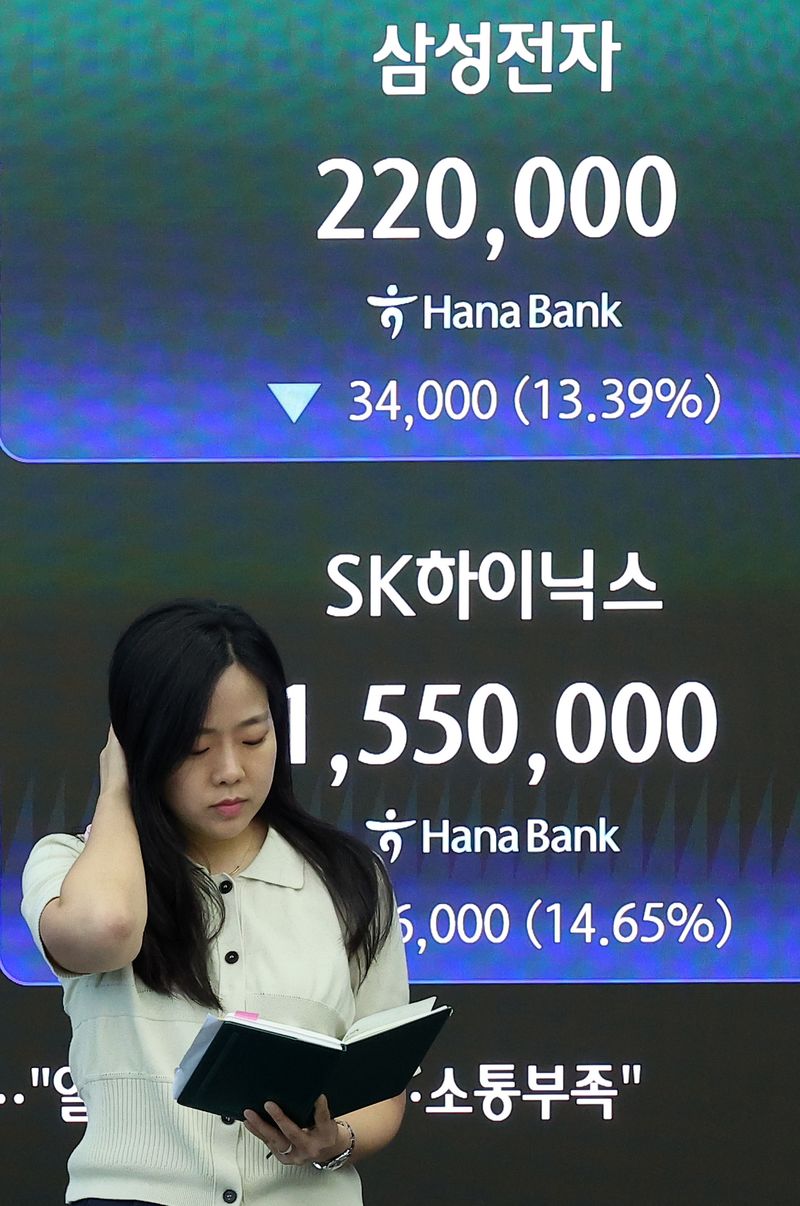
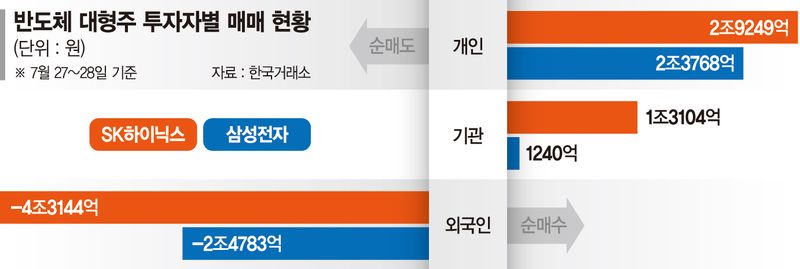
According to the Korea Exchange on the 28th, foreign investors net sold 431.44 billion won worth of SK hynix and 247.83 billion won worth of Samsung Electronics over the two days from the 27th to the 28th. They sold a combined 679.27 billion won in just those two stocks, ranking them first and second among foreign net sales. That accounted for 86.1% of the 789.15 billion won in total net selling in the Korea Exchange Main Board over the same period. Rather than reducing exposure across the market, they appear to have locked in profits mainly from the large semiconductor names that had led the rally.
Institutions, by contrast, moved in the opposite direction. Over the same period, they net bought 131.04 billion won of SK hynix and 12.4 billion won of Samsung Electronics, for a combined 143.44 billion won in the two stocks. Institutional funds were also concentrated in large semiconductor names rather than spread across other sectors. The tug-of-war around SK hynix was especially intense. While foreigners net sold more than 4 trillion won over two days, institutions net bought more than 1.3 trillion won. Institutional net buying of SK hynix was more than 10 times larger than that of Samsung Electronics, showing that buying interest within semiconductors was focused on SK hynix.
Brokerage analysts point to uncertainty surrounding the AI investment cycle and China’s semiconductor industry as the main reasons behind foreigners’ aggressive selling of semiconductor stocks. As doubts grow over the so-called "circular financing" structure among AI companies, concerns are spreading that the AI infrastructure investment cycle may be passing its peak. Added to that is growing caution that China’s semiconductor self-sufficiency could advance faster than expected, following mass production of deep ultraviolet (DUV) lithography equipment by state-owned Chinese firms and the listing of ChangXin Memory Technologies (CXMT).
Joain, a researcher at Samsung Securities, said, "As NVIDIA has unveiled a series of large-scale investment plans involving SK Group and OpenAI, the controversy over 'AI circular trading' has been reignited." She added, "Chinese-made semiconductor equipment is not yet at a level that can immediately threaten the global ecosystem, but the faster-than-expected pace of technological development is heightening investor caution."
Some market watchers say this correction could mark a turning point for the semiconductor-centered rally. If profit momentum in semiconductors slows and earnings estimates begin to be revised down in earnest, rotation could spread into energy, machinery, finance, retail, and batteries.
Yoon Yeo-sam, a researcher at Kyobo Securities, said, "Semiconductor earnings growth is expected to slow after the third quarter of this year, and downward revisions to earnings consensus are already beginning." He added, "The point at which expectations for the semiconductor industry weaken could become the turning point where new leading sectors emerge."
Others, however, say it is too early to view this as a clear sign of a leadership rotation. They argue that the recent strength in defensive sectors such as banks and healthcare is likely a relative effect of the semiconductor correction. Yoon Yeo-sam of Meritz Securities explained, "More than 80% of the decline after the KOSPI peaked came from the semiconductor sector." He added, "Rather than concluding that the recent outperformance of banks and healthcare versus semiconductors reflects a full-scale shift in fund flows, we need more confirmation on whether it is simply relative strength caused by the sharp drop in semiconductors."
[email protected] Choi Doo-seon Reporter