"AI Is Effective for Capital Market Investing, but It Has Limits"
- Input
- 2026-07-28 18:33:18
- Updated
- 2026-07-28 18:33:18
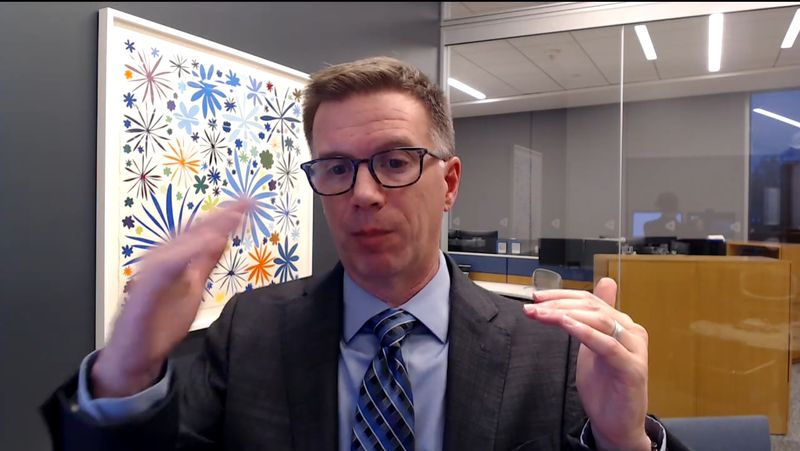
At an IGE webinar hosted on the 28th by the World Economy Research Institute, Peter Dillard, head of global investment engineering at Dimensional Fund Advisors (DFA), said as much. Dillard, who uses AI at DFA, which manages more than $1 trillion in assets, to forecast markets and predict risk, explained that "AI is a truly remarkable and mysterious technology, with many positive aspects."
DFA, which has Nobel laureates Eugene Fama and Robert Merton as advisers, is known for its data-driven, scientific approach to investing. In his presentation, titled "Portfolio Investment Strategies in the AI Era," Dillard introduced how AI can be used in business settings and explained the differences between traditional software and AI software.
Dillard emphasized that "traditional software is deterministic and always produces the same output for the same input, whereas AI software is probabilistic, so the same input can yield different results."
He also said that "AI hallucinations and the risk of resulting errors can also be linked to creativity," and advised that "the financial investment industry should consider four criteria when deciding whether to adopt AI tools: the nature of the work, whether the results can be verified, the value of the information, and the reversibility of the action."
He also shared AI prompts that DFA actually uses in its investment work. Dillard cited "coding assistance" and "customized research prompts" as useful examples. He said that "AI assistance in coding provides immediate and reliable results," adding that "we have seen major efficiency gains in code summarization, documentation, and automation of repetitive tasks." By contrast, he noted that "AI has not shown clear advantages over existing methods in areas such as anomaly detection in data or summarizing massive bond contracts," and added that "AI tools do not solve every problem." In other words, the scope of AI use should be carefully determined based on the nature of the work and where responsibility lies.
He also discussed his experience applying AI and machine learning techniques to market volatility forecasting. DFA's research team compared traditional statistical models with nonlinear AI models such as neural networks. Dillard said that "nonlinear models performed better during periods of extreme volatility, but showed little difference from conventional models in normal times." He added that "AI cannot replace traditional alpha, given that the long-term returns of AI-based Exchange-Traded Funds (ETFs) are not especially superior to those of conventional indexes."
Jeon Kwang-woo, chairman of the World Economy Research Institute, who served as moderator, said, "Compared with stock markets around the world, the Korean domestic market has performed well in recent years," and asked, "Many policymakers would want to look into this more closely. Is there a way to use AI tools for that?" Dillard drew a line, saying that "AI can contribute in part to forecasting and easing volatility, but it is impossible to eliminate all volatility given the inherent nature of the market." Asked about the AI Supercycle and the sustainability of the memory chip industry, Dillard said that "long-term prospects can change depending on shifts in supply and demand," adding that "nothing lasts forever. But I believe in views that are in the middle, rather than those at either extreme."
[email protected] Park Moon-soo Reporter