Sharp Market Slump Hits Hard: Six in 10 Stocks Are Undervalued
- Input
- 2026-07-28 18:22:11
- Updated
- 2026-07-28 18:22:11
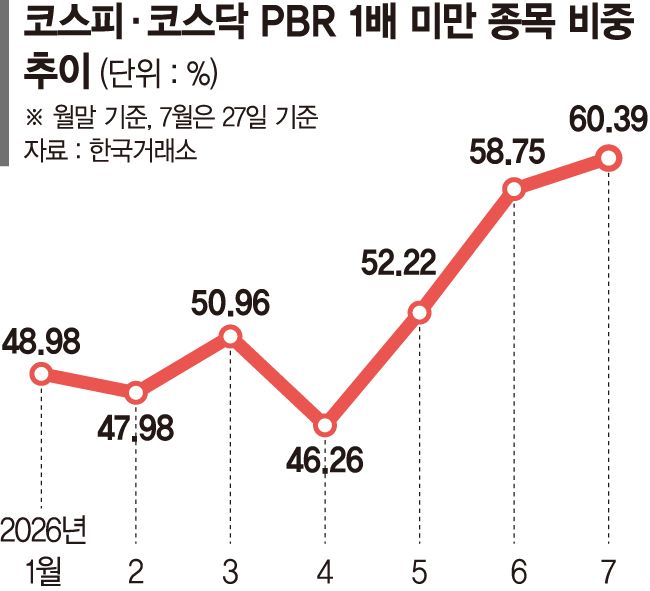
According to the Korea Exchange on the 28th, 1,520 of the 2,517 stocks listed on the KOSPI Composite Index and KOSDAQ (Korea Securities Dealers Automated Quotations) markets as of the previous day had a PBR below 1, meaning 60.39% of the market was in undervalued territory. The figure excludes preferred shares, SPACs, and suspended stocks.
PBR is an indicator that shows how a stock is valued relative to its equity value. In general, a PBR below 1 is interpreted as a sign that a stock is undervalued, with its market capitalization falling short of its book net asset value.
At the end of April, the share of stocks with a PBR below 1 in the KOSPI Composite Index and KOSDAQ markets stood at 46.26%. That figure has jumped by 14.13 percentage points in just three months. It is also higher than the levels seen in January (48.98%), February (47.98%), March (50.96%), May (52.22%), and last month (58.75%).
The market, which had been on a steep upward run this year, has become highly volatile. As the concentration in leading stocks such as Samsung Electronics and SK hynix has deepened, more undervalued stocks have emerged. During the rally, gains were driven by semiconductor-led leaders, and the benefits did not spread to neglected stocks. During the downturn, however, most stocks fell together.
A source in the financial investment industry said, "Global markets, including the United States, are also seeing sharp corrections in semiconductor stocks, but other sectors are helping support the indexes to some extent." The source added, "In the domestic market, however, concentration is severe and the pool of funds available to provide support is limited, so when semiconductors fall, other sectors often weaken as well."
Market participants say liquidity support is needed for stocks to rebound. Lee Kyung-min, a researcher at Daishin Securities, said, "The recent plunge in the KOSPI appears to have been driven by growing psychological pressure from concerns that the AI and semiconductor industries may have passed their peak, as well as from the chain reaction of events such as the armed conflict between the United States and Iran." He added, "Investor sentiment is fragile, so even a small trigger could reverse the mood."
He continued, "The KOSPI 12-month forward price-earnings ratio is 5.7 times, which is close to a historical low." He added, "A spring with strong elasticity bounces back forcefully when pressed down, and the KOSPI has been compressed for so long that I expect a flexible rebound."
Jo A-in, a researcher at Samsung Securities, said, "The lack of a clear buying force is acting as a constraint on the KOSPI's rebound." She noted, "At the start of the market decline, individual investors absorbed foreign investors' selling, so their additional buying power is limited. In addition, the return of foreign and institutional flows remains uncertain amid extreme volatility."
[email protected] Seo Min-ji Reporter