[Editorial] China’s Semiconductor Alarm: Only Innovation Can Stop It
- Input
- 2026-07-28 18:09:24
- Updated
- 2026-07-28 18:09:24
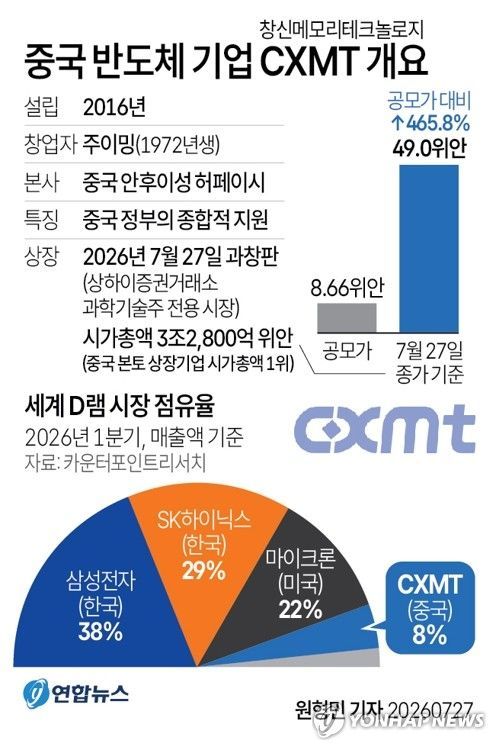
ChangXin Memory Technologies (CXMT), a Chinese memory chip maker that listed the previous day, quickly rose to become China’s top company by market capitalization, surpassing Intel. This means CXMT has secured an enormous amount of capital and now has vast resources for investment. Backed by sweeping government support, Chinese semiconductor companies are already growing rapidly and are emerging as a serious threat not only to South Korea but also to the global market.
Even more shocking was the news that a Chinese state-owned company had begun mass production of DUV lithography equipment for semiconductor manufacturing. Shares of global semiconductor equipment makers, including ASML, which has been exporting manufacturing tools to Chinese companies, fell sharply across the board, and the impact also reached South Korean chipmakers.
By producing semiconductor manufacturing equipment as well, China’s chip industry appears to have built a foundation that could allow it to stand on its own without help from other countries, despite U.S. restrictions. CXMT is said to be mass-producing memory chips at the 16-nanometer level. It is still two to three years behind South Korean chipmakers, and its High Bandwidth Memory technology is not yet a match for ours.
Still, it seems only a matter of time before China’s semiconductor industry, though still somewhat behind, catches up with global companies including those in South Korea. China’s chip sector is growing quickly not only in foundry and Fabless design, but also in equipment, materials, and component manufacturing. That means China could reduce its semiconductor imports and, armed with low prices and quality that is not far behind, encroach on the global market.
Global semiconductor demand is expected to grow so much that securing supply will be difficult for the time being, but that situation could change if Chinese companies accelerate their pace. South Korea is building, or planning to build, large-scale semiconductor industrial complexes in Yongin and the southwestern region. If construction schedules are not brought forward, however, they could end up out of step with market supply and demand.
For South Korea, the priority must be to complete the semiconductor fabs now under construction as quickly as possible and to devote all-out effort to technological innovation that can fend off China’s advance. If China catches up, the only option is for South Korea to pull further ahead with even more advanced technology.
China is also trying to overtake South Korea in electric vehicles and consumer electronics such as TVs. If South Korea responds complacently in semiconductors as well, it could lose market share and fall behind. Japan, which has already gone down that path, shows what can happen. Now is the golden window to push back against China and take another leap forward.
Semiconductors are the engine that supports the South Korean economy. Conversely, if semiconductors falter, the entire economy could be thrown into trouble in an instant. As the saying goes, a running horse needs a whip. With the semiconductor industry enjoying its biggest boom ever, all available policy support should be mobilized so it can surge even further ahead.
In that sense, it is regrettable that even a single issue such as flexible working hours cannot be resolved because labor and management remain divided. Watching the rise of China’s semiconductor industry, the government, companies, and labor unions should act as one and devote themselves to the future. This is no time for leisurely disputes.