"If I Had Known It Was AI Translation, I Wouldn't Have Bought It" ... Questions Left by the 'Book Thief' Controversy [Worthwhile Issue]
- Input
- 2026-07-29 07:00:00
- Updated
- 2026-07-29 07:00:00
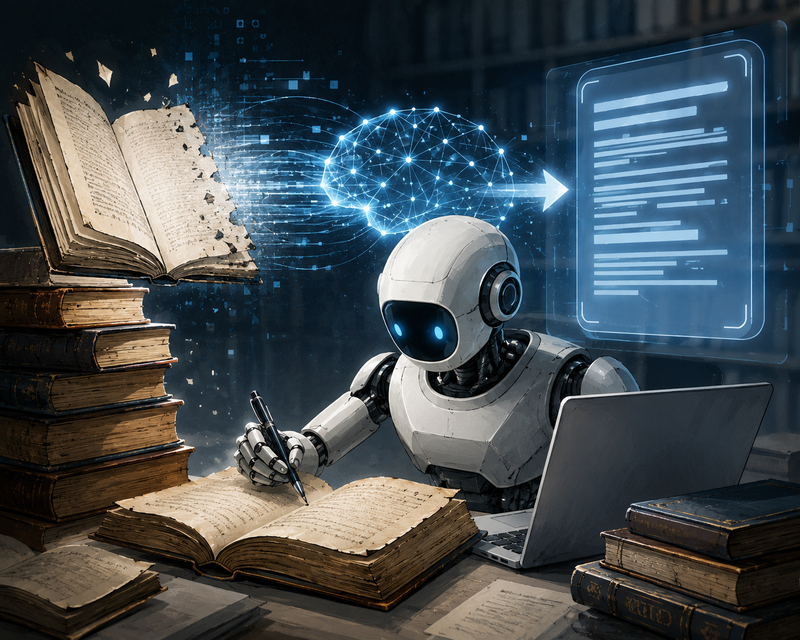
[Financial News] The e-book app "Book Thief," which had gained popularity for offering users the bold promise of lifetime access to classic literature e-books for just 19,800 won, has apologized after belatedly admitting that it used AI translation.
Since the service launched in September last year, some users had raised suspicions that generative AI was being used in the translation process. Book Thief repeatedly denied the claim, but as the controversy grew, it eventually reversed its position. Users say they feel betrayed less by the AI translation itself than by the operator's response.
Legal experts also said the issue was not the use of AI itself, but the failure to disclose it.
Lee Yu-rim, managing attorney at Law Firm Ro&N, who has spoken out on the issue on social media, told Financial News on the 27th, "This is not a problem with AI technology itself, but with the way it was handled. Using AI is not wrong. The problem is hiding that fact and making consumers believe the work was translated by human effort."
Why did the promise of unlimited access to 1,000 classic books for 19,800 won become controversial?
Book Thief was launched in September last year by The Better Tomorrow, which described it as "an e-book reading app that newly translates world classics whose copyrights have expired into modern language, and for books not previously available in Korea, translates them for the first time so users can keep them forever without a subscription fee."
The problem was that Book Thief used AI in translation without informing customers on the payment screen. As of the 28th, 730 books were registered on the service, and the "lifetime access pass" that allows unlimited reading costs 19,800 won. Suspicious users, questioning the unusually low price, raised concerns about AI translation. On the 25th, Book Thief wrote on social media, "Many people have been asking whether we use AI, so let us clarify. We do use AI. In return, we offer books at an absurdly low price."
Once this became known, users reacted strongly, saying, "If I had known these were AI-translated books, I would not have paid," "They criticized the distribution structure of traditional publishers and sold lifetime access, but it was just a scheme to make money using AI," and "Shouldn't they have disclosed the use of AI in advance? It feels like I was deceived."
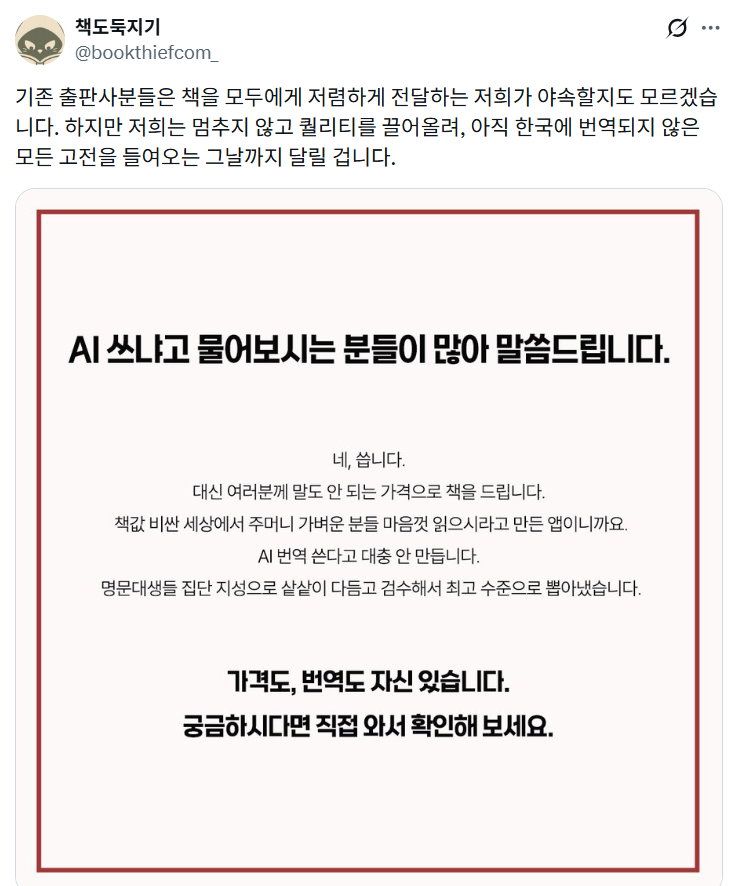
Refund requests then surged after it was revealed that when some users asked in December last year whether the translations were AI-generated, the company had responded in a way that suggested denial.
In the end, Book Thief issued a statement on social media on the 27th, saying, "We bow our heads and sincerely apologize for causing great concern and disappointment to readers regarding our service and translation process."
It added, "For readers who were disappointed by this matter, we will provide a full refund upon request for purchases made before July 27, regardless of the deadline."
The company has also announced that the lifetime access pass will rise to 49,000 won starting August 1. It was asked for comment on the controversy, but no response was received.
"Using AI Is Not Wrong, but Hiding It Is the Problem"
Amid the controversy, voices emerged saying the core issue was not AI use itself, but the failure to disclose it in advance, raising questions about legal liability.
Lee said, "If it is confirmed that AI translation was actually used, but consumers were told it was not AI translation, that could go beyond a simple failure to disclose."
The Basic Act on Artificial Intelligence, which took effect on Jan. 22 this year, imposes two obligations on generative AI-based services. One is a duty to notify users before payment that AI is being used, under Article 31, Paragraph 1. The other is a duty to label the output, under Article 31, Paragraph 2.
Violations of the disclosure obligation under the Basic Act on Artificial Intelligence can result in a fine of up to 30 million won.
Lee explained, "Under the enforcement decree, the actual fine level for failing to provide advance notice is known to start in the several-million-won range and increase depending on the number of violations. Since there is currently a grace period, even if a violation is recognized, a corrective recommendation or corrective order is likely to come first. However, if a corrective order is ignored, that itself becomes subject to a fine."
She added, "If we look only at the Basic Act on Artificial Intelligence, the level of sanctions in this case is not very high. In practice, the stronger regulatory response may come from the Act on Fair Labeling and Advertising or the Act on the Consumer Protection in Electronic Commerce, Etc."
She explained that if the company went beyond passive concealment of an important fact and actively stated something contrary to the truth, the likelihood of it constituting false or deceptive labeling and advertising under the Act on Fair Labeling and Advertising becomes much higher.
Lee said, "The translation method is important information that affects a consumer's purchasing decision. If the company gave an answer that was contrary to the facts, the deceptive nature becomes clear." She added, "From a civil-law perspective as well, if consumers believed that answer and purchased the product under the mistaken belief that a human had translated it, there is room to view that as a declaration of intent induced by deception."

Do AI-translated works have copyright?
Questions were also raised about copyright. In principle, works whose copyright protection period has expired may be used by anyone. However, even if the copyright in the original classic has expired, existing Korean translations of that work are separately protected as derivative works that reflect the translator's creative effort. This is because creativity is recognized in the choices made in selecting words and refining expressions.
Lee replied, "If AI learned from or referred to a specific existing translation rather than the original text and produced a result that is substantially similar in expression, copyright infringement may be established not against the original work, but against that translation." The key issue is whether the original text was newly translated or whether the expressions of an existing translator were used. In such a case, the rights holder, whether the translator or the publisher, can compare the two texts in detail to determine whether actual infringement occurred.
On the other hand, if AI newly translated the original text, the output itself would be difficult to protect under copyright. Lee said, "Korean copyright law defines a copyrighted work as a creative work expressing human thought or emotion, so it assumes a human creator. Hiding the fact that it was AI translation and presenting it as if a person had painstakingly translated it could amount to selling a result that would be difficult to recognize even as a copyrighted work as though it were a creative work."
Finally, Lee emphasized, "From the perspective of the content industry, repeated concealment like this is what most seriously destroys consumer trust. Once trust collapses, even businesses that use AI honestly are viewed with suspicion, and the entire industry suffers. In the AI era, the most basic courtesy and legal duty for anyone selling content is to be transparent, not deceive consumers, and respect the rights of others."
We sift through the flood of news and write only the issues worth reading. Politics, economy, society, and culture — we explore a wide range of topics from a fresh, sharp, and sometimes skeptical perspective.[Worthwhile Issue]If you want to follow this series more easily, please subscribe to the reporter's page.
[email protected] Kim Hee-sun Reporter