Real Estate Dominates National Policy Committee as Opposition Asks, "Did the Office for Government Policy Coordination Check Lee's Mortgage?"
- Input
- 2026-07-28 16:18:42
- Updated
- 2026-07-28 16:18:42
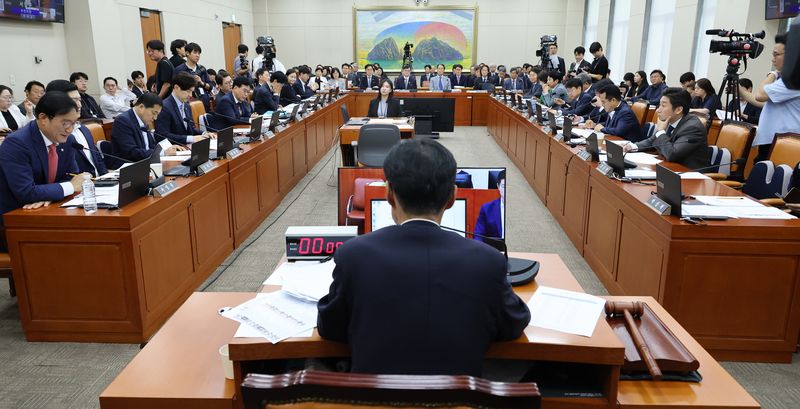
On the 28th, the committee held a plenary session at the National Assembly and received work reports from the Office for Government Policy Coordination, the Ministry of Patriots and Veterans Affairs (MPVA), the Korea Fair Trade Commission (KFTC), and the Personal Information Protection Commission (PIPC), among other non-financial ministries and agencies.
The issue that heated up the committee the most that day was real estate. The People Power Party focused on concerns over President Lee Jae Myung's 1.77 billion won mortgage registration, the effectiveness of the Real Estate Supervision Task Force under the Office for Government Policy Coordination, and worries over loan regulations and tax reforms.
First, People Power Party lawmaker Shin Dong-wook targeted the controversy over President Lee Jae Myung's 1.77 billion won mortgage registration on an apartment in Bundang, Seongnam, Gyeonggi Province.
Shin asked Office for Government Policy Coordination Minister Im Gi-geun, "Have you checked the status of the real estate transaction in which President Lee recently set a 1.77 billion won mortgage?" He said the task force should recognize it as illegal activity and investigate it accordingly.
Im replied, "There are no clear signs suggesting illegal activity."
Shin then shot back, "Even the transaction itself is being seen this way because President Lee is using loopholes and taking a detour. Are you only monitoring ordinary citizens while avoiding anything that burdens the government?"
People Power Party lawmaker Kim Jae-seop said, "No matter how you look at it, the Lee Jae Myung administration's real estate policy can be judged a failure in the short term." He added, "When President Lee was a presidential candidate, he promised to cut taxes, increase supply, and ease real estate lending rules. Instead of moving toward that correct answer, it seems the government created a Real Estate Supervision Task Force under the Office for Government Policy Coordination to build a redundant structure and look for the wrong answer."
He also criticized the task force, saying, "It says it will eradicate illegal activity, but local governments and the National Police Agency are already doing that. The government is talking about creating a Real Estate Supervision Task Force and even a real estate watchdog, but I don't know what it is actually doing, especially when the redundant structure has no clear effectiveness."
Im responded, "We are not only dealing with illegal activity, but also working to address supply issues and speculative demand." He explained, "Many major real estate violations involve multiple government ministries and agencies. Relevant institutions are gathering, sharing information, checking cases, and responding more effectively to complex incidents."
Song Eon-seok of the same party said the government had failed to review the side effects of its loan regulations in advance. He also asked whether the government planned to abolish the long-term holding special deduction for capital gains tax and raised concerns about the push to increase property taxes.
Song said, "Many people are suffering huge losses because of the apartment balance loan restrictions. Some have even been pushed out onto the streets." He added, "When making policy, you have to think through the side effects and design it carefully. But the government's attitude of just throwing out a policy first and saying we'll deal with the problems later is wrong. The people and economy of South Korea are not subjects for a live experiment."
He also criticized the government, saying, "The long-term holding special deduction was created to curb short-term speculation and encourage long-term ownership, helping foster a healthier livelihood for the public." He added, "Even knowing that, if you abolish the deduction and raise property taxes, how are people supposed to live?"
In response to Song's criticism, Im countered, "We also need to consider whether excessive benefits should be reduced or adjusted."
[email protected] Kim Hyeong-gu Reporter