KOSPI Falls Below 6,000 Intraday as Foreign Investors Dump 4 Trillion Won in Panic Selling [fn Market Close]
- Input
- 2026-07-28 15:40:48
- Updated
- 2026-07-28 15:40:48
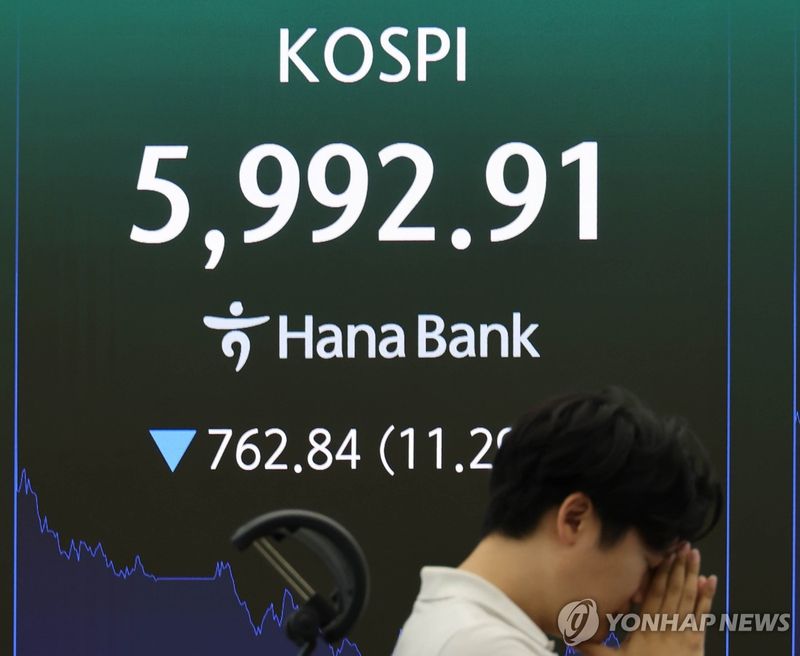
The KOSPI closed at 6,023.66, down 732.09 points, or 10.84%, from the previous session. It opened at 6,400.27, down 355.48 points, or 5.26%, and quickly widened its losses.
At 9:06 a.m., a sell sidecar was triggered on the KOSPI shortly after the market opened, and a sell sidecar was also activated on the KOSDAQ at 9:14 a.m. As the KOSPI then fell more than 8%, a circuit breaker mechanism was triggered around 10:13 a.m., halting trading for 20 minutes. The KOSDAQ also triggered a circuit breaker mechanism around 12:01 p.m.
As the session drew to a close, both the KOSPI and KOSDAQ briefly broke below the 6,000 and 700 levels, respectively.
Foreign selling was at the center of the rout. On the Korea Exchange Main Board, individuals and institutions bought a net 4.3179 trillion won and 638.6 billion won, respectively, while foreigners sold a net 4.9841 trillion won. Major large-cap stocks also tumbled across the board. Among the top 14 stocks by market capitalization, all but Samsung Biologics, which rose 0.26%, finished lower.
Samsung Electronics, the largest stock by market value, fell 13.39%, while SK hynix dropped 14.65%. The KOSDAQ also closed at 705.85, down 59.01 points, or 7.72%, from the previous session. It opened at 742.13, down 22.73 points, or 2.97%, before extending its losses.
Market watchers said the selloff was not simply profit-taking, but the result of several factors converging at once: deteriorating global sentiment toward semiconductor investment, concerns over AI spending, and a heavy domestic concentration of funds. One securities industry official said, "With buying heavily concentrated in semiconductor giants such as Samsung Electronics and SK hynix, as well as leveraged ETFs, profit-taking triggered a chain reaction. Because of the leverage effect, the decline prompted additional selling. The drop widened further as foreigners also reduced their exposure."
KB Kookmin Bank also pointed to profit-taking in semiconductor heavyweights and uncertainty over the global semiconductor cycle as the backdrop to the recent market plunge in its WM market commentary. It said that, as funds had been concentrated in semiconductor blue chips since the start of the year, helped by the launch of leveraged products, profit-taking orders poured in. The bank added that the surge in ChangXin Memory Technologies (CXMT) after its listing in China, with intraday gains of more than 530% from the offering price, also weighed on the domestic market by drawing in global liquidity.
Concerns over China’s semiconductor self-sufficiency also dampened investor sentiment. Jo A-in, a researcher at Samsung Securities Co., Ltd., said reports that Chinese semiconductor equipment makers may be able to mass-produce deep ultraviolet (DUV) lithography equipment fueled worries that China’s semiconductor independence could advance faster than expected. "That led to selling across the global semiconductor sector, including a sharp drop in ASML shares," she explained. She added, however, that "the technical possibility of China’s DUV equipment threatening the global semiconductor ecosystem in the short term remains limited," while noting that "the faster-than-expected pace of technological development appears to have unsettled investors."
Financial strain from expanding AI investment also emerged as a new headwind. Jo said, "Credit Default Swap (CDS) premiums for major AI companies such as Oracle Corporation, Alphabet Inc., Amazon, Meta Platforms, and NVIDIA all rose at once, showing that cash flow concerns tied to massive AI investment are beginning to spill into the credit market." She added that "as NVIDIA has repeatedly announced large-scale AI investment plans with SK Group, OpenAI and others, debate over so-called 'AI circular trading' has resurfaced."
Attention is now turning to a series of major events scheduled for this week. Major Korean companies, including Samsung Electronics and SK hynix, as well as U.S. big tech firms such as Meta Platforms, Microsoft, Amazon and Apple Inc., are set to release earnings. The results of the Federal Open Market Committee (FOMC) meeting will also be announced in the early hours of the 31st, Korea time. Jo said, "Ahead of key events that will determine the market’s direction, investors are more inclined to reduce risk assets than to buy aggressively."
KB Kookmin Bank, however, said that despite the short-term spike in volatility, valuations have become more attractive from a long-term investment perspective. "The current price-earnings ratio (PER) of the KOSPI is even lower than the trough seen during the Global Financial Crisis (GFC)," the bank said. "While a V-shaped rebound like the one seen during the COVID-19 pandemic appears limited, investors should review their strategies from a long-term perspective rather than being swayed by short-term volatility."
[email protected] Kim Hyun-jung Reporter