South Korea Enters the Era of an 'Aging Nation' as the Share of Taxpayers and Working-Age People Falls Below 70%
- Input
- 2026-07-28 12:00:00
- Updated
- 2026-07-28 12:00:00
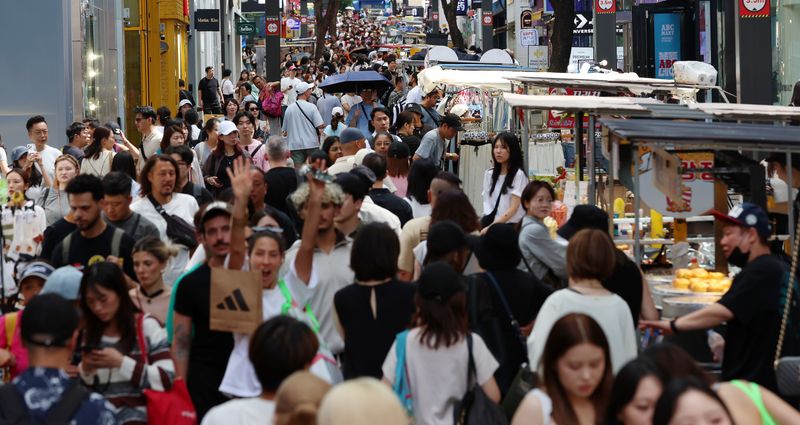
[Financial News] South Korea has officially joined the ranks of aging nations as ultra-aging accelerates. The share of the working-age population, aged 15 to 64 and responsible for taxes and support, fell below 70% for the first time. Chronic low birthrates and rapid aging have accelerated the population decline since 2018. In 2025, the total population stood at 51.82 million, while the elderly population reached a record 20.7%. By contrast, children accounted for just 10% of the population, roughly half the share seen 25 years ago.
On the 28th, the Ministry of Data and Statistics released the 2025 census results containing these findings.
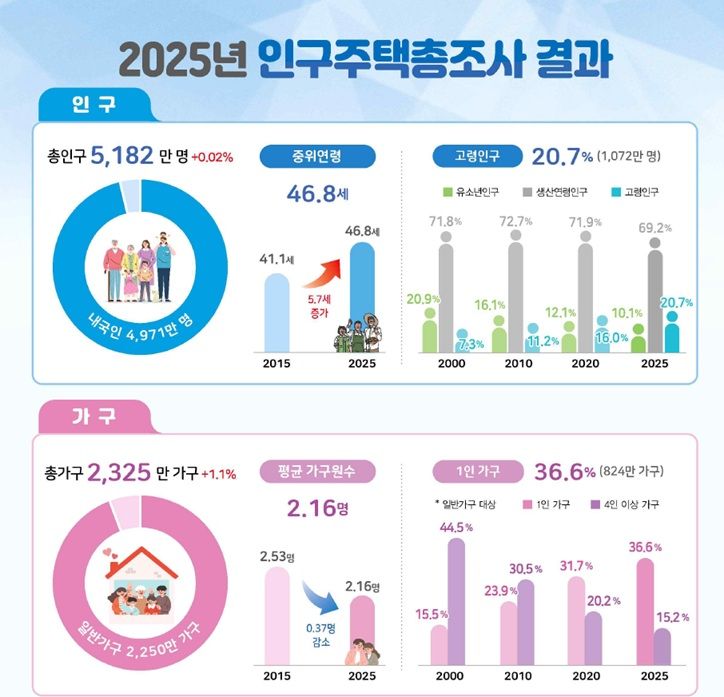
South Korea's total population came to 51.82 million, up 0.02% from a year earlier, or 10,000 people. After bottoming out at 51.69 million in 2022, the figure has rebounded and risen for three consecutive years. The increase was driven by growth in the foreign population rather than the domestic population. The number of Korean nationals fell by 50,000, or 0.1%, from a year earlier to 49.71 million, accounting for 95.9% of the total. Foreign residents, meanwhile, rose by 70,000, or 3.2%, to 2.11 million, or 4.1% of the total. That is nearly four times the 590,000 recorded in 2010. The increase reflects a steady rise in international students, trainees, and seasonal workers.
The working-age population, aged 15 to 64, totaled 35.87 million, pushing the share of the total population below 70% for the first time. The ratio has been falling steadily since 2018 and dropped to 69.2% last year, down 0.8 percentage point from 70.0% a year earlier.
The median age, which marks the exact midpoint when the population is sorted by age, rose by 0.6 year from a year earlier to 46.8.
The elderly population, aged 65 and older, also exceeded 20% of the total for the first time. As aging continued, the number of older adults reached 10.72 million last year, or 20.7% of the population.
The aging index, which measures the number of elderly people per 100 children, rose 18.5 points from a year earlier to 205.2. That means there are more than twice as many older adults as children.
Children, however, are shrinking rapidly in number. The child population, aged 0 to 14, stood at 5.22 million, or 10.1% of the total. With low birthrates worsening, the 10% threshold is expected to be broken this year. Compared with 2000, when children made up 20.9% of the population, the share has been cut in half over 25 years. The old-age dependency ratio, which shows the number of elderly people per 100 working-age people, rose to 29.9, up 2.0 from a year earlier. That means roughly three working-age people must support one older adult.
Population continues to concentrate in the Capital Region, but the pace of growth is slowing. The Capital Region population reached 26.38 million, up 0.3% from a year earlier. Its share stood at 50.9%, just over half. The ratio rose sharply from 46.3% in 2000 to 49.1% in 2010, and then to 50.2% in 2020, though the pace of increase has gradually slowed since then. The central region, including North Chungcheong Province, also grew 0.3% and accounted for 14.1% of the total. By contrast, the Yeongnam Region and Honam region each declined 0.4%.
The total number of households rose 1.1% from a year earlier, or 250,000, to 23.25 million. General households accounted for 96.8% of the total, or 22.5 million, up 0.9%, or 200,000, from a year earlier. Among them, one-person and two-person households made up 66.1%, or 14.87 million.
Kyung Eun-sook, head of the census division at the Ministry of Data and Statistics, said, "As of 2025, one-person households numbered 8.24 million, or 36.6%, up 2.5% from 8.04 million a year earlier. Both the size and share are the highest ever recorded."
By age group, one-person households were most common among people in their 60s at 17.7%, followed by those in their 30s at 17.5% and those aged 20 or younger at 16.9%. The pattern differed by gender, with men in their 30s accounting for the largest share at 21.8%, while women in their 60s were highest at 18.6%.
However, the growth rate of one-person households is slowing. Over the past 10 years, it peaked at 8.1% in 2020 before steadily declining, and last year's growth rate came to just 2.5%. This is seen as the result of several factors, including soaring real estate prices and difficulties young people face in finding jobs.
Multicultural households rose 2.8% from a year earlier to 450,000, continuing to increase every year since 2015. The number of people with disabilities, among Korean nationals, stood at 2.6 million, while households with a disabled member totaled 2.26 million, accounting for 10.1% of all general households.
[email protected] Jung Sang-gyun Reporter