From a roller-coaster KOSPI to safer deposits: time deposits jump by 21 trillion won in a month
- Input
- 2026-07-28 10:43:18
- Updated
- 2026-07-28 10:43:18
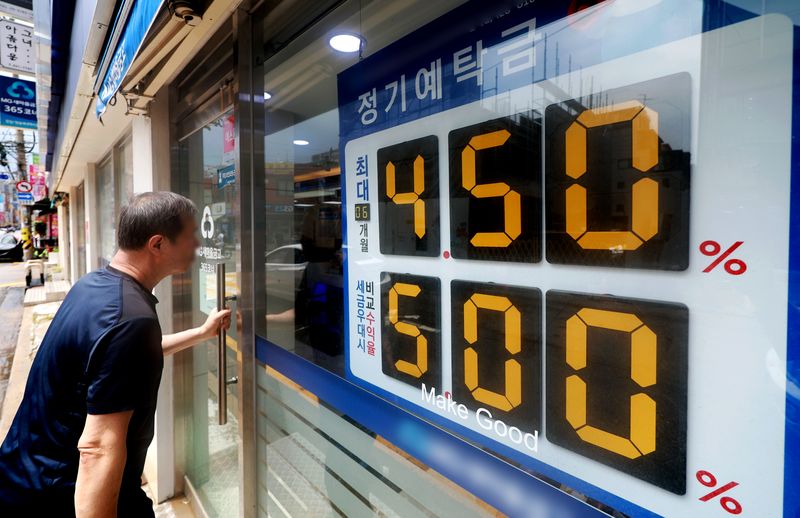
[Financial News] As volatility in the domestic stock market has recently intensified and the Bank of Korea raised its base rate, idle investment funds are increasingly moving into deposits.
According to News 1 on the 28th, demand deposits, including MMDA, at the five major banks — KB Kookmin Bank, Shinhan, Hana Bank, Woori Bank and NH NongHyup — stood at 681.4612 trillion won, down 40.8316 trillion won from the end of last month, when they totaled 722.2928 trillion won. The decline was about 1.3 times larger than the 30.745 trillion won drop at the end of January, which had been the biggest decrease so far this year.
Demand deposits carry almost no interest, with rates in the 0% range, so they are considered a 'core deposit' that banks can raise at low cost and also 'idle investment funds' waiting to be deployed.
One area drawing attention is the decline in MMDA, a type of deposit with frequent deposits and withdrawals that is heavily used by companies. MMDA balances at the five major banks fell 12.9% to 129.2608 trillion won from 148.4527 trillion won at the end of last month, and were down 18% from 157.6669 trillion won at the end of May.
Analysts say the drop in MMDA reflects changes in corporate cash management strategies. Companies with more spare cash, helped by strong semiconductor exports and other factors, are moving funds from lower-yielding MMDA into time deposits, where interest rates have risen.
By contrast, money has flowed rapidly into time deposits. As of the 24th, time deposit balances at the five major banks reached 971.0883 trillion won. That was up 21.6885 trillion won from the end of last month, marking the largest increase this year. The pace of growth has also accelerated. Time deposits rose by only 4.6837 trillion won in June, but this month the increase expanded to about 4.6 times the previous month's level.
The trend appears to reflect banks' successive hikes in deposit rates after the Bank of Korea raised the base rate from 2.5% to 2.75%. Major commercial banks raised the rates on their flagship time deposit products to the high 2% range and low 3% range this month in an effort to attract deposits.
A 'reverse money move,' in which funds shift from stocks to deposits, is also gaining momentum. As market volatility rises and losses mount, investors are turning back to bank deposits that guarantee principal. According to the Korea Financial Investment Association, investor deposits swelled to a record 139.6948 trillion won on the 4th of last month, but had fallen to 104.2975 trillion won by the 23rd, down more than 20% in two months.
A financial industry official said, "With stock market volatility widening, the appeal of time deposits that offer a fixed return of around 3% a year has increased," adding, "Not only individuals but also companies' short-term idle funds are moving into time deposits."
The financial sector expects the preference for time deposits to continue for now, as the possibility of another base rate hike by the Bank of Korea is also being discussed. A banking industry official said, "As the KOSPI correction has heightened investors' risk aversion, demand for deposits rather than bargain hunting has increased," adding, "The inflow of short-term idle funds into time deposits is likely to continue for some time."
[email protected] Kim Hee-sun Reporter