Mortgage and Credit Loan Rates Jump Together Before Tightening Cycle Even Begins
- Input
- 2026-07-28 12:00:00
- Updated
- 2026-07-28 12:00:00

According to the Bank of Korea's 'Weighted Average Interest Rates of Financial Institutions for June 2026,' released on the 28th, new mortgage loans extended by deposit banks in June carried an average rate of 4.36% per year. That was up 0.04 percentage point from 4.32% in the previous month.
The yield on five-year bank bonds, the benchmark rate, rose 0.15 percentage point in June to 4.32%. The market had already largely priced in a rate hike by the Monetary Policy Board on the 16th. As a result, fixed mortgage rates climbed 0.09 percentage point from 4.44% to 4.53%. They have risen for nine straight months since October last year. Variable rates, which had fallen in the previous month, also rebounded from 4.23% to 4.27%.
Even though both fixed and variable rates increased, the overall mortgage rate rose only 0.04 percentage point because the share of fixed-rate loans fell. In June, fixed-rate mortgages accounted for 37.7% of new mortgage lending.
That was down 3.9 percentage points from the previous month. The share has fallen for eight consecutive months since November last year, when it stood at 90.2%, and is now well below half. It is the lowest level since February 2014, when it was 31.8%, marking a 12-year and four-month low. In other words, fewer than four out of 10 new mortgage borrowers are now choosing fixed rates.
Lee Hye-young, head of the Financial Statistics Team at the Bank of Korea's Economic Statistics Department 1, said, "The share has been falling steadily on a new-loan basis, so it is something we need to watch closely." She added, "On a balance basis, however, it is not declining to that extent." In fact, the share of fixed-rate mortgages on a balance basis fell only 6.7 percentage points, from 38.1% in November last year to 31.4% in June.
Lee added, "For the time being, demand for variable rates, which are relatively lower, will likely remain strong. But as the benchmark rate is raised this month, short-term rates will be affected, and the share of fixed-rate loans could rise with a lag."
Jeonse loan rates also rose 0.10 percentage point from the previous month to 4.07%. After increasing in both April and May, they returned in June to the March level of 4.07% after three months. Guarantee loan rates, which include jeonse loans, were unchanged at 4.11%.
General credit loan rates jumped 0.23 percentage point to 5.72%. Kim Ji-eun, deputy head of the Financial Statistics Team at the Bank of Korea's Economic Statistics Department 1, said this was due to a sharp rise in six-month bank bond yields, the benchmark rate, as well as a higher share of loans to mid- and low-credit borrowers at some banks.
Overall household loan rates, including mortgages, jeonse loans and credit loans, rose 0.04 percentage point to 4.50%.
The share of fixed-rate household loans on a new-loan basis fell 1.9 percentage points from the previous month to 22.7%. It has been declining for 11 straight months since August last year, when it stood at 62.2%.
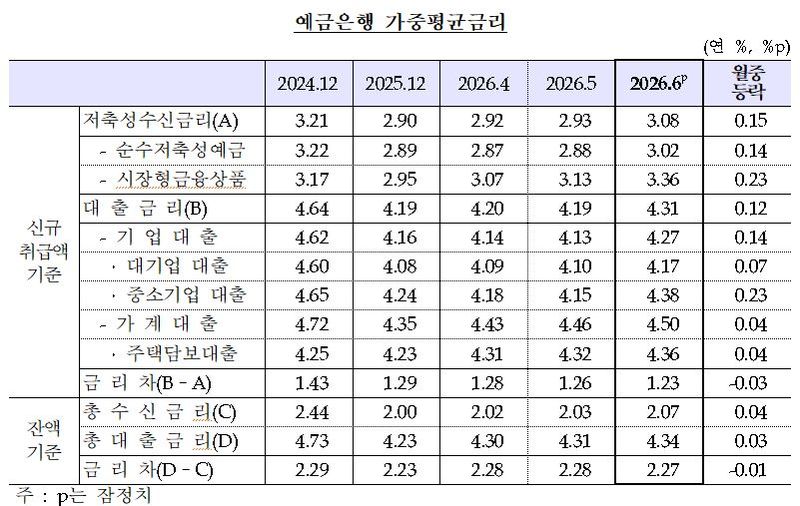
The spread between lending and deposit rates on a new-loan basis narrowed 0.03 percentage point from 1.26 percentage points to 1.23 percentage points.
In June, deposit rates for savings products rose 0.15 percentage point from the previous month to 3.08% per year. Rates on pure savings deposits such as time deposits, as well as market-based financial products such as financial bonds and certificates of deposit, also increased by 0.14 percentage point and 0.23 percentage point, respectively.
At the end of June, the average interest rate on total deposits, based on outstanding balances, rose 0.04 percentage point from the previous month to 2.07% per year. The average lending rate also increased 0.03 percentage point to 4.34% per year. The spread between the two indicators narrowed by 0.01 percentage point to 2.27 percentage points.
Among non-bank financial institutions, deposit rates for one-year time deposits and installment savings rose 0.35 percentage point at mutual savings banks, 0.18 percentage point at credit cooperatives, 0.12 percentage point at mutual finance institutions and 0.32 percentage point at community credit cooperatives. Lending rates moved in different directions, falling 0.38 percentage point, rising 0.20 percentage point, rising 0.09 percentage point and falling 0.21 percentage point, respectively.
[email protected] Kim Tae-il Reporter