Japan's Takaichi, Facing a Sharp Drop in Approval Ratings, Says She Will Quickly Submit a Bill to Cut the Consumption Tax
- Input
- 2026-07-27 19:19:35
- Updated
- 2026-07-27 19:19:35
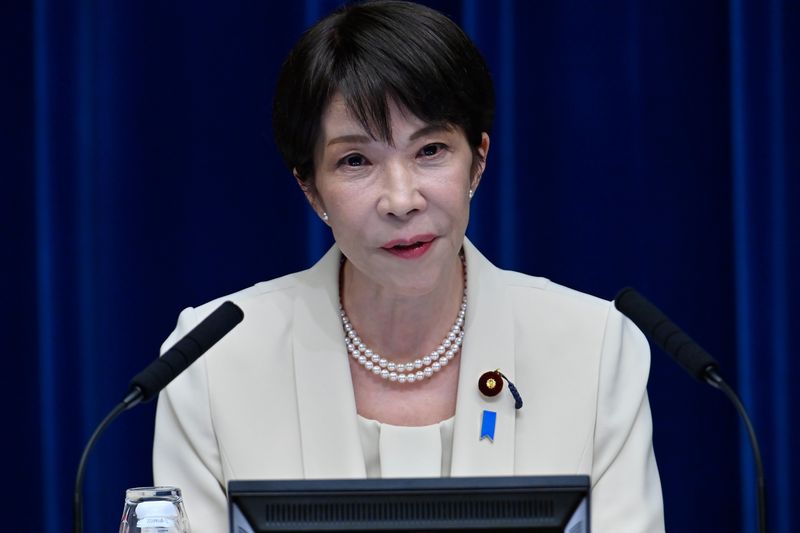
With her cabinet approval rating falling to its lowest level since taking office amid criticism over her response to inflation and revisions to the Imperial House Law, she appears to be trying to steady public opinion by once again emphasizing tax cuts and an expansionary fiscal stance. At a press conference marking the close of the extraordinary session of the Diet, held at 6 p.
m. that day at the Prime Minister's Office of Japan, Takaichi said of the food consumption tax cut, "As soon as the bipartisan Social Security National Conference reaches a conclusion, we will quickly submit the bill so that the public can feel the burden relief as soon as possible.
" Takaichi's cabinet is considering lowering the food consumption tax rate from the current 8% to 1% for two years and providing additional support to middle- and low-income households. However, some opposition parties prefer cash handouts over tax cuts, so ruling and opposition parties are expected to continue coordinating on the details of the plan.■ As approval ratings plunge, "inflation measures are the top priority" In major opinion polls released earlier in the day, approval ratings for Takaichi's cabinet all fell to their lowest levels since the administration began. A Yomiuri Shimbun poll showed support dropping 12 percentage points from the previous month to 57%.A Nikkei, Inc. and TV Tokyo Corporation poll put it at 58%, down 10 points.
7%. Including polls released last week by The Asahi Shimbun and Mainichi Shimbun, approval ratings fell in all five major media surveys.
In the Mainichi poll, support stood at 41%, below the 44% disapproval rate. The main reason for the decline is seen as dissatisfaction with the government's response to inflation.
In the Yomiuri Shimbun poll, 71% of respondents said they did not approve of the cabinet's inflation measures.
Even among cabinet supporters, negative views reached 56%, exceeding half.
At the press conference, Takaichi stressed that inflation measures had been the administration's "top priority" since it took office.She explained that the government had secured alternative crude oil and naphtha supplies, released stockpiles, and provided gasoline and diesel subsidies as well as support for electricity and gas bills in response to instability in the Middle East and the risk of a Strait of Hormuz blockade.
She said, "Japan's inflation rate is the lowest among the G7, while real wage growth is at the highest level," adding, "We will continue to implement the necessary inflation measures by using reserve funds.
" On the current state of the Japanese economy, she said it is not in a deflationary state, meaning a sustained decline in prices.
Takaichi said, "If, in economic terms, any rise in prices is called inflation, then we are now in an inflationary situation." She was, however, cautious about making an official government declaration that Japan has escaped deflation."We must make a comprehensive judgment by considering the overall trend and background of prices," she said.
"We are not yet in a situation where we can say we have escaped deflation.
" She added that it is necessary to closely monitor how developments in the Middle East may affect energy prices and the real economy.
The remark was interpreted to mean that, although prices are rising, it remains to be seen whether inflation has taken root as a stable trend supported by wages and demand.
■ "Stable real growth of 1% and nominal growth of 3%" Takaichi defined next year as the "first year of responsible proactive fiscal policy" and said she would reflect that stance across the budget from fiscal 2027 onward.She said, "We will establish real growth of at least 1% and nominal growth of at least 3% as early as possible, and then push them even higher." She also reaffirmed her goal of reaching 250 trillion yen in domestic private capital investment and a GDP of nearly 1,100 trillion yen by fiscal 2040.
In the Honebuto policy and the Japan Revitalization Strategy finalized this month, Takaichi's cabinet selected 17 strategic sectors and 62 products and technologies for focused support, including semiconductors, shipbuilding, Physical AI, Quantum technology, and nuclear fusion.
In response to criticism that expansionary fiscal policy could weaken fiscal discipline, Takaichi countered, "What matters is not whether the words 'fiscal consolidation' are included, but whether we clearly present the path to achieve it.
" She added, "The core of our fiscal management goal is a stable decline in the ratio of government debt to GDP," and said, "We will achieve both growth and fiscal discipline.
"
[email protected] Seo Hye-jin Reporter