Capital Gains Tax Exemption for Single-Home Owners Excluded from ‘Time Limit’... Comprehensive Real Estate Tax Strengthened for Ultra-High Prices [Real Estate Measures Imminent]
- Input
- 2026-07-27 18:19:23
- Updated
- 2026-07-27 18:19:23
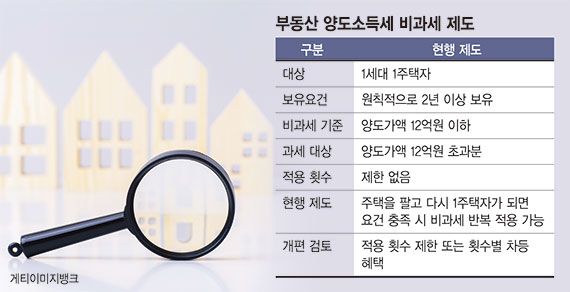
This is interpreted as reflecting concerns that it could dampen residential mobility among actual buyers, such as newlyweds, and intensify the preference for owning a single, high-quality property. Furthermore, given that the government has placed emphasis on strengthening the Comprehensive Real Estate Tax targeting owners of ultra-high-priced single homes, it appears to be a move to consider the balance between holding taxes and transaction taxes. ■ Exclusion of Limit on Capital Gains Tax Exemption.
Consideration of Mobility for Actual Buyers According to the government and other sources on the 27th, the Ministry of Finance and Economy is internally discussing the exclusion of the measure to limit the number of times the capital gains tax exemption for a single-home household is applied from the '2026 Tax Reform Plan' to be announced at the end of this month. Earlier, at the National Debate on Real Estate Policy held on the 23rd, President Lee stated, "Granting unlimited opportunities for capital gains tax exemptions appears problematic," adding, "It is worth considering measures such as limiting the number of times or providing greater benefits for the first time and less for the second. 2 billion won.
Residency requirements may be added depending on the acquisition date and region. Since there is no limit on the number of times the tax exemption can be applied, one can receive it repeatedly if they sell a house, become a single-home owner again, and meet the requirements. The government excluded the measure to limit the number of times from this reform plan due to significant concerns that it could restrict the normal residential mobility of actual homebuyers.
Moving to a larger home due to marriage, childbirth, or family growth is a typical residential movement within the life cycle. Critics pointed out that limiting the tax exemption to a single lifetime could lead to market distortions, such as exhausting all benefits at the first home or delaying relocation in anticipation of greater tax savings. It was cited as a burden that uniformly setting the timing of tax exemption to the sale of the first home disadvantages actual buyers in the early stages of asset formation, while allowing taxpayers to choose could be utilized as a means of tax avoidance.
The fact that limiting the number of times could actually intensify the "one smart home" phenomenon also acted as a concern. Kwon Dae-jung, a professor of real estate at Myongji University, pointed out, "If there is a limit on the number of times tax exemptions are applied or differential benefits are given, buyers will try to use those benefits on the most valuable home," adding, "As a result, demand will concentrate on prime locations and high-priced homes, which could actually intensify the 'one smart home' phenomenon that the government is trying to suppress.
" ■ Strengthening Comprehensive Real Estate Tax. Burden on the Elderly in Gangnam On the other hand, the government is seriously considering measures to strengthen the burden of the Comprehensive Real Estate Tax, focusing on owners of ultra-high-priced single homes.
The direction involves establishing new taxation standards and differentiating tax credits based on actual residency. Measures such as reducing the deduction for non-resident single-home owners or adding residency requirements are being considered.
Under the current Comprehensive Real Estate Tax, a single-home owner can receive a tax credit of up to 80% if they meet the requirements of long-term ownership and being elderly. Consequently, backlash is expected to erupt among non-resident elderly individuals who rent out a single home for retirement income while renting a more affordable residence themselves.
Lee Jeom-ok, Deputy Director of Shinhan Premier Pathfinder, stated, "There is a possibility that the criteria for the Comprehensive Real Estate Tax credit will be changed from the holding period to the residency period," adding, "Elderly individuals who have held homes without liquidity to pass them on to their children may have to revise their inheritance plans. " Woo Byung-tak, a specialist at Shinhan Premier Pathfinder, remarked, "Even if holding taxes are raised significantly, there are not many cases of people selling their homes.
This is because the burden of capital gains tax is greater than that of holding taxes," and added, "If capital gains tax is strengthened simultaneously in this tax reform plan, transaction volume will temporarily surge, followed by a resurgence of properties being withheld from the market. " At a major real estate debate presided over by the President, opinions were also raised that the ability to bear the Comprehensive Real Estate Tax should not be judged solely on current housing prices.
Suggestions have also been made that the acquisition price or holding period should be reflected in the tax assessment criteria, as the elderly—who purchased homes at low prices about 20 years ago and saw their value rise due to reconstruction—possess substantial assets but low cash income. While President Lee signaled a stance to strengthen the Comprehensive Real Estate Tax, he also mentioned that "there is also a method to defer holding taxes.
" The real estate industry is paying close attention to whether improvements will be made to the existing systems for deferring and paying the Comprehensive Real Estate Tax.
[email protected] Kim Chan-mi, Choi Yong-jun Reporter