"Tax Relief for Non-Resident Single-Home Owners Should Be Based on Occupancy Period, Not Ownership" [Real Estate Measures Imminent]
- Input
- 2026-07-27 18:18:09
- Updated
- 2026-07-27 18:18:09
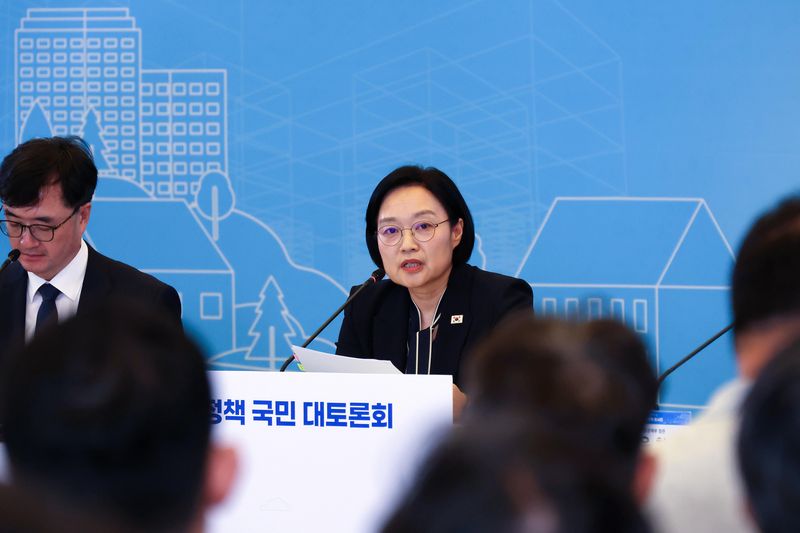
Prime Minister Han Seong-sook chaired the National Grand Forum on Real Estate Policy at KCCI in Jung District, Seoul, on the 27th.
In a presentation at the forum, Hanyang University professor Kang Seong-hoon proposed setting a deduction cap for ultra-high-value owner-occupied single homes. At present, there is no clear standard for what qualifies as an ultra-high-value home. Kang said, "It is important to build social consensus on the standard for ultra-high-value homes through broad discussion."
Normalizing the tax burden on non-owner-occupied homes and multi-home owners was also presented as a key task. Kang said, "For single-home owners who do not live in the property, the tax deduction standard should shift from ownership period to occupancy period. For multi-home owners, the basic deduction, fair market value ratio, and tax rate should be adjusted."
For capital gains tax, he suggested keeping the current level of the long-term holding special deduction for owner-occupied single homes, while considering additional relief for those who have lived in the home for a long time. Kang said, "Even for an owner-occupied single home, ultra-high-value homes with large capital gains should face a cap on the long-term holding special deduction," adding, "We need to provide an opportunity to sell in response to stronger property taxes."
In the supply sector, speakers said bottlenecks must be removed. Myongji University professor Jin Mi-yoon proposed step-by-step, selective support for private redevelopment and reconstruction projects, financial and tax support to revive new supply of non-apartment housing, and diversification of housing supply providers, including professional rental operators.
Jin said redevelopment and reconstruction projects would likely become a major source of housing supply in the medium to long term. She explained, "It is difficult for redevelopment and reconstruction projects to deliver results in the short term, but as the population becomes super-aged, housing is aging too. We must never leave deteriorating and outdated living environments unattended." She added, "Demand for redevelopment and reconstruction will rise sharply. The challenge is deciding which areas to develop and how. The government should make selective, concentrated investments in areas that need redevelopment."
In the financial sector, participants said that even if support for young people and other end users is expanded, it must be accompanied by careful targeting and sophisticated policy design. As part of support measures for younger borrowers, they called for expanding policy mortgages and home loans for young people from commercial lenders, while also revising jeonse loans to reduce cases of use that stray from their original purpose.
[email protected] Seo Young-joon, Choi Yong-joon, Kim Chan-mi Reporter